Loading video player…

Intro to Object-Oriented Programming (OOP) in Python (Overview)

Object-oriented programming (OOP) is one of the biggest and most important subjects in all of programming. This series will provide you with a basic conceptual understanding of object-oriented programming so you can take your Python skills to the next level.

You’ll learn how to define custom types using classes, and how to instantiate those classes into Python objects that can be used throughout your program.

Finally, you’ll learn how classes can subclass one another with a brief introduction to inheritance, which allows you to write maintainable and less redundant Python code.

Resource mentioned in this lesson: Defining Your Own Python Function
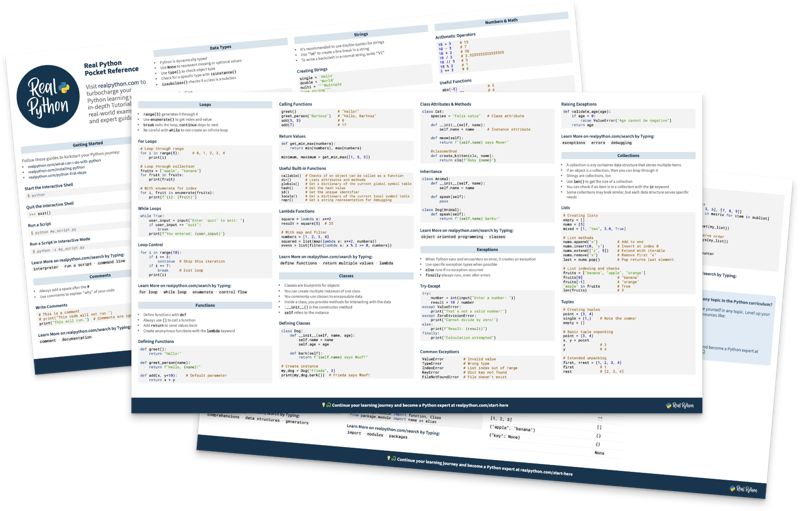
Download

Course Slides (.pdf)

1.7 MB
Download

Sample Code (.zip)

2.6 KB

00:00 Hello there. Welcome to Intro to Object-Oriented Programming in Python. My name’s Joseph, and I’ll be your navigator in this video course. You’ve probably figured out from the title, this course is about object-oriented programming, often shortened to OOP or even “oop”.

00:15 Because I find it kind of hard to say “oop” with a straight face, I’ll stick with O-O-P. OOP is a programming paradigm—that is, it’s a way of thinking about writing code and structuring your programs.

00:27 It’s a kind of philosophy based around a few organizing principles. And by applying these principles to software design, you can build robust, maintainable applications that not only scale more easily, but are friendlier to collaboration.

00:41 In this course, you will learn the syntax and rules surrounding OOP, but the focus is really to get you thinking about code through an object-oriented lens.

00:50 My hope is that this will not only improve your ability to write code, but also provide you with a vocabulary you can use to talk about what you’ve written, as well as discuss programming in general, both of which will be essential in your Python development journey.

01:03 In this course, you’ll learn how to use classes to apply object-oriented principles in Python, create objects by instantiating those classes, how to model the properties and behaviors of real-world systems and entities using attributes and methods, build child classes using inheritance and the built-in super() function.

01:22 And finally, leverage OOP’s principles of encapsulation, abstraction, inheritance, and polymorphism to write clean, flexible code.

01:32 To get the most out of this course, you should be comfortable with Python fundamentals, things like variables, functions, built-in data types, and general Python syntax.

01:42 I’ll be explaining everything as we go along, but it will help if you have a good grasp on functions, especially defining your own functions. So if you feel like your knowledge on that needs a bit of a top up, check out Defining Your Own Python Function.

01:55 And next up, we’ll take a 10,000-foot view on object oriented programming, as well as its place in the Python ecosystem.

Become a Member to join the conversation.