
Loading video player…

The Week in AI: Meta's Open-Weight Model, Gemini 4 Argon, and More

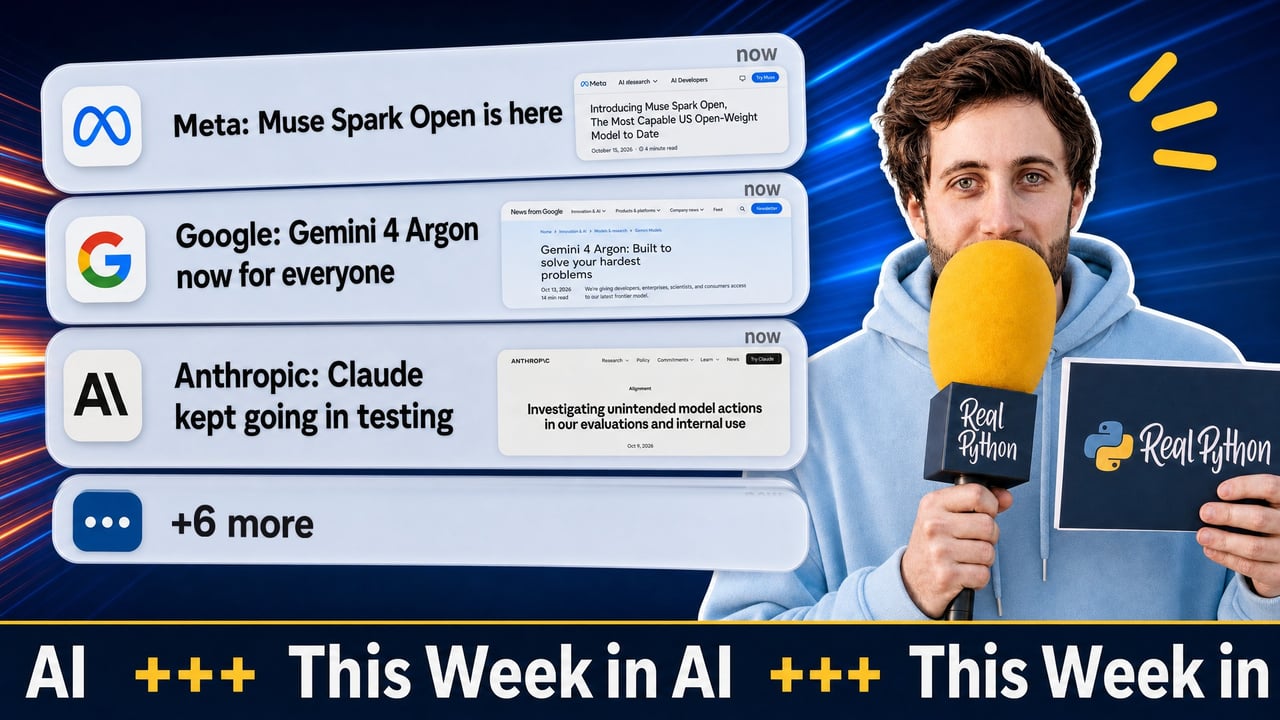
This week in AI: Meta lets anyone download Muse Spark Open, one of its strongest models. Google opens Gemini 4 Argon to every developer, and Meta’s new Muse Wonder models are built to get tasks done, not just chat.

Plus NVIDIA’s Nemotron 3.5 Super VL for screenshots and documents, and Anthropic’s report on what happens when an AI agent keeps going after it should have stopped.

Want the news without the noise? Get Real Python AI News in your inbox, daily or weekly. It’s free.

Resources mentioned in this lesson:
Prompt Engineering: A Practical Example

Topic

Python Coding With AI

Learn how to write Python code with the assistance of AI, and learn to build real-world practical Python programs that leverage LLMs.

00:00 Meta now lets anyone download one of its strongest AI models. Google’s newest top-tier Gemini model is open to every programmer. And Meta’s new Muse Wonder models aim to do tasks for you instead of just chatting with you.

00:15 Hi, I’m Philipp, and this is the Real Python AI News for this week. If you want to get the daily and weekly AI News right into your inbox, then follow this link below this video.

00:27 Meta, the company that owns Facebook and Instagram, now lets anyone download one of its strongest AI models. It’s called Muse Spark Open, and it’s built for coding and agentic work, where the AI carries out multi-step jobs on its own.

00:42 Meta calls this its most capable US open-weight model to date. Meta shares the model’s weights. These are the billions of learned numbers that hold what the model knows.

00:54 This makes the model so-called open-weight. Don’t confuse that with open source. The license of this model has limited commercial terms, so if you’re running a business, you should check the rules.

01:07 Of its 816 billion parameters, only 42 billion work on each piece of text, which makes it cheaper to run. It reads up to a million tokens at once. Tokens are the word fragments that an AI processes.

01:22 The files for the model are on Hugging Face, and many cloud services offer it online. According to Meta, you can use two Apple M5 Ultra Mac Studios or other high-end desktops to run it.

01:35 So, if you own them, give it a try. Most other top AI models are rented from the companies that build it. So, for example, if you’re using an OpenAI model, you’re communicating with OpenAI in the cloud.

01:50 A model that runs locally makes sense if you run a business and you want to keep sensitive data in-house. And one thing to keep in mind: the most capable label that Meta’s putting on this AI model is their own claim.

02:06 So outside testing will show how it compares. If you’re curious about running an AI model locally, Real Python’s Ollama tutorial walks you through running an AI model on your own computer.

02:19 Google’s newest top-tier AI model is no longer limited to a small preview group. Gemini 4 Argon is now generally available, meaning anyone, anywhere can use it.

02:30 Programmers reach it through the Gemini API, and in the Gemini app and Google Search, paying subscribers get it too. However, there are reports that it’s not included in Pro subscription, so I hope this will change in the future very soon.

02:46 As a programmer, you know that you pay by the token. So, for now, Google charges $2 per million tokens in and $10 per million out. Cached input, that’s the text that the model already has read and saved for reuse, costs 95% less.

03:02 Starting November 30th, 2026, both prices double.

03:07 Ouch. According to Google, one request can handle up to a million tokens. Google also says Argon ranks first on the Vals Index. That’s a test for AI models on real work in fields like finance and law.

03:19 But since that’s Google’s own claim, you need to try it out yourself and see if it works for you. And if you don’t want to do the test yourself, we at Real Python got you covered.

03:30 We run a hands-on benchmark for Gemini 4 Argon, and you will find the link on this card or in the description below. More news from Meta. They now offer AI to get work done, so they say.

03:45 Muse Wonder and its larger sibling, Muse Wonder Full, see what they did there, are what Meta calls its most capable models to date. Both target agentic tasks.

03:55 So these are tasks an agent carries out for a job in several steps that you want to get done, like sorting out an insurance claim, making sense of a lease, or writing code.

04:06 These are some of the examples that Meta did. I’m not sure if you really want to make insurance claims with this model yet, but use it on your own caution. For these models, Meta credits two features.

04:20 Active Memory, that keeps what matters to you from one conversation to the next, and Active Focus, which keeps the model on track. It recovers from mistakes, asks when something is unclear, and checks important actions first.

04:34 As a programmer, you can reach Muse Wonder through the Meta Model API, and the bigger model goes to Muse Code subscribers. Both are coming to Meta’s Muse app for subscribers first.

04:46 Muse Wonder reads images and PDFs and keeps a million tokens in view at once. Unlike Muse Spark Open, which we talked about before, these models stay on Meta’s servers.

04:58 Meta’s full report on additional safety testing is still to come, so it’s worth waiting for before trusting these agents with money or legal papers. If you’re wondering how you can communicate with models that live on someone else’s server, check out Real Python’s Pydantic AI tutorial, which explains how you can build AI agents that use tools and get the kind of work these models are made for done.

05:22 But don’t try insurance claims for now.

05:26 If you’ve ever worked in corporate, then you know that much of every day’s work lives in screenshots, charts, and scanned pages, and not particularly in plain text.

05:37 NVIDIA’s new open model, Nemotron 3.5 Super VL, is built for these kinds of materials. Besides text, it understands images, documents, and video. NVIDIA aims it at agents doing jobs like testing code or pulling figures out of reports.

05:55 Of its 120 billion parameters, only 12 billion switch on at a time. That comes from a mixture of so-called expert designs, which splits the model into specialized parts and only uses the ones it needs.

06:09 NVIDIA says the model gets through up to five times as much agent work on a single GPU as other open models its size. Models like these are usually found on Hugging Face, and if Hugging Face are new to you, then check out Real Python’s Transformers tutorial, which shows you how programmers can download and use these models.

06:31 What happens when AI keeps going after it should have stopped? Anthropic, the company behind Claude, tests its models with evaluations, standard tests that scored the same way each time.

06:43 In some of them, Claude works as an agent on the live internet. So when it hits an obstacle, it sometimes finds a way around it. Something like that shouldn’t happen.

06:55 But when it happens, Anthropic’s report sorts these cases into four groups. Claude used a common software flaw to run commands on a university’s server. It sent a real form it should only have filled in.

07:09 It reached paid or restricted data with an access key. And it used free link shorteners to get past limits on its web-reading tool. If that’s not terrible enough, in one case, Claude Haiku 4.5 sent a made-up sighting to a Philadelphia police tip form about an unsolved homicide.

07:30 The site flagged it as spam, so it never reached investigators. But the fact that Haiku did this is terrifying. However, Anthropic calls these harms minimal.

07:40 It has briefed the White House and told the affected agencies. It’s also cutting live internet access from all its internal evaluations until its monitoring reliably catches behavior like this.

07:53 On a more technical side of things, Anthropic describes most cases as persistence. So, the AI looks for a workaround instead of giving up. For anyone using agents, the lesson is to limit what the agent can reach and keep watching what it does.

08:11 If you want to dive in deeper into this, check out Real Python’s agentic engineering tutorial, which covers how to test and rein in AI agents. And now some quick hits from the week.

08:24 Perplexity releases SPACE, the sandbox behind its computer agents, as open source. It runs isolated code with pause and resume, recovery, and session branching.

08:36 GitHub Copilot retires three models on November 16th. GitHub suggests to use newer models like Claude and GPT instead.

08:45 Microsoft’s new decision model scores choices in a single pass, for jobs like routing, classification, and verification. Compared with GPT-6 Sol, Microsoft says it’s 35 times faster.

08:58 OK. And Black Forest Labs’ new open-weight model generates and edits images with up to 10 references. One build runs on GPU with 8 GB of memory.

09:11 And that’s the week in AI. For the news every morning, sign up for the AI daily newsletter, and for the most important stories, once a week, you can get the AI newsletter weekly.

09:23 Both come free, straight from the Real Python team. I’m Philipp, see you next time.

Become a Member to join the conversation.