Python Decorators Cheat Sheet
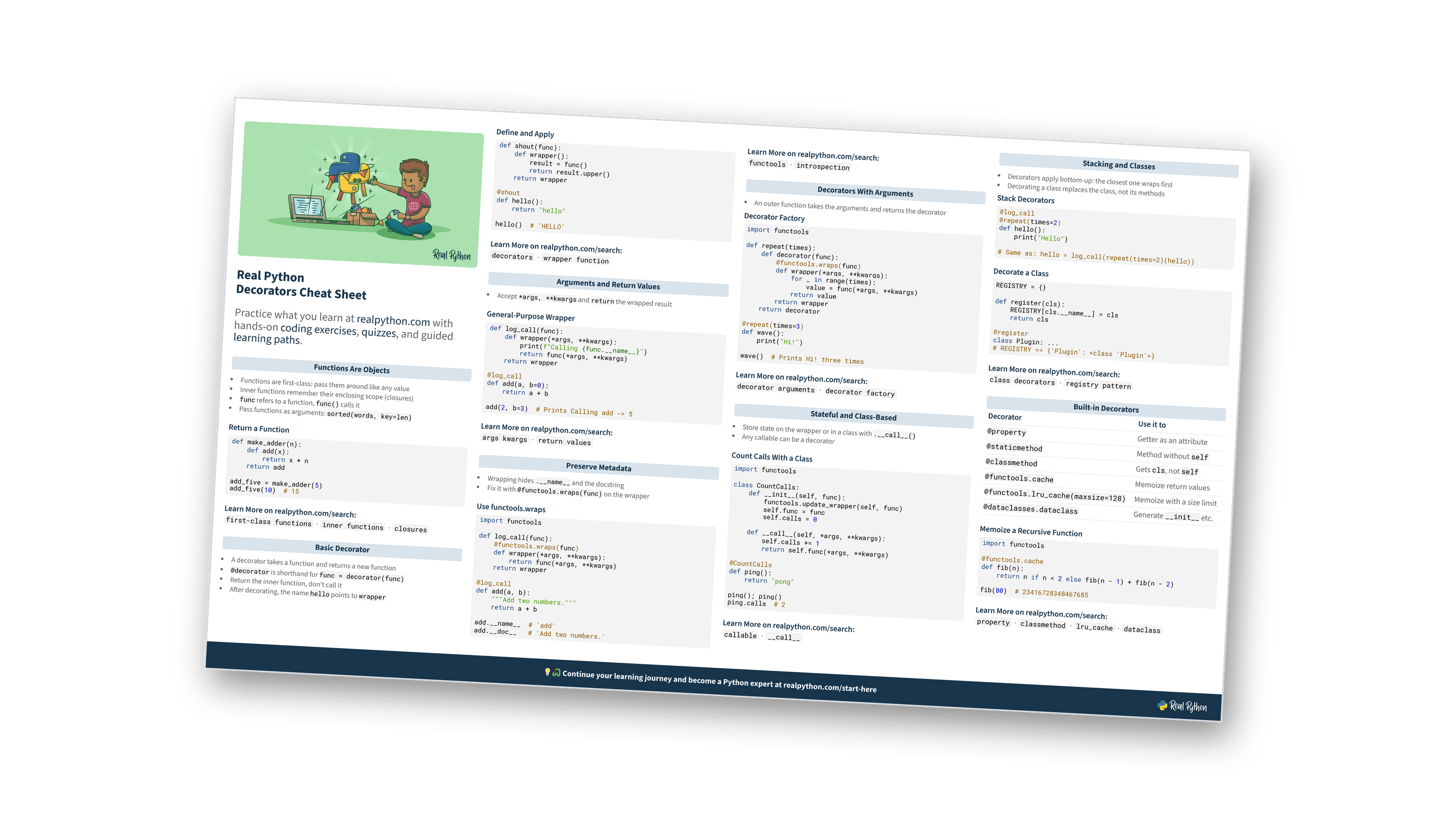
This page contains a condensed overview of Python decorators. It covers how functions work as objects, how to write a basic decorator, how to handle arguments and preserve metadata, decorators with arguments, class-based decorators, stacking, and the most useful built-in decorators. For the full explanations behind each pattern, read the full tutorial, Primer on Python Decorators. You can also download the information as a printable cheat sheet:
Free Bonus: Python Decorators Cheat Sheet
Get a Python Decorators Cheat Sheet (PDF) and keep the essentials at hand: writing decorators, handling arguments, preserving metadata, decorator factories, and the built-in decorators you'll use most:
Practice what you learn with hands-on coding exercises, quizzes, and guided learning paths. Not sure where to begin? Start here.
New to decorators?
Functions Are Objects
- Functions are first-class: pass them around like any value
- Inner functions remember their enclosing scope (closures)
funcrefers to a function,func()calls it- Pass functions as arguments:
sorted(words, key=len)
Return a Function
def make_adder(n):
    def add(x):
        return x + n
    return add

add_five = make_adder(5)
add_five(10)  # 15
Want to go deeper on closures?
Basic Decorator
- A decorator takes a function and returns a new function
@decoratoris shorthand forfunc = decorator(func)- Return the inner function, don’t call it
- After decorating, the name
hellopoints towrapper
Define and Apply
def shout(func):
    def wrapper():
        result = func()
        return result.upper()
    return wrapper

@shout
def hello():
    return "hello"

hello()  # 'HELLO'
Think you’ve got the basics down?
Arguments and Return Values
- Accept
*args, **kwargsandreturnthe wrapped result
General-Purpose Wrapper
def log_call(func):
    def wrapper(*args, **kwargs):
        print(f"Calling {func.__name__}")
        return func(*args, **kwargs)
    return wrapper

@log_call
def add(a, b=0):
    return a + b

add(2, b=3)  # Prints Calling add -> 5
What does the wrapper need?
Preserve Metadata
- Wrapping hides
.__name__and the docstring - Fix it with
@functools.wraps(func)on the wrapper
Use functools.wraps
import functools

def log_call(func):
    @functools.wraps(func)
    def wrapper(*args, **kwargs):
        return func(*args, **kwargs)
    return wrapper

@log_call
def add(a, b):
    """Add two numbers."""
    return a + b

add.__name__  # 'add'
add.__doc__   # 'Add two numbers.'
Wondering why wraps matters?
Free Bonus: Download the Python Decorators Cheat Sheet PDF and keep the essentials at hand.
Decorators With Arguments
- An outer function takes the arguments and returns the decorator
Decorator Factory
import functools

def repeat(times):
    def decorator(func):
        @functools.wraps(func)
        def wrapper(*args, **kwargs):
            for _ in range(times):
                value = func(*args, **kwargs)
            return value
        return wrapper
    return decorator

@repeat(times=3)
def wave():
    print("Hi!")

wave()  # Prints Hi! three times
Still fuzzy on decorator factories?
Stateful and Class-Based
- Store state on the wrapper or in a class with
.__call__() - Any callable can be a decorator
Count Calls With a Class
import functools

class CountCalls:
    def __init__(self, func):
        functools.update_wrapper(self, func)
        self.func = func
        self.calls = 0

    def __call__(self, *args, **kwargs):
        self.calls += 1
        return self.func(*args, **kwargs)

@CountCalls
def ping():
    return "pong"

ping(); ping()
ping.calls  # 2
Closure or class?
Stacking and Classes
- Decorators apply bottom-up: the closest one wraps first
- Decorating a class replaces the class, not its methods
Stack Decorators
@log_call
@repeat(times=2)
def hello():
    print("Hello")

# Same as: hello = log_call(repeat(times=2)(hello))
Decorate a Class
REGISTRY = {}

def register(cls):
    REGISTRY[cls.__name__] = cls
    return cls

@register
class Plugin: ...
# REGISTRY == {'Plugin': <class 'Plugin'>}
Ready to test yourself on stacking?
Built-in Decorators
| Decorator | Use it to |
|---|---|
@property |
Getter as an attribute |
@staticmethod |
Method without self |
@classmethod |
Gets cls, not self |
@functools.cache |
Memoize return values |
@functools.lru_cache(maxsize=128) |
Memoize with a size limit |
@dataclasses.dataclass |
Generate __init__ etc. |
Memoize a Recursive Function
import functools

@functools.cache
def fib(n):
    return n if n < 2 else fib(n - 1) + fib(n - 2)

fib(80)  # 23416728348467685
Want to put these to work?
Ready to go beyond the cheat sheet?
You can download this information as a printable cheat sheet:
Free Bonus: Python Decorators Cheat Sheet
Get a Python Decorators Cheat Sheet (PDF) and keep the essentials at hand: writing decorators, handling arguments, preserving metadata, decorator factories, and the built-in decorators you'll use most:
