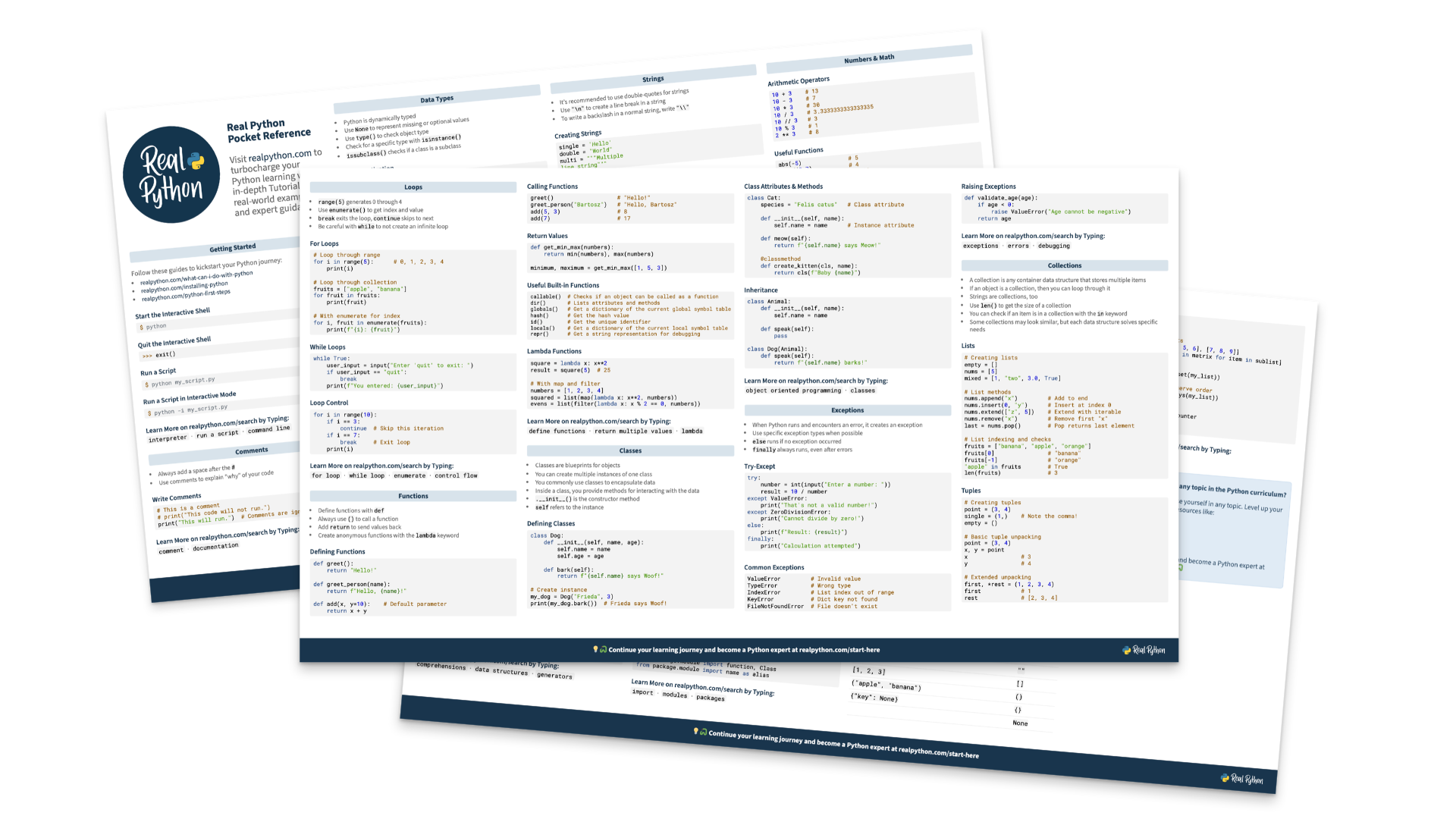
FastAPI Cheat Sheet
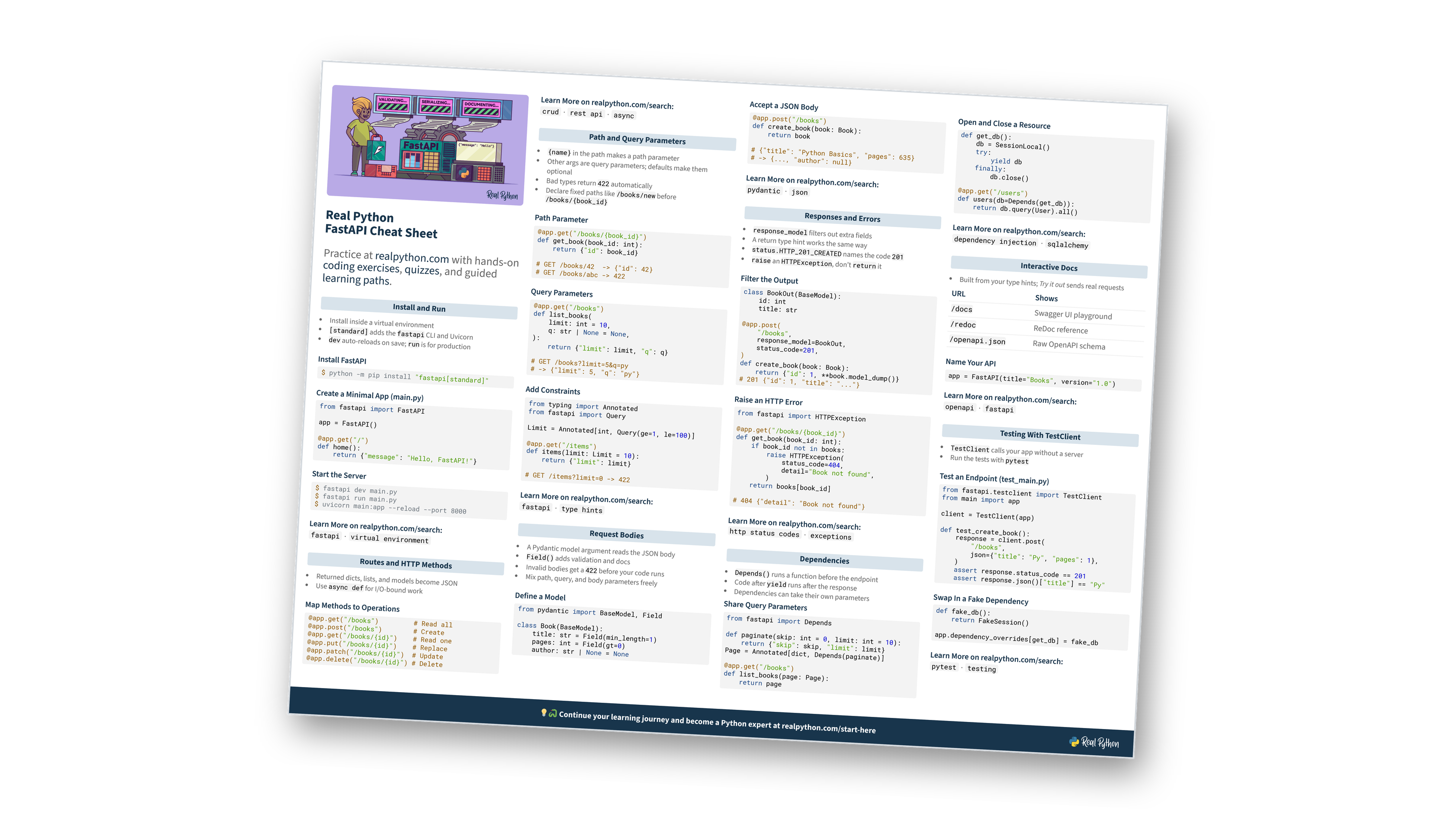
This page contains a condensed overview of FastAPI. It covers installing and running an app, routes and HTTP methods, path and query parameters, request bodies, responses and errors, dependencies, the interactive docs, and testing with TestClient. You can also download the information as a printable cheat sheet:
Free Bonus: FastAPI Cheat Sheet
Get a FastAPI Cheat Sheet (PDF) and keep routes, parameters, request bodies, dependencies, and testing patterns at your fingertips:
Practice with hands-on coding exercises, quizzes, and guided learning paths. Not sure where to begin? Start here.
New to FastAPI?
Install and Run
- Install inside a virtual environment
[standard]adds thefastapiCLI and Uvicorndevauto-reloads on save;runis for production
Install FastAPI
$ python -m pip install "fastapi[standard]"
Create a Minimal App (main.py)
from fastapi import FastAPI

app = FastAPI()

@app.get("/")
def home():
    return {"message": "Hello, FastAPI!"}
Start the Server
$ fastapi dev main.py
$ fastapi run main.py
$ uvicorn main:app --reload --port 8000
Setting up your first API?
Routes and HTTP Methods
- Returned dicts, lists, and models become JSON
- Use
async deffor I/O-bound work
Map Methods to Operations
@app.get("/books")         # Read all
@app.post("/books")        # Create
@app.get("/books/{id}")    # Read one
@app.put("/books/{id}")    # Replace
@app.patch("/books/{id}")  # Update
@app.delete("/books/{id}") # Delete
Sync or async endpoints?
Path and Query Parameters
{name}in the path makes a path parameter- Other args are query parameters; defaults make them optional
- Bad types return
422automatically - Declare fixed paths like
/books/newbefore/books/{book_id}
Path Parameter
@app.get("/books/{book_id}")
def get_book(book_id: int):
    return {"id": book_id}

# GET /books/42  -> {"id": 42}
# GET /books/abc -> 422
Query Parameters
@app.get("/books")
def list_books(
    limit: int = 10,
    q: str | None = None,
):
    return {"limit": limit, "q": q}

# GET /books?limit=5&q=py
# -> {"limit": 5, "q": "py"}
Add Constraints
from typing import Annotated
from fastapi import Query

Limit = Annotated[int, Query(ge=1, le=100)]

@app.get("/items")
def items(limit: Limit = 10):
    return {"limit": limit}

# GET /items?limit=0 -> 422
What happens to a bad value?
Request Bodies
- A Pydantic model argument reads the JSON body
Field()adds validation and docs- Invalid bodies get a
422before your code runs - Mix path, query, and body parameters freely
Define a Model
from pydantic import BaseModel, Field

class Book(BaseModel):
    title: str = Field(min_length=1)
    pages: int = Field(gt=0)
    author: str | None = None
Accept a JSON Body
@app.post("/books")
def create_book(book: Book):
    return book

# {"title": "Python Basics", "pages": 635}
# -> {..., "author": null}
Think you’ve got request bodies down?
Free Bonus: Download the FastAPI Cheat Sheet PDF and keep the essentials at hand.
Responses and Errors
response_modelfilters out extra fields- A return type hint works the same way
status.HTTP_201_CREATEDnames the code201raiseanHTTPException, don’treturnit
Filter the Output
class BookOut(BaseModel):
    id: int
    title: str

@app.post(
    "/books",
    response_model=BookOut,
    status_code=201,
)
def create_book(book: Book):
    return {"id": 1, **book.model_dump()}
# 201 {"id": 1, "title": "..."}
Raise an HTTP Error
from fastapi import HTTPException

@app.get("/books/{book_id}")
def get_book(book_id: int):
    if book_id not in books:
        raise HTTPException(
            status_code=404,
            detail="Book not found",
        )
    return books[book_id]

# 404 {"detail": "Book not found"}
Why raise and not return?
Dependencies
Depends()runs a function before the endpoint- Code after
yieldruns after the response - Dependencies can take their own parameters
Share Query Parameters
from fastapi import Depends

def paginate(skip: int = 0, limit: int = 10):
    return {"skip": skip, "limit": limit}
Page = Annotated[dict, Depends(paginate)]

@app.get("/books")
def list_books(page: Page):
    return page
Open and Close a Resource
def get_db():
    db = SessionLocal()
    try:
        yield db
    finally:
        db.close()

@app.get("/users")
def users(db=Depends(get_db)):
    return db.query(User).all()
Still fuzzy on dependencies?
Interactive Docs
- Built from your type hints; Try it out sends real requests
| URL | Shows |
|---|---|
/docs |
Swagger UI playground |
/redoc |
ReDoc reference |
/openapi.json |
Raw OpenAPI schema |
Name Your API
app = FastAPI(title="Books", version="1.0")
Want to document your API well?
Testing With TestClient
TestClientcalls your app without a server- Run the tests with
pytest
Test an Endpoint (test_main.py)
from fastapi.testclient import TestClient
from main import app

client = TestClient(app)

def test_create_book():
    response = client.post(
        "/books",
        json={"title": "Py", "pages": 1},
    )
    assert response.status_code == 201
    assert response.json()["title"] == "Py"
Swap In a Fake Dependency
def fake_db():
    return FakeSession()

app.dependency_overrides[get_db] = fake_db
Ready to test yourself on testing?
Ready to go beyond the cheat sheet?
You can download this information as a printable cheat sheet:
Free Bonus: FastAPI Cheat Sheet
Get a FastAPI Cheat Sheet (PDF) and keep routes, parameters, request bodies, dependencies, and testing patterns at your fingertips: