Python Time and Space Complexity Cheat Sheet
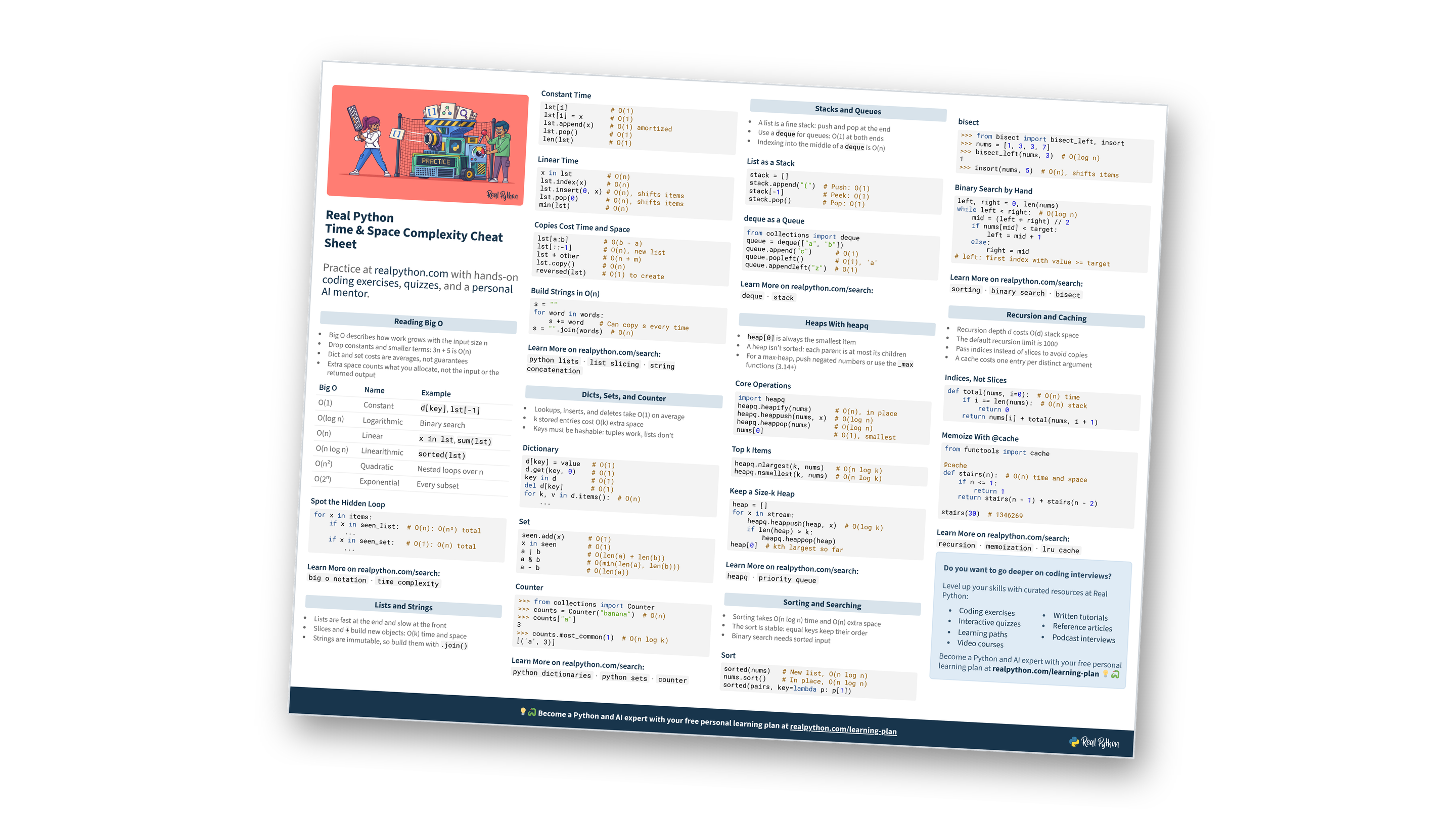
This page contains a condensed overview of the time and space costs of Python’s built-in data structures and standard library tools. It covers Big O basics, lists and strings, dictionaries and sets, stacks and queues, heaps, sorting and binary search, and recursion with caching. You can also download the information as a printable cheat sheet:
Free Bonus: Python Time and Space Complexity Cheat Sheet
Get a Python Time and Space Complexity Cheat Sheet (PDF) with the Big O costs of lists, dicts, sets, deques, heaps, sorting, and recursion on one page:
Practice with hands‑on coding exercises and put these costs to work in the Coding Interview Practice learning path.
New to Big O?
Reading Big O
- Big O describes how work grows with the input size n
- Drop constants and smaller terms: 3n + 5 is O(n)
- Dict and set costs are averages, not guarantees
- Extra space counts what you allocate, not the input or the returned output
| Big O | Name | Example |
|---|---|---|
| O(1) | Constant | d[key], lst[-1] |
| O(log n) | Logarithmic | Binary search |
| O(n) | Linear | x in lst, sum(lst) |
| O(n log n) | Linearithmic | sorted(lst) |
| O(n²) | Quadratic | Nested loops over n |
| O(2ⁿ) | Exponential | Every subset |
Spot the Hidden Loop
for x in items:
    if x in seen_list:  # O(n): O(n²) total
        ...
    if x in seen_set:   # O(1): O(n) total
        ...
Want to go deeper on Big O?
Lists and Strings
- Lists are fast at the end and slow at the front
- Slices and
+build new objects: O(k) time and space - Strings are immutable, so build them with
.join()
Constant Time
lst[i]           # O(1)
lst[i] = x       # O(1)
lst.append(x)    # O(1) amortized
lst.pop()        # O(1)
len(lst)         # O(1)
Linear Time
x in lst         # O(n)
lst.index(x)     # O(n)
lst.insert(0, x) # O(n), shifts items
lst.pop(0)       # O(n), shifts items
min(lst)         # O(n)
Copies Cost Time and Space
lst[a:b]         # O(b - a)
lst[::-1]        # O(n), new list
lst + other      # O(n + m)
lst.copy()       # O(n)
reversed(lst)    # O(1) to create
Build Strings in O(n)
s = ""
for word in words:
    s += word    # Can copy s every time
s = "".join(words)  # O(n)
Why does join() win?
Dicts, Sets, and Counter
- Lookups, inserts, and deletes take O(1) on average
- k stored entries cost O(k) extra space
- Keys must be hashable: tuples work, lists don’t
Dictionary
d[key] = value   # O(1)
d.get(key, 0)    # O(1)
key in d         # O(1)
del d[key]       # O(1)
for k, v in d.items():  # O(n)
    ...
Set
seen.add(x)      # O(1)
x in seen        # O(1)
a | b            # O(len(a) + len(b))
a & b            # O(min(len(a), len(b)))
a - b            # O(len(a))
Counter
>>> from collections import Counter
>>> counts = Counter("banana")  # O(n)
>>> counts["a"]
3
>>> counts.most_common(1)  # O(n log k)
[('a', 3)]
Think you know your hash tables?
Stacks and Queues
- A list is a fine stack: push and pop at the end
- Use a
dequefor queues: O(1) at both ends - Indexing into the middle of a
dequeis O(n)
List as a Stack
stack = []
stack.append("(")  # Push: O(1)
stack[-1]          # Peek: O(1)
stack.pop()        # Pop: O(1)
deque as a Queue
from collections import deque
queue = deque(["a", "b"])
queue.append("c")      # O(1)
queue.popleft()        # O(1), 'a'
queue.appendleft("z")  # O(1)
Want to go deeper on stacks and queues?
Free Bonus: Download the Python Time and Space Complexity Cheat Sheet PDF and keep the Big O costs at hand.
Heaps With heapq
heap[0]is always the smallest item- A heap isn’t sorted: each parent is at most its children
- For a max-heap, push negated numbers or use the
_maxfunctions (3.14+)
Core Operations
import heapq
heapq.heapify(nums)      # O(n), in place
heapq.heappush(nums, x)  # O(log n)
heapq.heappop(nums)      # O(log n)
nums[0]                  # O(1), smallest
Top k Items
heapq.nlargest(k, nums)   # O(n log k)
heapq.nsmallest(k, nums)  # O(n log k)
Keep a Size-k Heap
heap = []
for x in stream:
    heapq.heappush(heap, x)  # O(log k)
    if len(heap) > k:
        heapq.heappop(heap)
heap[0]  # Kth largest so far
Ready to test yourself on heaps?
Sorting and Searching
- Sorting takes O(n log n) time and O(n) extra space
- The sort is stable: equal keys keep their order
- Binary search needs sorted input
Sort
sorted(nums)   # New list, O(n log n)
nums.sort()    # In place, O(n log n)
sorted(pairs, key=lambda p: p[1])
bisect
>>> from bisect import bisect_left, insort
>>> nums = [1, 3, 3, 7]
>>> bisect_left(nums, 3)  # O(log n)
1
>>> insort(nums, 5)  # O(n), shifts items
Binary Search by Hand
left, right = 0, len(nums)
while left < right:  # O(log n)
    mid = (left + right) // 2
    if nums[mid] < target:
        left = mid + 1
    else:
        right = mid
# Result: left is the first index >= target
Where do off-by-one bugs hide?
Recursion and Caching
- Recursion depth d costs O(d) stack space
- The default recursion limit is 1000
- Pass indices instead of slices to avoid copies
- A cache costs one entry per distinct argument
Indices, Not Slices
def total(nums, i=0):  # O(n) time
    if i == len(nums):  # O(n) stack
        return 0
    return nums[i] + total(nums, i + 1)
Memoize With @cache
from functools import cache

@cache
def stairs(n):  # O(n) time and space
    if n <= 1:
        return 1
    return stairs(n - 1) + stairs(n - 2)

stairs(30)  # 1346269
Still fuzzy on stack space?
Do you want to go deeper on coding interviews?
Level up your skills with curated resources at Real Python:
- Coding exercises
- Interactive quizzes
- Learning paths
- Video courses
- Written tutorials
- Reference articles
- Podcast interviews
Become a Python and AI expert with your free personal learning plan at realpython.com/learning-plan 💡🐍
Ready to go beyond the cheat sheet?
You can download this information as a printable cheat sheet:
Free Bonus: Python Time and Space Complexity Cheat Sheet
Get a Python Time and Space Complexity Cheat Sheet (PDF) with the Big O costs of lists, dicts, sets, deques, heaps, sorting, and recursion on one page:
