Python’s experimental JIT compiler has been riding along in CPython’s main branch since Python 3.13. It’s off by default and easy to forget about. In June, the Steering Council decided that the JIT needs a proper standards-track PEP, and it set a six-month clock to make that happen. Otherwise, the JIT gets taken back out of main.
The JIT debate wasn’t the only relevant news this month. Python 3.14.6 and 3.13.14 shipped their routine bug fixes, and Python 3.15 picked up two more betas on its way to a fall release. The wider ecosystem kept pace, with security fixes from Django and Starlette, and fresh releases across the data stack from scikit-learn and Polars. Conference season is heating up too, with EuroPython 2026 landing in Kraków in mid-July.
Time to dig into the Python news from the past month!
Join Now: Click here to join the Real Python Newsletter and you’ll never miss another Python tutorial, course, or news update.
Python Releases and PEP Highlights
The most notable news this month is a deadline rather than a new feature. The Steering Council put the JIT compiler on notice, while the rest of the release news—two maintenance drops and two more 3.15 betas—was quieter by comparison.
The Steering Council Puts the JIT on Notice
CPython’s JIT compiler arrived in Python 3.13 as an experimental, off-by-default feature, backed only by the informational PEP 744. In June, the Steering Council announced that this arrangement has run its course.
No new JIT functionality can merge into main until the community approves the project through a standards-track PEP, and that PEP has roughly six months to materialize. If it doesn’t, then the JIT code comes out of main, and development continues somewhere else.
The council’s reasoning is less about the code and more about the commitments around it. Its list of missing pieces includes:
- Committed long-term maintainers
- A security review
- Debugging and out-of-process tooling support
- Defined runtime guarantees
There’s also a process point underneath it all:
…experiments should not be done on the main branch of CPython without a backing PEP. (Source)
The forthcoming PEP will need to spell out who maintains the JIT, how it coexists with CPython features like free threading, profilers, and debuggers, and what counts as success.
That last question is where the community discussion got lively. The current JIT delivers roughly an 8–9 percent geometric-mean speedup on x86-64 Linux and 12–13 percent on AArch64 macOS, but individual benchmarks swing from a 15 percent slowdown to better than a 100 percent speedup.
JIT lead Ken Jin floated a long-term target of around 20 percent, or as he put it, “one-half to one-quarter of PyPy.” For context, contributors measured PyPy at roughly 50 percent faster than CPython 3.15 on macOS, and 80–90 percent faster on x86-64 Linux. Either way, the JIT isn’t there yet, and the council wants a clear-eyed plan before it commits. Side by side, the gap is stark:
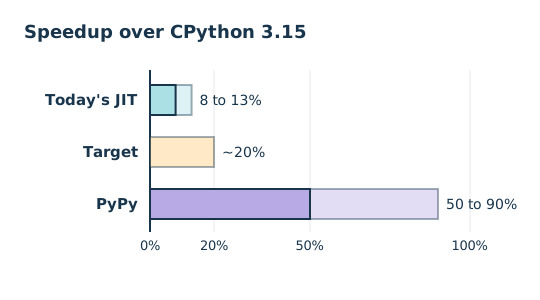
Even the JIT’s optimistic 20 percent target barely dents PyPy’s lead, and today’s modest gains leave it well short of either mark.
Note: The JIT still disables itself the moment you start threads, so it doesn’t yet play nicely with free-threaded Python. Making those two flagship projects work together is exactly the kind of guarantee the new PEP will need to address.
It’s a healthy moment for the project. Forcing a real maintenance and security story now beats discovering the gaps after the JIT is on by default, so here’s hoping the extra rigor sets the JIT up for a strong future.
Two Maintenance Python Releases and Two Betas
While the JIT debate simmered, the release managers kept the regular cadence going. Python 3.14.6 and 3.13.14 both shipped on June 10, with around 179 and 240 bug fixes, respectively. Neither is a security release, so there’s no fire drill here, just the usual steady stream of fixes that make it worth staying current on the latest bugfix version.
On the pre-release front, Python 3.15.0b2 landed on June 2, the second of four planned betas. The feature set is frozen, so these betas are about stabilizing what’s already in.
Note: Now that the 3.15 feature set is locked, running your test suite against the beta is the single most useful thing you can do for the release. Install the pre-release in an isolated environment, and file anything that breaks while there’s still time to fix it.
Beta 3 followed on June 23, adding around 195 fixes from 86 contributors. Beta 4 is due July 18, the release candidate phase opens August 4, and the final release is expected this fall.
The 3.15 Feature List Locks In
A couple of 3.15-bound proposals crossed the finish line. PEP 798 brings unpacking operations (* and **) into comprehensions, and PEP 800 adds the @typing.disjoint_base decorator for the type system. Both reached Final status as the beta locked their behavior in.
Of the two, PEP 798 is the one you’ll feel day to day. Say that you want to flatten a nested list. That used to take a double loop:
Python < 3.15
>>> matrix = [[1, 2], [3, 4], [5, 6]]
>>> [value for row in matrix for value in row]
[1, 2, 3, 4, 5, 6]
Now you can unpack the inner iterable right in the comprehension:
Python >= 3.15
>>> [*row for row in matrix]
[1, 2, 3, 4, 5, 6]
The same * and ** work in set, dict, and generator expressions, so {**d for d in dicts} merges a list of dictionaries in one line.
A mid-June housekeeping pass flipped a whole batch of 3.15 PEPs to Final status at once. The headliners include PEP 814’s new built-in frozendict, the long-deferred PEP 686 that finally makes UTF-8 mode the default, PEP 661’s sentinel values, and PEP 831’s frame-pointer support for profiling. With the betas rolling, the 3.15 feature list is essentially settled.
Community and Ecosystem Highlights
Some of the most interesting work this month happened away from the Python releases. The highlights include a candid look at the finances of the Python Software Foundation (PSF), Django’s hunt for its first Executive Director, and a guided tour of free threading’s internals.
The PSF Opens Its 2026 Plan for Comment
The Python Software Foundation took its planning work a step further, publishing a draft 2026 strategic plan and inviting the community to weigh in through late June. The recurring theme is financial sustainability.
Board chair Jannis Leidel said bluntly that the topic “came up repeatedly” and that the PSF is “stable for now, but we cannot continue on the current path without making meaningful changes.”
The draft lays out a set of organizational and program goals, and the foundation asked the direction-level questions that matter most:
- Are these the right goals?
- Is anything important missing?
Even with the comment window closed, the plan is worth reading if you want to understand the pressures on the organization behind Python itself, the one that funds much of the core development and keeps infrastructure like PyPI online. If your company runs on Python, then it’s a fair prompt to ask whether you’re giving anything back.
That structural pressure is showing up on the calendar, too. The PSF set its 2026 board election dates, with nominations opening July 28 and voting running September 1–15. This year, the vote runs alongside the first-ever election for the new Packaging Council.
Django Hunts for Its First Executive Director
The Django Software Foundation (DSF) is hiring its first-ever Executive Director.
The foundation has always leaned on an all-volunteer board, whose members fund Django Fellows, hand out event grants worldwide, manage memberships, and shoulder the legal and nonprofit work behind the framework. As the DSF’s board president put it:
…for years our board has run the DSF on volunteer time, and we’ve hit the limits of what that can do.
The new position is paid and open to part-time or full-time candidates, covering day-to-day operations, sponsorships, community outreach, and coordination with the Fellows and working groups.
To get it off the ground, a group of Django agencies has pledged seed funding for the role’s first year. Since that covers only the launch, the DSF is raising its annual fundraising goal to sustain the position for the long haul. The board is still finalizing the details and expects to post the job in the coming weeks.
A Core Developer Demystifies Free Threading’s Internals
If the free-threading rollout has felt like a black box, core developer Victor Stinner wrote a couple of posts that open it up:
They’re a clear read on why removing the GIL was so hard in the first place. The short version is that naive thread-safe reference counting is brutally slow. An early experiment made Python about 19 times slower across seven cores because every Py_INCREF turned into a contended atomic operation.
The fix is a stack of techniques:
- Biased reference counting: Each object gets an owning thread that can use cheap, non-atomic updates for the common case.
- Object immortality: Small integers, built-in types, and similar values skip counting entirely (PEP 683).
- Deferred reference counting: Certain objects go to the garbage collector instead of being tracked on every reference.
Together, these techniques keep single-threaded code fast while letting multi-core code actually scale. If you’ve ever wondered what free threading is buying and costing under the hood, those two posts are the ones to read.
Library and Tooling Updates
Beyond CPython itself, it was a steady month for libraries and tooling. None of this is earth-shaking on its own, but each release could save you a debugging session or smooth out an upgrade, depending on what your stack leans on:
-
Django shipped security releases 6.0.6 and 5.2.15 on June 3, fixing five low-severity issues across cookies, caching, and STARTTLS handling.
-
scikit-learn 1.9 shipped on June 12 with an experimental callback mechanism for progress tracking and early stopping, plus native missing-value support in more tree models. It also adds more GPU-capable estimators through the Array API and switches to sparse arrays over the legacy sparse matrices.
-
PyPy 7.3.23 landed with a reworked bytecode interpreter that uses exception tables instead of dedicated opcodes, bringing its disassembly output closer to CPython’s.
-
Polars 1.41 arrived with a hand-written Thrift decoder for Parquet metadata that runs up to 3.3 times faster on very wide tables. It also brings smarter query-plan optimization and a lazy
LazyFrame.gatherfor selecting rows by index without forcing materialization, building on May’s streaming-engine and spill-to-disk work in 1.40. -
Starlette 1.0.1 patched a 6.5 “moderate” CVE where a malformed
Hostheader could makerequest.url.pathreport a different path than the router actually matched, fooling any middleware that makes authorization decisions on that path. Because Starlette underpins FastAPI and a growing pile of MCP servers and AI-agent backends, the fix is worth applying now. -
httpx2 is now a shipping project. Following Pydantic’s stewardship of the
httpxfork, it has been releasing steadily, reaching version 2.4.0 in June. Recent releases swapcertififortruststore, handlezstdresponses, drop Python 3.9, and add 3.14. -
Pydantic AI 2.0 went stable. After seven betas, it shipped its first stable release, reorganized around a new
capabilitiesprimitive that bundles an agent’s tools, hooks, instructions, and model settings into one composable unit.
The through-line here is steady maintenance rather than fireworks. Individually these are easy to skip, but together they’re the housekeeping that keeps your dependencies healthy, so it’s worth checking which ones your project uses and bumping them when you get the chance.
AI Tooling Updates
There was no shortage of AI model releases this month. A recurring theme for working developers was growing pushback against letting the tools run unsupervised. Two pieces in particular reframed the conversation from How do I prompt better? to How do I stay in control?
Context Rot Erodes Long Agent Sessions
If you’ve watched a coding agent start strong and then slowly lose the plot over a long session, there’s a name for it now: context rot.
A widely shared piece titled Context isolation in coding agent loops made the rounds.
Ticket text, logs, test output, abandoned ideas, and stale assumptions all pile into a single context window until, as the author puts it:
…the context window was a junk drawer. The agent still had all the words, technically. But the structure was gone.
The proposed fix is a matter of architecture rather than a better prompt: split the work across several specialized agents, each with its own clean context, and pass compact summaries between them instead of dragging the entire transcript along.
It’s the same instinct behind treating context as something you deliberately manage, which is exactly the ground that the Context Engineering for Python Codebases tutorial covers.
None of this means long agent sessions are hopeless. The remedy is to curate context instead of letting it accumulate, and a little structure up front buys you far steadier results from the same model.
Delegating Friction Dulls Your Instincts
In a similar vein, Bob Belderbos argued that you shouldn’t delegate the friction of development to AI wholesale. His framing is useful, sorting friction into three kinds:
| Friction | Examples |
|---|---|
| Worth eliminating | Boilerplate, config |
| Worth preserving | Design decisions, debugging |
| Worth seeking out | Reading library source, learning a new language |
Hand all of it to a model, and your instincts get rusty. He suggests reviewing AI diffs the way you’d review a junior engineer’s pull request, and even coding solo for a couple of hours a week to keep the muscles working.
The teams getting real value out of these AI tools are the ones who stay in the loop on the parts that matter, not the ones who delegate the most.
Conferences and Events
EuroPython 2026 comes to Kraków, Poland, July 13–19, and this year the conference is celebrating its 25th anniversary:

The schedule follows the familiar shape: tutorials and summits to start, three days of main-conference talks in the middle, and sprints to close, with keynotes from Guido van Rossum, Pablo Galindo Salgado, and Łukasz Langa, among others. Registration is open.
Tucked into the opening days is the Language Summit on July 14. It’s the invitation-only gathering where CPython and alternative-implementation maintainers hash out direction. This year’s sessions reportedly cover Rust integration, garbage-collection improvements, buffer protocol modernization, and free-threading concurrency primitives.
If Kraków isn’t in the cards, SciPy 2026 heads to Minneapolis this summer for the scientific Python crowd, and registration is open.
Either way, most of the talks get recorded, so you can catch up from your desk once they’re online.
Real Python Roundup
The Real Python team has been busy as usual. Here’s what’s new on the site.
Note: Real Python’s new Codex Live Course runs July 11–12.
Join Philipp Acsany for a hands-on Codex CLI masterclass in agentic coding. Over two sessions (4 hours each, via Zoom), Philipp shows you how to move beyond toy prompts and build a complete Python CLI app from an empty directory.
You’ll leave with a working project in your portfolio and a professional workflow you can put to work right away. Reserve Your Seat →
You can start your next learning session with these written tutorials:
- How to Get Started With the GitHub Copilot CLI
- Django Tasks: Exploring the Built-in Tasks Framework
- Python for Data Analysis: A Practical Guide
- Context Engineering for Python Codebases
- Implementing Interfaces in Python: ABCs and Protocols
- Cursor vs Windsurf: Which AI Code Editor Is Best for Python?
- How to Use GitHub Copilot Code Review in Pull Requests
- Python sleep(): How to Add Time Delays to Your Code
If you’d rather learn by watching, then check out these new video courses:
If you want to check what stuck, test yourself with these new quizzes:
- Managing and Measuring Python Code Quality
- How to Get Started With the GitHub Copilot CLI
- Django Tasks: Exploring the Built-in Tasks Framework
- Using LlamaIndex for RAG in Python
- Implementing Interfaces in Python: ABCs and Protocols
- Context Engineering for Python Codebases
- Using the Python zip() Function for Parallel Iteration
- Sorting a Python Dictionary: Values, Keys, and More
- Serialize Your Data With Python
- Embeddings and Vector Databases With ChromaDB
- Develop Data Visualization Interfaces in Python With Dash
- How to Use GitHub Copilot Code Review in Pull Requests
- Structuring Your Python Script
- Regular Expressions: Regexes in Python (Part 1)
On The Real Python Podcast, Christopher Bailey and guests worked through a full slate of episodes:
- Episode 298: Reducing the Size of Python Docker Containers
- Episode 299: EuroPython 2026: Celebrating 25 Years
- Episode 300: Maintaining Your Python Developer Instincts While Using LLM Tools
If you only have time for one, then episode 300 lands right on this month’s AI-tooling thread. It explores staying sharp as a developer even when LLM tools are writing the code, which is the same worry behind Bob Belderbos’s piece from earlier.
What’s Next for Python?
The next few months belong to 3.15. Beta 3 landed June 23, Beta 4 is due July 18, the release candidate phase opens August 4, and the final release follows in the fall. With the feature set frozen, running your projects against the beta now is what keeps that final release solid.
But the question hanging over the rest of the year is the one the Steering Council asked: What does Python want its performance story to be? The JIT has six months to make its case, free threading is still proving it can scale, and a clock is ticking on both.
If you’ve ever wanted a say in where CPython goes next, then the PEP drafts and discussion threads are open right now, and they could use more voices. See you next month!
Join Now: Click here to join the Real Python Newsletter and you’ll never miss another Python tutorial, course, or news update.