agentic coding
Agentic coding is an approach to software development where AI agents plan, write, run, and iteratively improve code using tools and feedback loops under human oversight.
Unlike autocomplete that assists line by line, agentic coding treats the model more like an autonomous problem solver. The agent can decompose high-level goals, execute the code it writes, run tests and other commands, analyze failures, and retry until a specification is met. This loop of generate -> execute -> evaluate -> refine is core to the paradigm where human supervision is key.
In practice, systems implementing agentic coding define principles and guardrails for safety, observability, and accountability. They also orchestrate multi-step or multi-agent workflows, which increasingly run in the background, in CI, or on a schedule rather than in a live terminal session.
These workflows integrate with existing tooling, such as version control, testing frameworks, issue trackers, and deployment environments, often through MCP servers that expose those systems to the agent as tools.
Related Resources
Tutorial
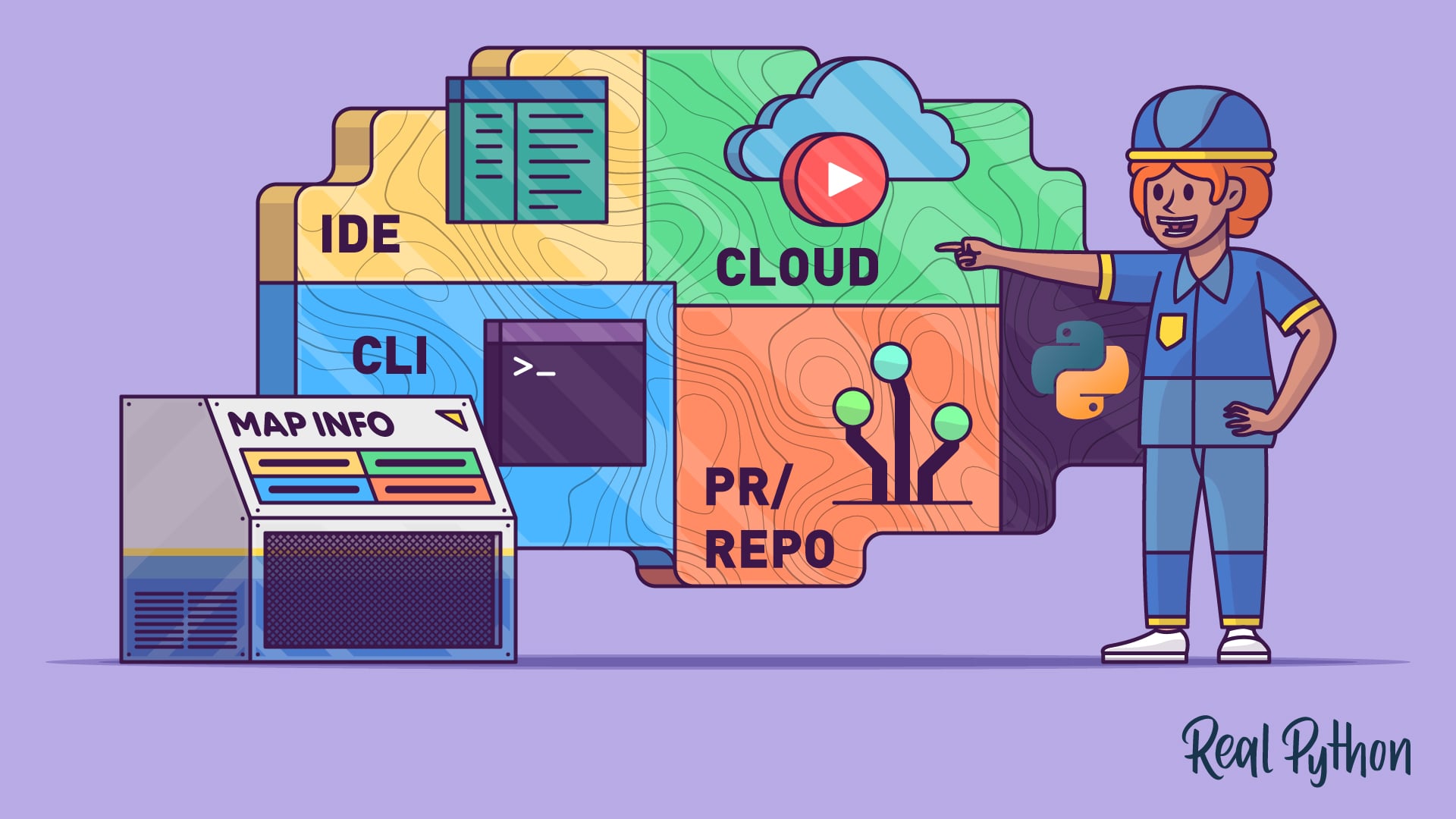
AI Coding Agents Guide: A Map of the Four Workflow Types
AI coding agents come in four types: IDE, terminal, PR, and cloud. Learn how each workflow fits into modern Python development.
For additional information on related topics, take a look at the following resources:
- How to Debug Python Code With an AI Agent (Tutorial)
- Getting Started With Claude Code (Course)
- How to Get Started With the GitHub Copilot CLI (Tutorial)
- How to Use OpenCode for AI-Assisted Python Coding (Tutorial)
- How to Use GitHub Copilot Code Review in Pull Requests (Tutorial)
- Python Coding With AI (Learning Path)
- How to Use Google's Gemini CLI for AI Code Assistance (Tutorial)
- AI Coding Agents Guide: A Map of the Four Workflow Types (Quiz)
- How to Debug Python Code With an AI Agent (Quiz)
- How to Get Started With the GitHub Copilot CLI (Quiz)
- Coding With OpenCode: AI-Assisted Python (Course)
- How to Use OpenCode for AI-Assisted Python Coding (Quiz)
- How to Use GitHub Copilot Code Review in Pull Requests (Quiz)
- Getting Started With Google Gemini CLI (Course)
- How to Use Google's Gemini CLI for AI Code Assistance (Quiz)
Have a question about this? Mentor AI can show you examples, compare related terms, and point you to tutorials.
Ask Mentor AI

By Leodanis Pozo Ramos • Updated Sept. 23, 2026
