tkinter
The Python tkinter package provides an object-oriented interface to the Tcl/Tk GUI toolkit. It’s Python’s standard interface to Tk and ships with most Python installations, allowing developers to build cross-platform graphical user interfaces with ease.
Here’s a quick app:
>>> import tkinter as tk
>>> root = tk.Tk()
>>> label = tk.Label(root, text="Hello, Tkinter!")
>>> label.pack()
>>> root.mainloop()
Key Features
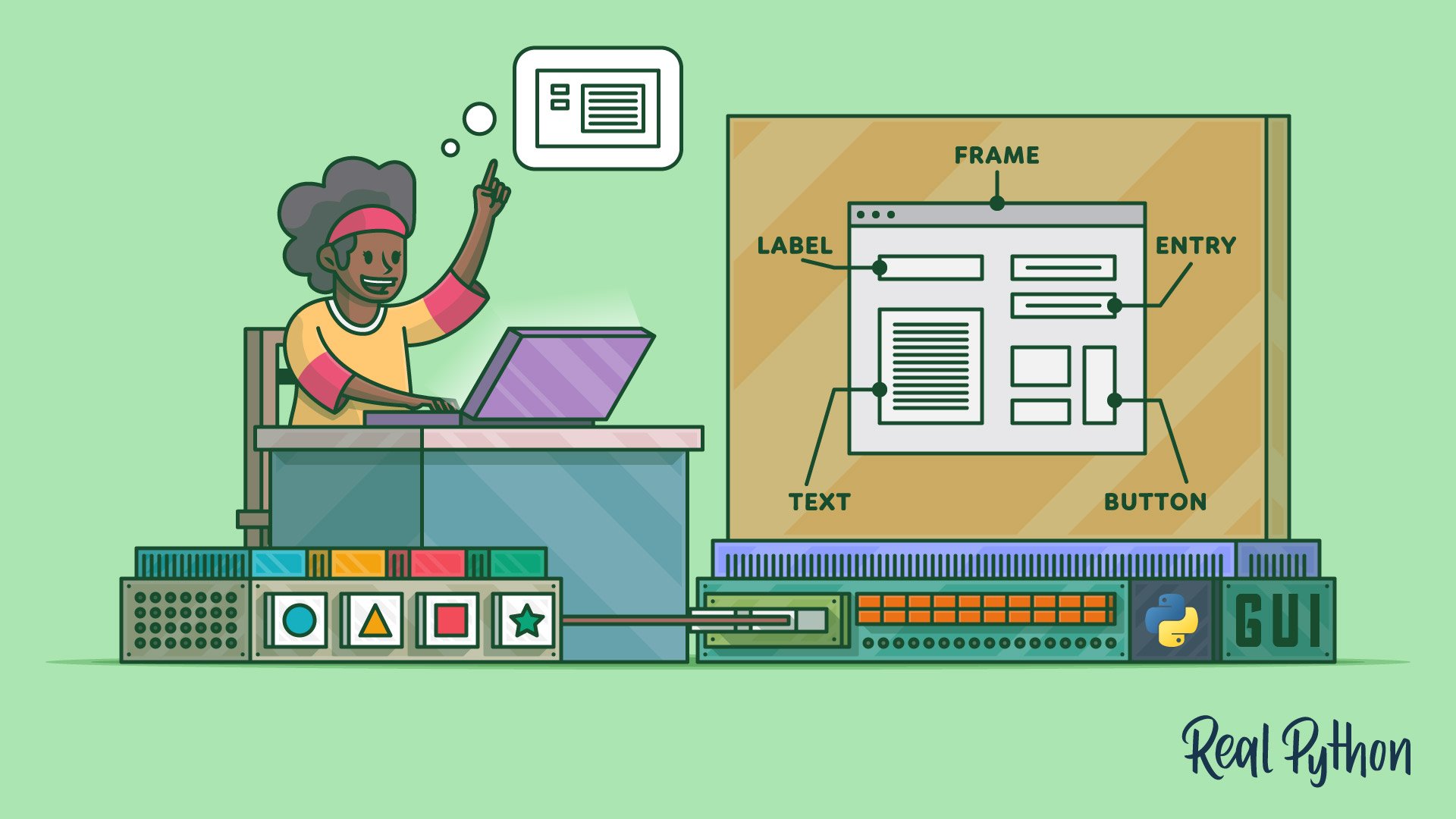
- Provides a wide range of widgets, including buttons, labels, and text entries
- Supports event-driven programming through callback functions
- Enables layout management with geometry managers like
.pack(),.grid(), and.place() - Offers access to the full power of the underlying Tk toolkit
- Provides the modern themed widget set through
tkinter.ttk, whose widgets adopt the platform’s native look and add extras such asCombobox,Notebook,Progressbar, andTreeview - Enables rapid development with built-in availability in the standard library
- Allows cross-platform deployment on Windows, macOS, and Linux
Frequently Used Classes and Functions
| Object | Type | Description |
|---|---|---|
tkinter.Tk |
Class | Represents the main application window |
tkinter.Label |
Class | Displays text or images |
tkinter.Button |
Class | Creates a clickable button widget |
tkinter.Entry |
Class | Creates a single-line text entry field |
tkinter.Tk.mainloop() |
Method | Starts the Tk event loop |
tkinter.Tk.title() |
Method | Sets the window title |
tkinter.IntVar |
Class | Manages an integer value for use in widgets and callbacks |
Examples
Creating a minimal window with a label:
>>> import tkinter as tk

>>> root = tk.Tk()
>>> label = tk.Label(root, text="Hello, Tkinter!")
>>> label.pack()

>>> root.mainloop()
That .pack() call is one of three geometry managers that tkinter gives you for
arranging widgets. Switch between them below to see where each one puts the same
label, entry, and button, along with the calls that produce each arrangement:
Adding a button with a callback function:
>>> import tkinter as tk

>>> def on_button_click():
...     print("Button clicked!")
...

>>> root = tk.Tk()
>>> root.title("Button App")
>>> label = tk.Label(root, text="Click the button below:")
>>> label.pack()
>>> button = tk.Button(root, text="Click Me", command=on_button_click)
>>> button.pack()

>>> root.mainloop()
Common Use Cases
- Developing desktop applications with a graphical user interface
- Creating custom dialogs and forms for user input
- Building educational tools and simple games
- Prototyping interfaces quickly and interactively
- Creating simple internal tools and automation dashboards
- Embedding GUI elements in scripts or utilities
Real-World Example
Here’s an example of a counter application using tkinter. It demonstrates how to use tk.IntVar() to manage dynamic values that update the user interface in response to user interactions:
>>> import tkinter as tk

>>> root = tk.Tk()
>>> root.title("Counter")

>>> count = tk.IntVar(value=0)

>>> def increase():
...     count.set(count.get() + 1)
...     label.config(text=str(count.get()))

>>> label = tk.Label(
...     root, text="0", font=("Helvetica", 48)
... )
>>> label.pack()
>>> button = tk.Button(
...     root, text="Increase", command=increase
... )
>>> button.pack()

>>> root.mainloop()
This example demonstrates how to build a basic counter app using tkinter. Each button press updates the displayed value dynamically.
Related Resources
Tutorial
Python GUI Programming: Your Tkinter Tutorial
Complete an interactive tutorial for Python's GUI library Tkinter. Add buttons, text boxes, widgets, event handlers, and more while building two GUI apps.
For additional information on related topics, take a look at the following resources:
- Build a Tic-Tac-Toe Game With Python and Tkinter (Tutorial)
- Building a Python GUI Application With Tkinter (Course)
- How to Build a Python GUI Application With wxPython (Tutorial)
- PySimpleGUI: The Simple Way to Create a GUI With Python (Tutorial)
- Python GUI Programming With Tkinter (Quiz)
- Build a Tic-Tac-Toe Game With Python and Tkinter (Quiz)
- Simplify Python GUI Development With PySimpleGUI (Course)
Have a question about this? Mentor AI can show you examples, compare related terms, and point you to tutorials.
Ask Mentor AI

By Leodanis Pozo Ramos • Updated Oct. 19, 2026
