set union
A set union is the operation that combines two or more sets into a single set containing every element that appears in at least one of them. Formally, the union of two sets A and B, written A ∪ B, is the set of all values that belong to A or to B, with elements that appear in both counted only once:
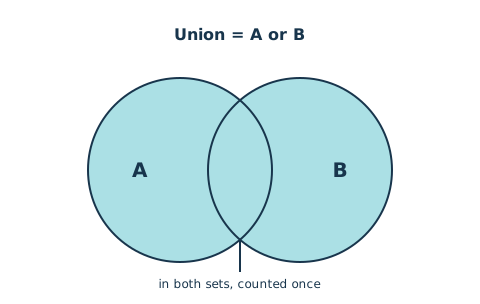
This deduplication follows from the fact that a set holds no repeated elements. Union is commutative and associative, so the order and grouping of the inputs never change the outcome. The empty set is the identity element for union, since uniting any set with it leaves the set unchanged.
The operation generalizes beyond two inputs. An n-ary union combines a finite list of sets, and an indexed union combines an arbitrary family of them.
When each set is stored as a hash table, computing the union of two sets takes time proportional to their combined size. Python exposes union on its built-in set type through the | operator and the .union() method, each returning a new set.
Related Resources
Tutorial
Sets in Python
Learn to work effectively with Python sets: define set objects, explore the supported operations, and know when sets fit your code.
For additional information on related topics, take a look at the following resources:
- Build a Wordle Clone With Python and Rich (Tutorial)
- Python Set Comprehensions: How and When to Use Them (Tutorial)
- Build a Hash Table in Python With TDD (Tutorial)
- Using Sets in Python (Course)
- Common Python Data Structures (Guide) (Tutorial)
- Python Sets (Quiz)
- Create a Python Wordle Clone With Rich (Course)
- Python Set Comprehensions: How and When to Use Them (Quiz)
- Build a Hash Table in Python With TDD (Quiz)
- Records and Sets: Selecting the Ideal Data Structure (Course)
- Stacks and Queues: Selecting the Ideal Data Structure (Course)
- Dictionaries and Arrays: Selecting the Ideal Data Structure (Course)
- Common Python Data Structures (Guide) (Quiz)
Have a question about this? Mentor AI can show you examples, compare related terms, and point you to tutorials.
Ask Mentor AI

