microservice
A microservice is a small, loosely coupled, independently deployable service that owns a single business capability and communicates with the rest of the system over a lightweight network connection, usually an HTTP API or a message queue.
A system built from many of these services is a microservices architecture. The application becomes a suite of small programs, each running in its own process and owning its own data. Each service exposes its capability through a versioned API instead of through in-process function calls.
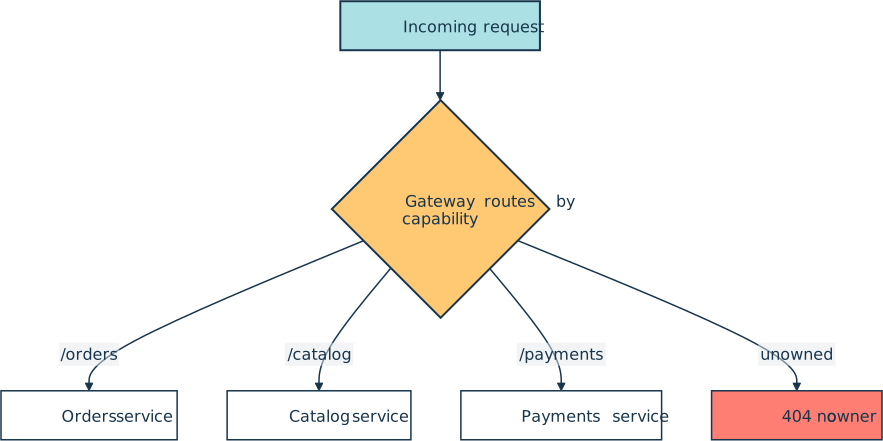
In a common setup, an API gateway sits in front of the fleet, inspects each incoming request, and forwards it to whichever service owns that capability. The gateway also absorbs cross-cutting concerns like authentication, TLS termination, and rate limiting, while staying free of any business logic of its own:
How It Shows Up in Practice
A Python developer usually meets microservices as a repository that holds a single service rather than the whole product. The service is a small web application, often built with FastAPI, Flask, or a gRPC server, that exposes a handful of endpoints and ships on its own schedule.
Calls to other parts of the system go out over the network, as HTTP requests or as messages on a broker such as RabbitMQ or Kafka. These calls frequently carry JSON payloads rather than running as in-process function calls.
Because the pieces are spread across processes and machines, the operational tooling matters as much as the code. Each service flows through its own pipeline, and its servers are usually described as infrastructure as code.
A request that fans out across several services is followed with distributed tracing, so a failure can be pinned to the service that caused it. Those same forces make observability a baseline requirement rather than an afterthought.
Microservices vs. Monolith
The alternative to microservices is a monolith, a single deployable unit that holds all of the application’s logic and usually talks to one shared database. A monolith is simpler to build, test, and run while it stays small, because every call is local and there is only one thing to deploy.
The cost shows up as it grows. A change anywhere means rebuilding and redeploying the whole application, and one team’s work can stall another’s release.
Microservices trade that simplicity for independence. Teams deploy, scale, and even choose the language of their own service without coordinating a single release, which is what lets a large organization keep moving in parallel. In practice, most teams cap that freedom with platform-wide standards for languages, logging, and deployment, because an unbounded mix of stacks becomes its own maintenance burden. The trade is real operational complexity, because network calls fail in ways local calls never do, and data spread across services is harder to keep consistent.
The system only stays manageable with the deployment and configuration discipline that a twelve-factor app codifies. The canonical advice, often called monolith first, is to start with a monolith, keep it modular, and split it into services only once the monolith itself becomes the problem. Splitting too early, before that discipline is in place, is a common way to take on technical debt instead of shedding it.
Related Resources

Tutorial
Python Microservices With gRPC
In this tutorial, you'll learn how to build a robust and developer-friendly Python microservices infrastructure. You'll learn what microservices are and how you can implement them using gRPC and Kubernetes. You'll also explore advanced topics such as interceptors and integration testing.
For additional information on related topics, take a look at the following resources:
- Python REST APIs With FastAPI (Course)
- Python and REST APIs: Interacting With Web Services (Tutorial)
- Python REST APIs With Flask, Connexion, and SQLAlchemy – Part 1 (Tutorial)
- A Close Look at a FastAPI Example Application (Tutorial)
- Build a URL Shortener With FastAPI and Python (Tutorial)
- Interacting With REST APIs and Python (Course)
- Python and REST APIs: Interacting With Web Services (Quiz)
- A Close Look at a FastAPI Example Application (Quiz)
- Building a URL Shortener With FastAPI and Python (Course)
Have a question about this? Mentor AI can show you examples, compare related terms, and point you to tutorials.
Ask Mentor AI

By Martin Breuss • Updated Aug. 14, 2026
