literal
In Python, a literal represents a fixed value in your code. These are the raw data elements that don’t change during execution.
Python supports literals for the following data types:
- Strings and bytes (
b"...") - Integer, floating-point, and imaginary (
2j) values, which denote complex numbers with a zero real part - Boolean values (
True,False) andNone
Lists, tuples, dictionaries, and sets don’t have literals in the strict sense. Python builds them with displays, such as [1, 2] or {"a": 1}, although many people informally call these list or dictionary literals.
Literals allow you to directly assign values to variables, making your code more readable and straightforward.
When you use literals, you hardcode values. This means that wherever the literal appears, it will always represent the same value. This is useful for initializing variables with known values or defining constants.
Examples
Here are some examples demonstrating different types of literals in Python:
# String literal
greeting = "Hello, Pythonista!"

# Integer literal
age = 30

# Floating-point literal
pi = 3.14159

# Boolean literal
is_active = True

# List display
fruits = ["apple", "orange", "mango"]

# Dictionary display
numbers = {"one": 1, "two": 2, "three": 3}
In these examples, you assign literals to variables using the assignment operator.
Related Resources
Tutorial
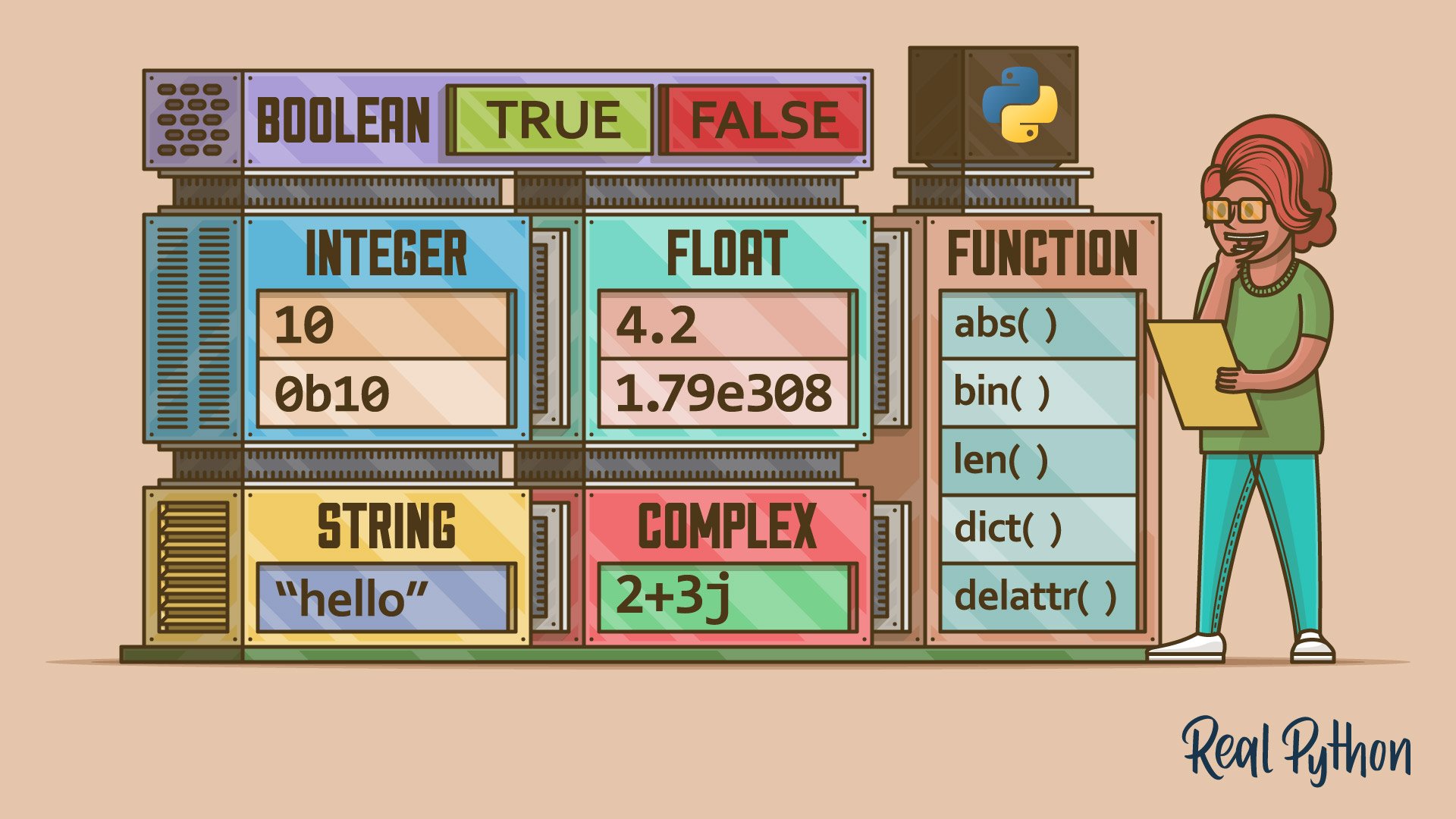
Basic Data Types in Python: A Quick Exploration
Explore the Python basic data types built into the language: numbers, strings, bytes, and Booleans, and how each one behaves.
For additional information on related topics, take a look at the following resources:
- Strings and Character Data in Python (Tutorial)
- Lists vs Tuples in Python (Tutorial)
- Dictionaries in Python (Tutorial)
- Sets in Python (Tutorial)
- What Are Python Raw Strings? (Tutorial)
- Python Constants: Improve Your Code's Maintainability (Tutorial)
- Python's Assignment Operator: Write Robust Assignments (Tutorial)
- Exploring Basic Data Types in Python (Course)
- Basic Data Types in Python: A Quick Exploration (Quiz)
- Strings and Character Data in Python (Course)
- Python Strings and Character Data (Quiz)
- Lists and Tuples in Python (Course)
- Lists vs Tuples in Python (Quiz)
- Using Dictionaries in Python (Course)
- Dictionaries in Python (Quiz)
- Using Sets in Python (Course)
- Python Sets (Quiz)
- Python Raw Strings (Quiz)
- Defining Python Constants for Code Maintainability (Course)
- Python Constants: Improve Your Code's Maintainability (Quiz)
- Python's Assignment Operator: Write Robust Assignments (Quiz)
Have a question about this? Mentor AI can show you examples, compare related terms, and point you to tutorials.
Ask Mentor AI