foundation model
A foundation model is a large machine learning model trained on broad, mostly unlabeled data at scale that can be adapted to a wide range of specific tasks, such as answering questions, summarizing text, or writing code. Foundation models exist for text, images, audio, and combinations of these, and a large language model is the most familiar case.
Researchers at Stanford’s Center for Research on Foundation Models coined the term in a 2021 report that named BERT, GPT-3, and DALL-E as examples. The authors picked “foundation” to stress that such a model is central yet incomplete. It’s rarely deployed as is. Other systems are built on top of it instead:
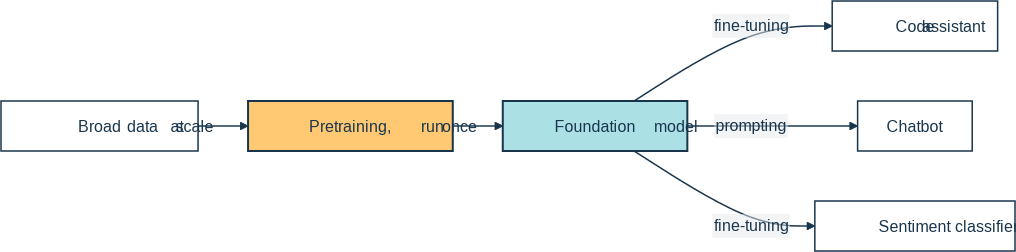
The workflow has two stages. One expensive pretraining run produces general-purpose representations, and cheaper adaptation then specializes them through fine-tuning or prompting. The split is transfer learning at scale. Platforms such as Amazon Bedrock host foundation models from many providers as a managed service.
The same report flagged homogenization as a risk. Because many applications are adapted from a handful of models, any defect or bias in a foundation model carries into every system built on it.
Related Resources

Tutorial
Hugging Face Transformers: Leverage Open-Source AI in Python
Get hands-on with Hugging Face Transformers in Python. Download, run, and inspect pretrained open-source AI models, and speed up inference on GPUs.
For additional information on related topics, take a look at the following resources:
- How to Use Ollama to Run Large Language Models Locally (Tutorial)
- LangGraph Tutorial: Build Stateful AI Agents in Python (Tutorial)
- Build an LLM RAG Chatbot With LangChain (Tutorial)
- How to Integrate ChatGPT's API With Python Projects (Tutorial)
- Pydantic AI: Build Type-Safe LLM Agents in Python (Tutorial)
- Hugging Face Transformers: Leverage Open-Source AI in Python (Quiz)
- How to Use Ollama to Run Large Language Models Locally (Quiz)
- Building an AI Agent With LangGraph and Python (Course)
- LangGraph: Build Stateful AI Agents in Python (Quiz)
- First Steps With LangChain (Course)
- Build an LLM RAG Chatbot With LangChain (Quiz)
- Leverage OpenAI's API in Your Python Projects (Course)
- How to Integrate ChatGPT's API With Python Projects (Quiz)
- Building Type-Safe LLM Agents With Pydantic AI (Course)
- Pydantic AI: Build Type-Safe LLM Agents in Python (Quiz)
Have a question about this? Mentor AI can show you examples, compare related terms, and point you to tutorials.
Ask Mentor AI

By Martin Breuss • Updated Nov. 16, 2026