Guido van Rossum
Guido van Rossum is the Dutch programmer who created Python and guided its development for nearly three decades. He started the language as a side project over the Christmas holidays of 1989 at CWI, a research institute in Amsterdam. In February 1991, he posted the first public release to Usenet, an early internet discussion network. He named the language after the BBC comedy series Monty Python’s Flying Circus.
Van Rossum set the design priorities that still shape Python, above all the insight that code is read far more often than it’s written. As Python’s benevolent dictator for life (BDFL), he held the final say on every Python Enhancement Proposal (PEP).
He stepped down on July 12, 2018, after a contentious community debate over the assignment expression. Python replaced the BDFL model with an elected steering council, and van Rossum won a seat on the first one in 2019. Today he’s Python’s emeritus BDFL.
His day job stayed close to the language throughout. He worked at Google and Dropbox, then joined Microsoft in 2020 and its Faster CPython team, which made CPython about 25 percent faster in version 3.11. He retired from Microsoft in 2026 and stays active in the Python community.
Related Resources
Course
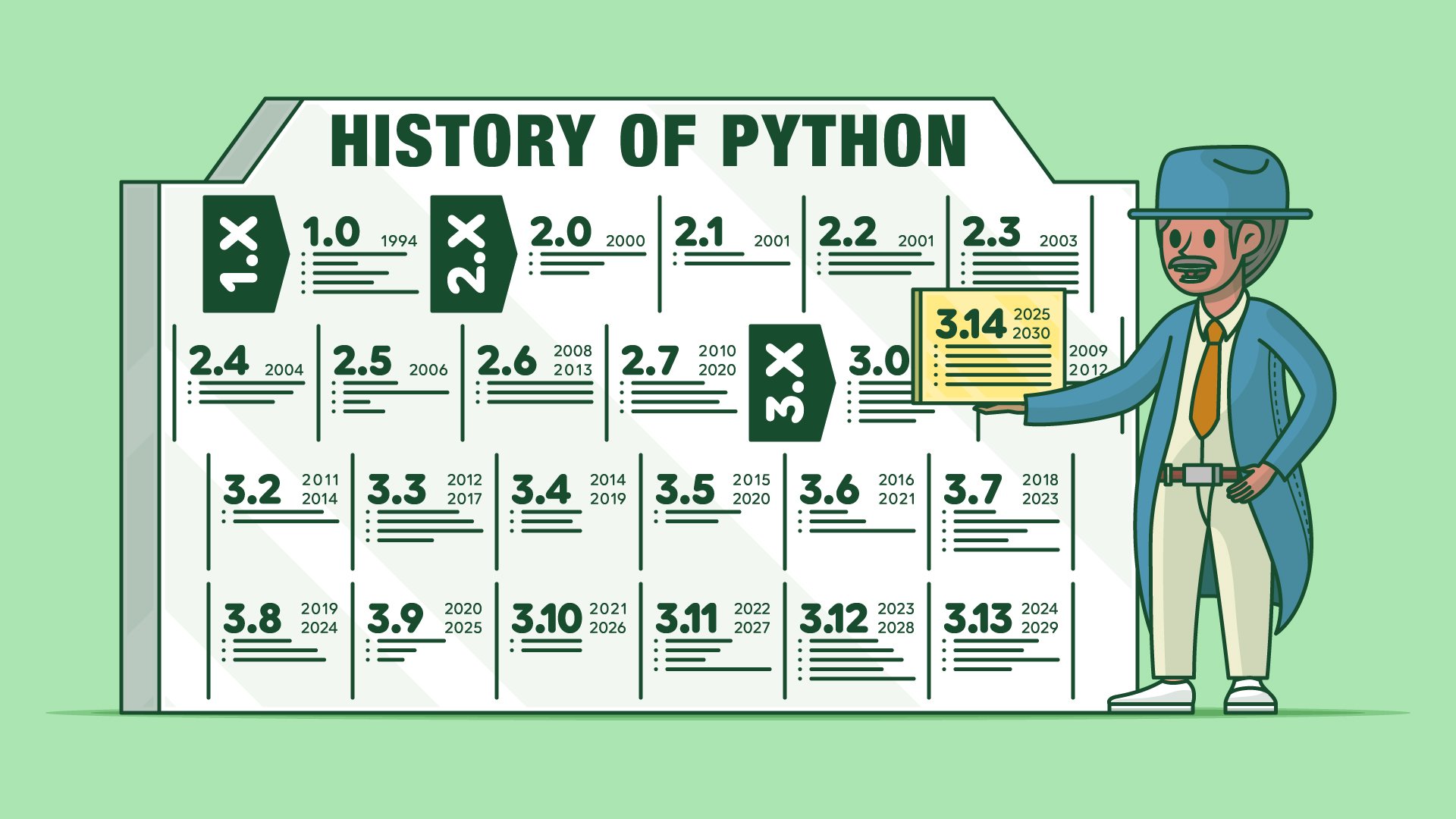
A History of Python Versions and Features
Explore Python’s evolution from the 1990s to today with a brief history and demos of key features added throughout its lifetime.
For additional information on related topics, take a look at the following resources:
- The Python Documentary Celebrates History While Developer Surveys Celebrate Python (Tutorial)
- How to Write Beautiful Python Code With PEP 8 (Tutorial)
- Your Guide to the CPython Source Code (Tutorial)
- Writing Beautiful Pythonic Code With PEP 8 (Course)
- How to Write Beautiful Python Code With PEP 8 (Quiz)
- Your Guide to the CPython Source Code (Quiz)
Have a question about this? Mentor AI can show you examples, compare related terms, and point you to tutorials.
Ask Mentor AI

By Martin Breuss • Updated Aug. 30, 2026
