test pyramid
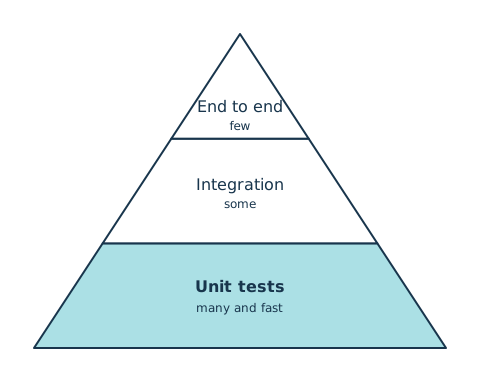
The test pyramid is a heuristic for how to spread an automated test suite across several layers of granularity. It recommends many fast, narrow tests at the base, fewer wider tests in the middle, and only a small set of slow end-to-end tests at the top. Mike Cohn first sketched the model in conversation with Lisa Crispin around 2003-2004 and published it in his 2009 book Succeeding with Agile, and Martin Fowler later popularized it as a counterweight to suites dominated by brittle UI tests.
The shape encodes two ideas at once. First, every test type has a different cost in run time, flakiness, and maintenance, so a healthy suite mixes granularities instead of relying on one. Second, the higher you go, the fewer tests you should have, because lower-level tests already cover most of the logic and run a thousand times faster, which gives the pyramid its characteristic shape:
How It Shows Up in Practice
A Python team usually maps each layer of the pyramid to a different tool and a different stage of the pipeline:
- Unit tests at the base run a single function or class in isolation. They are written with
pytestor the standard library’sunittest, mock out I/O, and finish in milliseconds. A typical project has hundreds or thousands of them, and they run on every commit. - Integration tests in the middle exercise how modules collaborate, including real databases, HTTP clients, and message queues. Common tools are
pytestfixtures,httpx,requests, andtestcontainers-pythonfor spinning up disposable services. They run on every pull request but are slower and fewer. - End-to-end tests at the top drive the whole system through the user interface or a full public API. Playwright, Selenium, and Robot Framework are typical choices. A team might have a few dozen of these, run on a schedule or before each release, and accept that they take minutes rather than seconds.
The pyramid describes a shape rather than a numeric prescription. A frequently quoted 70 / 20 / 10 split across the three layers traces back to Google’s testing blog, which offered it as “a good first guess” in 2015. Cohn himself never put ratios in print. The guiding principle is to push every test as far down the pyramid as it can usefully go.
Common Variations and Antipatterns
The most cited failure mode is the test ice cream cone, an inverted pyramid where most tests are slow UI or manual checks and the unit layer is thin or missing. Suites in this shape are slow, flaky, and discouraging to extend, and they are common in codebases where automated testing was added only after a QA team was already in place.
Several modern shapes adjust the pyramid for different architectures. Kent C. Dodds’ testing trophy widens the integration layer and adds static analysis from mypy, ruff, or pyright as a base, on the argument that integration tests give the best confidence per minute for frontend code. The testing honeycomb, published by Spotify’s engineering team in 2018 for microservice architectures, deliberately shrinks the unit layer, which Spotify calls implementation detail tests, and grows the cross-service integration layer.
The original pyramid still works as a starting point, and teams pick a variation when their architecture or risk profile pulls them away from the default shape.
Related Resources
Tutorial
Getting Started With Testing in Python
Learn Python testing in depth by writing unit and integration tests, measuring performance, and uncovering security issues. Find bugs before your users do!
For additional information on related topics, take a look at the following resources:
- pytest Tutorial: Effective Python Testing (Tutorial)
- Testing Your Code With pytest (Course)
- Python's unittest: Writing Unit Tests for Your Code (Tutorial)
- Understanding the Python Mock Object Library (Tutorial)
- Python's assert: Debug and Test Your Code Like a Pro (Tutorial)
- 4 Techniques for Testing Python Command-Line (CLI) Apps (Tutorial)
- Modern Web Automation With Python and Selenium (Tutorial)
- How to Provide Test Fixtures for Django Models in pytest (Tutorial)
- Test-Driven Development With pytest (Course)
- Getting Started With Testing in Python (Quiz)
- Effective Testing with Pytest (Quiz)
- Testing Your Code With Python's unittest (Course)
- Python's unittest: Writing Unit Tests for Your Code (Quiz)
- Improving Your Tests With the Python Mock Object Library (Course)
- Exploring unittest.mock in Python (Course)
- Understanding the Python Mock Object Library (Quiz)
- Using Python's assert to Debug and Test Your Code (Course)
- Python's assert: Debug and Test Your Code Like a Pro (Quiz)
- Modern Web Automation With Python and Selenium (Quiz)
Have a question about this? Mentor AI can show you examples, compare related terms, and point you to tutorials.
Ask Mentor AI

By Martin Breuss • Updated Aug. 8, 2026