software development life cycle (SDLC)
The software development life cycle, or SDLC, is the full sequence of phases that a piece of software moves through, from the first planning of a feature to maintaining it in production long after release. It names each stage of that journey so a team can agree on where a project stands and what comes next, and most teams today run the whole loop as an agile cycle rather than one long march.
A classic breakdown splits the work into six phases that flow into one another and then circle back to the start:
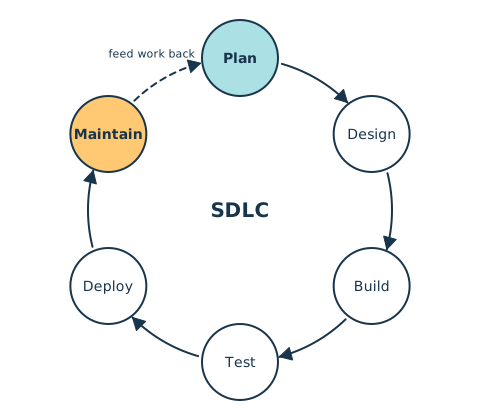
plan      ->  gather requirements and agree on scope
design    ->  choose an architecture and break the work into pieces
build     ->  write the code, review it, and merge it
test      ->  check each change against the requirements
deploy    ->  release the build to production
maintain  ->  fix bugs, watch the system, feed work back into plan
The exact count varies by source, from five phases up to eight, and some breakdowns add a retire phase after maintain, but the arc stays the same. The maintain phase loops back to plan, which is what makes the SDLC a cycle rather than a one-way checklist.
How It Shows Up in Practice
A Python developer rarely meets the SDLC as a document they sit down to read. It shows up instead as the rhythm of the team. The work gets scoped in a meeting, captured as a user story, and carried through review as a pull request.
A continuous integration run then tests the change, a staging environment holds it before production, and an observability dashboard watches it once it’s live. Each of those is one phase of the cycle in its everyday clothes.
The phrase itself surfaces most in job postings and process docs. “Experience across the full SDLC” is a common line in a Python job description, and it signals that the role expects more than writing code. Security-minded teams also talk about a secure SDLC, where threat modeling and dependency scanning move into the early phases instead of being bolted on at the end.
The defining trait is the loop. The maintain phase feeds bugs, feature requests, and accumulated technical debt back into planning, so the work circles around instead of ending at release.
SDLC Models
The SDLC says which phases exist, not how a team runs them, and a model fills that gap. The waterfall model runs the phases once in a strict order, finishing each before the next begins, so working software appears only near the end. That approach still suits work with fixed requirements and a hard regulatory sign-off.
Most modern Python teams run an iterative model instead. They cycle through the phases in short repeats and automate the middle of the loop, so a fix can travel from plan to production in days.
An agile process drives the planning and build phases, Kanban visualizes the flow of work through them, and continuous delivery keeps the test and deploy phases running on every change rather than once per project. To see how a single iteration of that loop is planned and run, read Scrum.
Related Resources

Tutorial
Continuous Integration and Deployment for Python With GitHub Actions
With most software following agile methodologies, it's essential to have robust DevOps systems in place to manage, maintain, and automate common tasks with a continually changing codebase. By using GitHub Actions, you can automate your workflows efficiently, especially for Python projects.
For additional information on related topics, take a look at the following resources:
- Python Continuous Integration and Deployment Using GitHub Actions (Course)
- Continuous Integration With Python: An Introduction (Tutorial)
- pytest Tutorial: Effective Python Testing (Tutorial)
- How to Use GitHub Copilot Code Review in Pull Requests (Tutorial)
- Flask Project Structure: Build a Scalable Web App (Tutorial)
- GitHub Actions for Python (Quiz)
- Continuous Integration With Python (Course)
- Testing Your Code With pytest (Course)
- Effective Testing with Pytest (Quiz)
- How to Use GitHub Copilot Code Review in Pull Requests (Quiz)
- Creating a Scalable Flask Web Application From Scratch (Course)
- Build a Scalable Flask Web Project From Scratch (Quiz)
Have a question about this? Mentor AI can show you examples, compare related terms, and point you to tutorials.
Ask Mentor AI

By Martin Breuss • Updated Aug. 17, 2026
