vector database
A vector database is a specialized data system for storing, indexing, and querying high-dimensional embedding vectors (numerical arrays). The embedding model places items with similar meaning or structure close together in vector space, and the database indexes that geometry so you can retrieve an item’s nearest neighbors quickly.
Vector search isn’t limited to dedicated products, though. General-purpose databases can gain the same capability through extensions like pgvector for PostgreSQL, which stores vectors alongside the rest of your data.
A vector database supports fast nearest-neighbor or similarity searches using different techniques, such as graph-based indices, inverted-file clustering, product quantization, or hybrid indexes. These searches often run in conjunction with metadata filters and keyword plus vector hybrid ranking.
Core capabilities of a vector database include inserting, updating, and deleting (CRUD/upsert) vectors and associated metadata, as well as batch ingestion. They also include support for similarity metrics like cosine similarity, Euclidean (L2) distance, or inner product, and trade-offs between recall and latency.
Related Resources
Tutorial
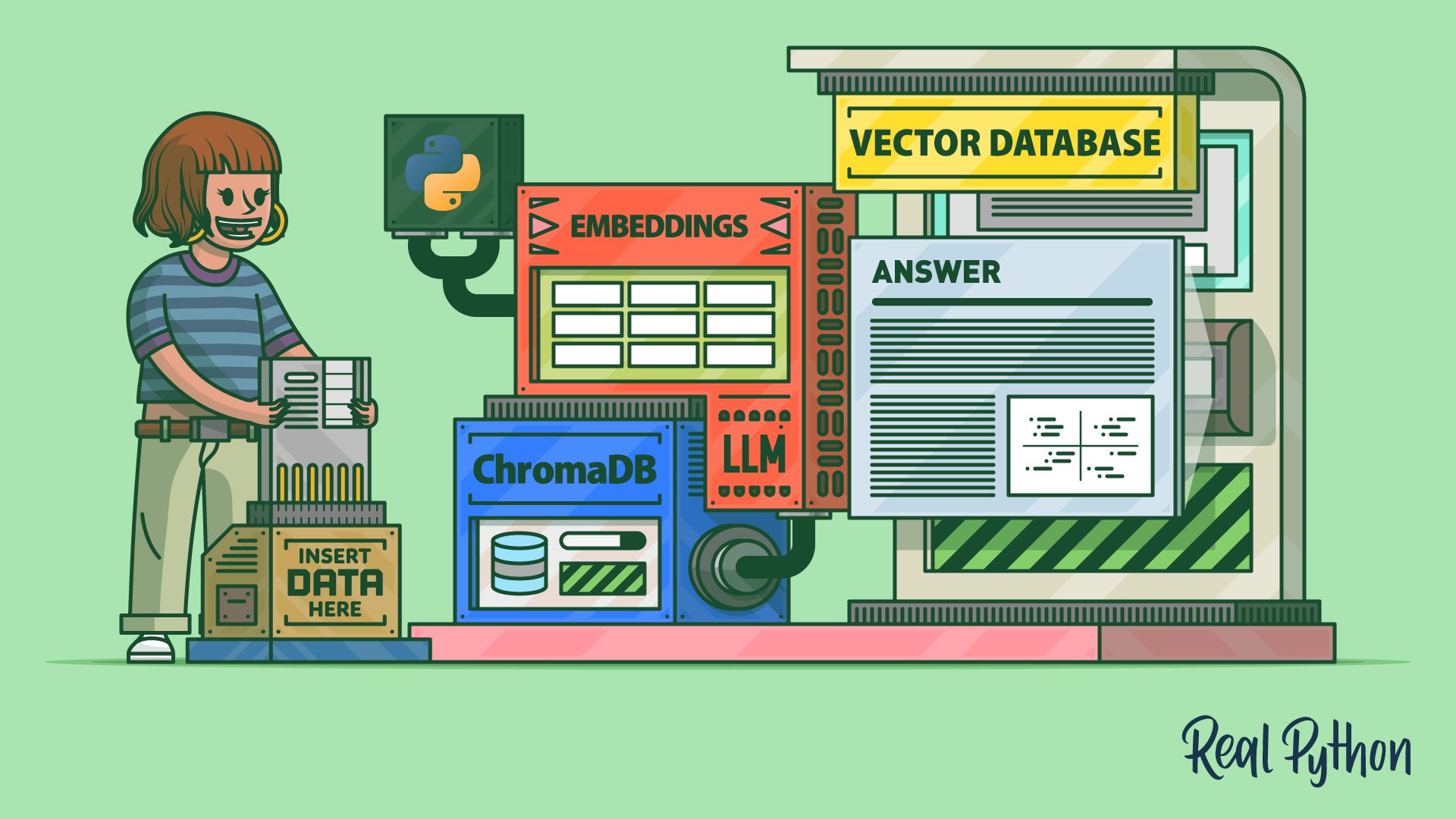
Embeddings and Vector Databases With ChromaDB
Learn how to use ChromaDB, an open-source Python vector database, to store embeddings and run semantic search with hands-on examples.
For additional information on related topics, take a look at the following resources:
- Vector Databases and Embeddings With ChromaDB (Course)
- Build an LLM RAG Chatbot With LangChain (Tutorial)
- LangGraph Tutorial: Build Stateful AI Agents in Python (Tutorial)
- Embeddings and Vector Databases With ChromaDB (Quiz)
- First Steps With LangChain (Course)
- Build an LLM RAG Chatbot With LangChain (Quiz)
- LangGraph: Build Stateful AI Agents in Python (Quiz)
Have a question about this? Mentor AI can show you examples, compare related terms, and point you to tutorials.
Ask Mentor AI

By Leodanis Pozo Ramos • Updated Oct. 6, 2026
