Linux
Linux is a family of free and open source, Unix-like operating systems built around the Linux kernel, which Linus Torvalds first released in 1991.
Strictly speaking, Linux is only the kernel, the core program that manages hardware, memory, file systems, and the preemptive multitasking of running programs. A usable system pairs that kernel with system utilities, libraries, and applications, most of them from the GNU project, which is why the Free Software Foundation calls the combination GNU/Linux.
That full bundle is known as a distribution, or distro. Debian, Ubuntu, Fedora, and Arch are widely used examples, each combining the same kernel with its own selection of software and package manager, all built on the same underlying layers:
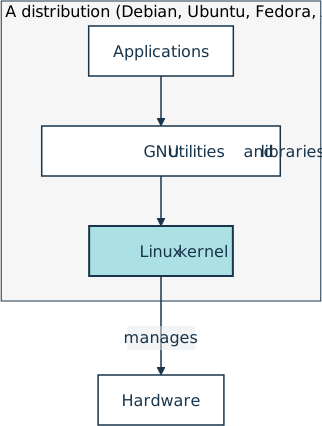
With the kernel released under version 2 of the GNU General Public License and highly portable, Linux dominates large-scale computing, turning up at nearly every tier of modern infrastructure:
- Servers and the cloud: It runs most of the world’s web servers and a large share of the public cloud.
- Supercomputers: Every one of the TOP500 fastest supercomputers runs Linux.
- Mobile and embedded: It forms the base of Android and countless embedded devices, from home routers to cars.
Python ships preinstalled on most distributions, and Linux’s hold on the server room makes it the usual deployment target for production Python code.
Related Resources
Course
Installing Python on Windows, macOS, and Linux
To get started working with Python, you'll need to have access to the Python interpreter. There are several common ways to accomplish this and in this course, you will learn how to install the latest version of Python on your computer.
For additional information on related topics, take a look at the following resources:
- Python 3.12 Preview: Support For the Linux perf Profiler (Tutorial)
- Python Command-Line Arguments (Tutorial)
- Build Command-Line Interfaces With Python's argparse (Tutorial)
- 4 Techniques for Testing Python Command-Line (CLI) Apps (Tutorial)
- Command Line Interfaces in Python (Course)
- Building Command Line Interfaces With argparse (Course)
- Build Command-Line Interfaces With Python's argparse (Quiz)
Have a question about this? Mentor AI can show you examples, compare related terms, and point you to tutorials.
Ask Mentor AI

By Martin Breuss • Updated Aug. 12, 2026
