feature engineering
Feature engineering is the process of transforming raw data into the input variables, called features, that a machine learning model learns from during training. That transformation runs as a pipeline:
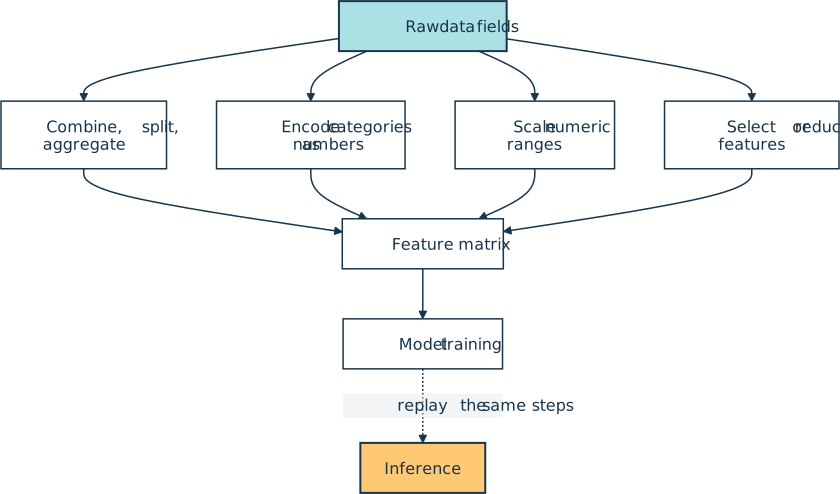
The work combines domain knowledge with iteration over a handful of recurring operations:
- Creating features by combining, decomposing, or aggregating existing fields, such as splitting a timestamp into hour and weekday
- Encoding categorical values and text as numbers that a model can consume
- Scaling numeric ranges so that no single feature dominates the updates made by gradient descent
- Selecting a subset of features, or reducing dimensionality with methods like principal component analysis (PCA), to cut noise and redundancy
Deep neural networks absorb much of this work, learning their own representations such as embeddings from raw text, images, or audio, so hand-built features matter most on tabular and time-series problems.
Recurring pitfalls include data leakage, where a feature encodes information that wouldn’t be available at prediction time, and applying different transformations during training and inference.
Related Resources
Tutorial
Pythonic Data Cleaning With pandas and NumPy
A tutorial to get you started with basic data cleaning techniques in Python using pandas and NumPy.
For additional information on related topics, take a look at the following resources:
- Using pandas and Python to Explore Your Dataset (Tutorial)
- Linear Regression in Python (Tutorial)
- Split Your Dataset With scikit-learn's train_test_split() (Tutorial)
- NumPy, SciPy, and pandas: Correlation With Python (Tutorial)
- Logistic Regression in Python (Tutorial)
- Data Cleaning With pandas and NumPy (Course)
- Explore Your Dataset With pandas (Course)
- Using pandas and Python to Explore Your Dataset (Quiz)
- Starting With Linear Regression in Python (Course)
- Linear Regression in Python (Quiz)
- Splitting Datasets With scikit-learn and train_test_split() (Course)
- Split Your Dataset With scikit-learn's train_test_split() (Quiz)
Have a question about this? Mentor AI can show you examples, compare related terms, and point you to tutorials.
Ask Mentor AI

By Martin Breuss • Updated Sept. 17, 2026
