CRUD
CRUD is an acronym for the four basic operations a program performs on persistent data: create, read, update, and delete. Together they cover the full life cycle of a stored record, from the moment it is added to the moment it is removed.
Each operation has a direct counterpart in the interfaces that manage data, such as the SQL statements of a relational database or the HTTP methods of a RESTful web API:
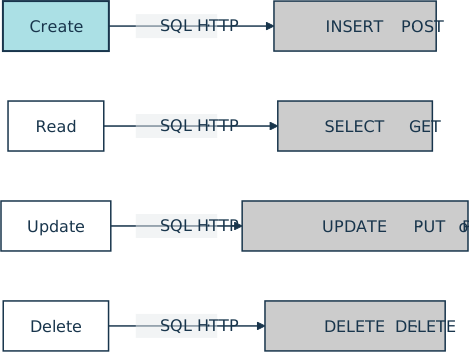
- Create: Adds a new record, as with SQL
INSERTor HTTPPOST. - Read: Retrieves records without changing them, as with
SELECTorGET. - Update: Modifies an existing record, as with
UPDATEorPUTandPATCH. - Delete: Removes a record, as with
DELETEin both SQL and HTTP.
CRUD also works as a checklist for completeness, since a data model that supports all four operations can be fully managed through its interface. The pattern is common enough that many web frameworks generate CRUD scaffolding automatically, and an application built mostly around these operations is often called a CRUD app.
Related Resources

Tutorial
What Are CRUD Operations?
CRUD operations are the cornerstone of application functionality. Whether you access a database or interact with a REST API, you usually want to create, retrieve, update, and delete data. In this tutorial, you'll explore how CRUD operations work in practice.
For additional information on related topics, take a look at the following resources:
- Python and REST APIs: Interacting With Web Services (Tutorial)
- Python REST APIs With Flask, Connexion, and SQLAlchemy – Part 1 (Tutorial)
- Python and MySQL Database: A Practical Introduction (Tutorial)
- Python and MongoDB: Connecting to NoSQL Databases (Tutorial)
- Handling SQL Databases With PyQt: The Basics (Tutorial)
- Understanding CRUD Operations in SQL (Course)
- What Are CRUD Operations? (Quiz)
- Interacting With REST APIs and Python (Course)
- Python and REST APIs: Interacting With Web Services (Quiz)
- MySQL Databases and Python (Course)
Have a question about this? Mentor AI can show you examples, compare related terms, and point you to tutorials.
Ask Mentor AI

By Martin Breuss • Updated July 20, 2026
