AskCodi
AskCodi is an AI coding platform that positions itself as an “AI agency”: you describe an outcome or connect a GitHub repository, and a Codi orchestrator agent plans the work on a task board. It assigns tasks to specialist agents that run in parallel, routes each task to an appropriate model, and returns every change as a pull request on its own branch, gated by the repository’s own checks.
It also runs a browser-based workspace with AskCodi Chat, reusable AskCodi Prompts, custom agents built in a visual agent builder, and the AskCodi UI Builder, along with a marketplace of prompts, skills, and MCP tools.
Rather than shipping its own editor plugins, AskCodi is consumed as an API key inside third-party coding tools such as Continue.dev, Cline, and Zed, among others. Those tools supply the chat-based help and in-editor actions, and Continue.dev alone covers Visual Studio Code and JetBrains IDEs. AskCodi Desktop packages the same orchestration in a native app that now ships for macOS on Apple Silicon and Windows x64. There’s still no Linux build.
AskCodi is also a model provider. Its AI Gateway is a drop-in OpenAI-compatible endpoint at https://api.askcodi.com/v1 that fronts more than two hundred models from vendors such as Anthropic, OpenAI, and Google under a single key, billed against the same balance as Agency runs. The web chat adds per-chat model and key selection, attachable skills and MCP servers, and side-by-side model comparison.
Official website: askcodi.com
Related Resources
Tutorial
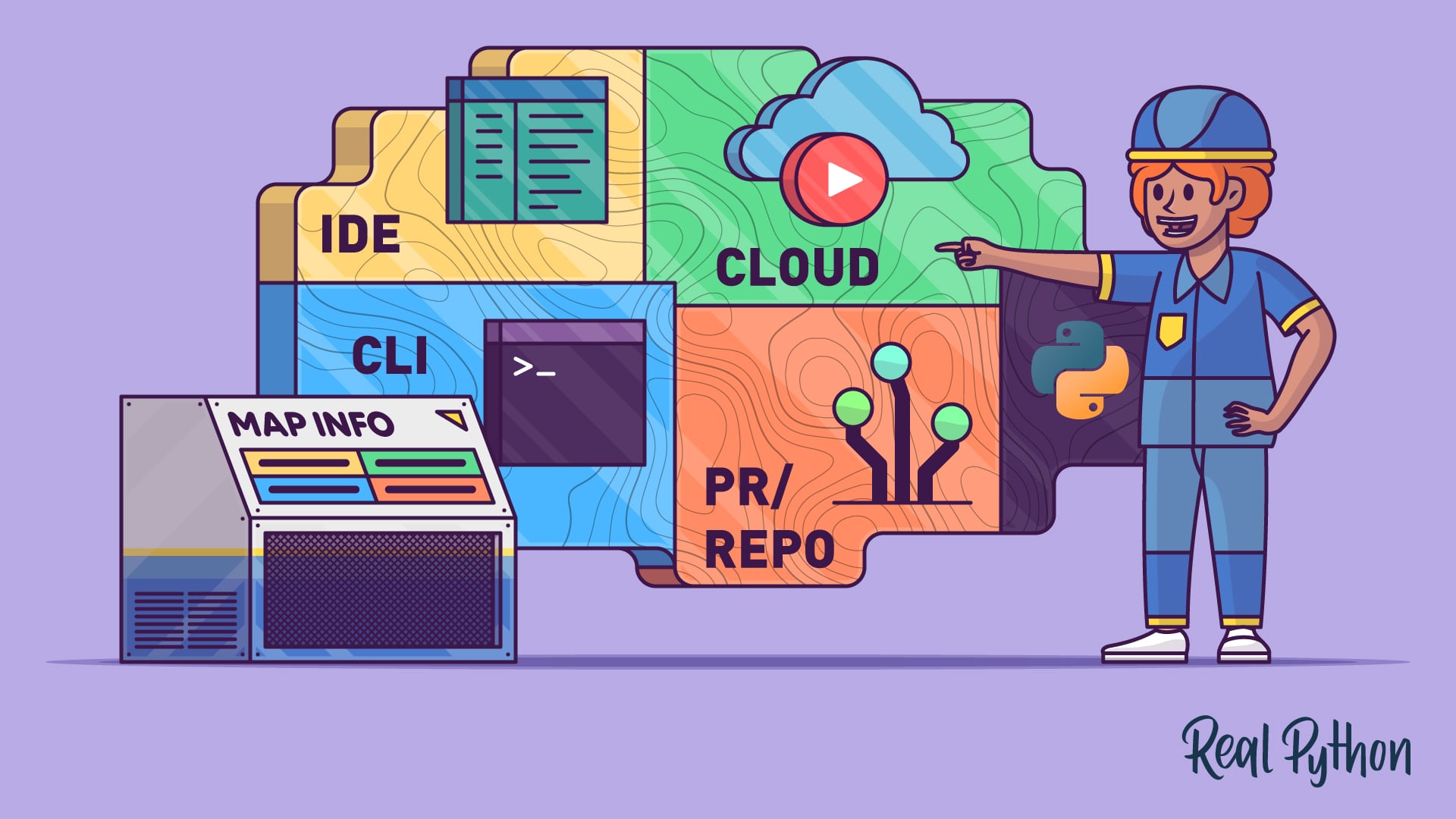
AI Coding Agents Guide: A Map of the Four Workflow Types
AI coding agents come in four types: IDE, terminal, PR, and cloud. Learn how each workflow fits into modern Python development.
For additional information on related topics, take a look at the following resources:
- How to Use OpenCode for AI-Assisted Python Coding (Tutorial)
- How to Use Google's Gemini CLI for AI Code Assistance (Tutorial)
- How to Use Google's Antigravity CLI for AI Code Assistance (Tutorial)
- Python Development in Visual Studio Code (Setup Guide) (Course)
- How to Use the OpenRouter API to Access Multiple AI Models via Python (Tutorial)
- Exploring AI Coding Agent Workflows (Course)
- AI Coding Agents Guide: A Map of the Four Workflow Types (Quiz)
- Coding With OpenCode: AI-Assisted Python (Course)
- How to Use OpenCode for AI-Assisted Python Coding (Quiz)
- Getting Started With Google Gemini CLI (Course)
- How to Use Google's Gemini CLI for AI Code Assistance (Quiz)
- How to Use Google's Antigravity CLI for AI Code Assistance (Quiz)
- Accessing Multiple AI Models With the OpenRouter API (Course)
- How to Use the OpenRouter API to Access Multiple AI Models via Python (Quiz)
Have a question about this? Mentor AI can show you examples, compare related terms, and point you to tutorials.
Ask Mentor AI

