architecture decision record (ADR)
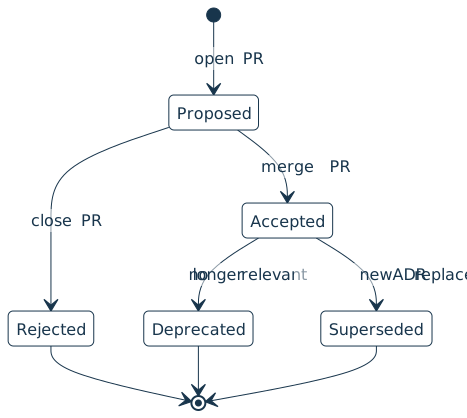
An architecture decision record, or ADR, is a short, dated document that captures a single architecturally significant decision, the context that forced it, and the consequences the team agrees to live with. ADRs are written as the decision is being made, stored in version control next to the code, and moved through a small lifecycle by adding new records that supersede earlier ones:
A typical ADR is one or two pages of Markdown checked in at doc/adr/0007-use-postgres-for-tenant-storage.md. The pull request that adds it is the forum where the decision is debated, amended, and accepted. Common topics include a deliberate piece of technical debt the team intends to revisit, or a security decision surfaced during a threat modeling session.
How It Shows Up in Practice
ADRs surface in a Python project the way any other piece of documentation does: as numbered files in a folder, reviewed through pull requests, and referenced from issues, design docs, and incident postmortems.
The convention popularized by Michael Nygard’s 2011 blog post and codified by Nat Pryce’s adr-tools CLI is to keep each record in doc/adr/. A typical filename looks like 0001-record-architecture-decisions.md, where the leading number is monotonically increasing and the rest is a present-tense imperative phrase.
adr-tools exposes a small set of subcommands that match the way teams actually work with these files:
adr init doc/adr
adr new "Use Postgres for tenant storage"
adr new -s 2 "Switch tenant storage to DynamoDB"
adr list
The -s flag stamps the new record as superseding ADR 2 and updates ADR 2 to point forward. Status moves through a small lifecycle of Proposed, Accepted, Deprecated, and Superseded. Records are never edited to flip a decision. A reversal is a new ADR with a new number, and the old one stays in the repository as the historical answer to “why did we ever do that?”
Because the records are plain Markdown committed beside the code, a single ADR stays short enough to read in a minute:
# 3. Switch tenant storage to DynamoDB

Status: Accepted (supersedes ADR 2)

## Context
Postgres tenant tables are hitting write limits under multi-tenant load,
and the team needs single-digit-millisecond key lookups.

## Decision
We will move tenant storage to DynamoDB with on-demand capacity.

## Consequences
Faster key lookups and less database tuning, at the cost of ad hoc SQL
queries and a new dependency on one cloud provider.
Anatomy of an ADR
Most templates share the same skeleton. Nygard’s original four-section form is the lowest common denominator:
- Title: a numbered, present-tense phrase such as
3. Switch tenant storage to DynamoDB. - Status:
Proposed,Accepted,Deprecated, orSuperseded by ADR N. - Context: the forces at play, written so a new engineer can understand the constraints without asking anyone.
- Decision: the response, stated in active voice, such as “We will…”.
- Consequences: the results the team accepts, both good and bad, including the new problems the decision creates.
Common variations layer extra sections on top. MADR, short for Markdown Architectural Decision Records, adds a Considered Options list with a Pros and Cons of the Options breakdown for each alternative, plus optional Decision Drivers and an explicit Decision Outcome section.
The Y-statement form compresses the whole record into a single sentence: “In the context of X, facing Y, we decided for Z and against W, to achieve Q, accepting R.” AWS Prescriptive Guidance recommends a longer form that keeps Nygard’s skeleton and adds Date, Compliance, and Notes sections, so a record carries an explicit changelog and a checklist of what conformance looks like during code review.
Related Resources

Tutorial
Documenting Python Code: A Complete Guide
A complete guide to documenting Python code. Whether you're documenting a small script or a large project, whether you're a beginner or seasoned Pythonista, this guide will cover everything you need to know.
For additional information on related topics, take a look at the following resources:
- Build Your Python Project Documentation With MkDocs (Tutorial)
- Python Code Quality: Best Practices and Tools (Tutorial)
- Refactoring Python Applications for Simplicity (Tutorial)
- Flask Project Structure: Build a Scalable Web App (Tutorial)
- Documenting Code in Python (Course)
- Documenting Python Code: A Complete Guide (Quiz)
- Building Python Project Documentation With MkDocs (Course)
- Managing and Measuring Python Code Quality (Course)
- Python Code Quality: Best Practices and Tools (Quiz)
- Creating a Scalable Flask Web Application From Scratch (Course)
- Build a Scalable Flask Web Project From Scratch (Quiz)
Have a question about this? Mentor AI can show you examples, compare related terms, and point you to tutorials.
Ask Mentor AI

By Martin Breuss • Updated Aug. 6, 2026
