minimum viable product (MVP)
A minimum viable product, or MVP, is the version of a new product that yields the most learning about real users for the least effort: the smallest thing a team can put in front of customers and still find out whether the idea is worth building further. Its purpose is to answer a concrete question about what customers want as fast as possible, so the next round of effort goes toward something validated rather than assumed.
The term was coined by Frank Robinson in 2001 and later popularized by Steve Blank and Eric Ries. In a 2009 post on his Startup Lessons Learned blog, which he expanded in his 2011 book The Lean Startup, Ries defines an MVP as “that version of a new product which allows a team to collect the maximum amount of validated learning about customers with the least effort.” Despite the name, he stresses, the aim is the speed of that learning, not the smallest possible feature set.
That first release kicks off a build-measure-learn loop, where each turn feeds the next:
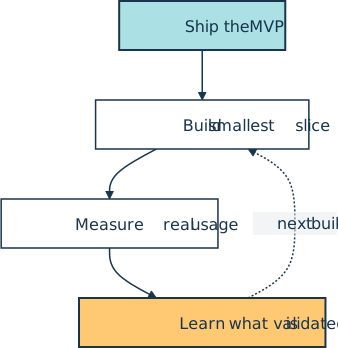
How It Shows Up in Practice
A Python developer meets the MVP idea in sprint planning, where a long backlog of ideas is cut down to the few features that make up a first releasable slice. That cut is the whole skill, because each candidate is kept only if the product still teaches the team something real without it. A backlog often carries that decision as a single split between the must-haves and everything else:
MVP for a project-sharing app
  ship now    email signup, create project, share project link
  defer       single sign-on, team workspaces, dark mode
In code, an MVP is usually a thin prototype that does one thing end to end, such as a single Flask or FastAPI route, a command-line script, or a landing page with a signup form and no backend behind it. It tends to ship as a 0.x release under semantic versioning, where the leading zero signals that the public interface is still unstable.
What counts as viable is fixed ahead of time by the release’s definition of done, so minimum never turns into an excuse to ship something broken.
Common Pitfalls
The most common failure is building too much. A team keeps adding one more feature until a release meant to test an assumption in two weeks takes four months, and the chance to learn early is gone. The opposite failure is shipping something so thin it isn’t viable at all, since a product that crashes or solves nothing teaches the team about its own bugs rather than about its customers.
A subtler trap is treating the MVP as the finished product. The shortcuts that make an MVP fast, such as hard-coded values, a single-file design, and skipped edge cases, are deliberate technical debt that has to be paid down once the idea proves out. The habit that keeps an MVP honest is committing in advance to act on what it measures, whether that means a quick smoke test of demand or a full build-out of the validated feature.
Related Resources
Course
Creating a Scalable Flask Web Application From Scratch
In this video course, you'll explore the process of creating a boilerplate for a Flask web project. It's a great starting point for any scalable Flask web app that you wish to develop in the future, from basic web pages to complex web applications.
For additional information on related topics, take a look at the following resources:
- Python Web Applications: Deploy Your Script as a Flask App (Tutorial)
- A Close Look at a FastAPI Example Application (Tutorial)
- Using Google Login With Flask (Course)
- Deploy Your Python Script on the Web With Flask (Course)
- Python Web Applications: Deploy Your Script as a Flask App (Quiz)
- Python REST APIs With FastAPI (Course)
- A Close Look at a FastAPI Example Application (Quiz)
Have a question about this? Mentor AI can show you examples, compare related terms, and point you to tutorials.
Ask Mentor AI

By Martin Breuss • Updated Aug. 23, 2026
