operator
The Python operator module provides functions that correspond to the Python operators. This module allows you to use operators as functions, which can be especially useful when combined with higher-order functions, such as map(), filter(), and reduce().
Here’s a quick example:
>>> import operator

>>> operator.add(1, 2)
3
Key Features
Frequently Used Classes and Functions
| Object | Type | Description |
|---|---|---|
operator.add() |
Function | Adds two numbers |
operator.sub() |
Function | Subtracts the second number from the first |
operator.itemgetter() |
Function | Returns a callable that fetches an item from its operand |
operator.attrgetter() |
Function | Returns a callable that fetches an attribute from its operand |
operator.methodcaller() |
Function | Returns a callable that calls a method on its operand |
Examples
Using the operator.sub() function:
>>> import operator

>>> operator.sub(4, 5)
-1
Using operator.itemgetter() to extract elements by index:
>>> import operator

>>> data = [(2, "b"), (1, "a"), (3, "c")]
>>> sorted(data, key=operator.itemgetter(1))
[(1, 'a'), (2, 'b'), (3, 'c')]
Common Use Cases
- Replacing
lambdafunctions with more readable operator functions - Using
itemgetter()andattrgetter()for sorting and key extraction - Performing functional programming operations in a concise manner
Real-World Example
Suppose you have a list of tuples representing students’ grades, and you want to sort them by their scores:
>>> import operator

>>> students = [("John", 88), ("Jane", 92), ("Dave", 85)]
>>> sorted(students, key=operator.itemgetter(1), reverse=True)
[('Jane', 92), ('John', 88), ('Dave', 85)]
In this example, you use operator.itemgetter() to sort a list of tuples by the second element, providing a clear and efficient solution.
Related Resources
Tutorial
Operators and Expressions in Python
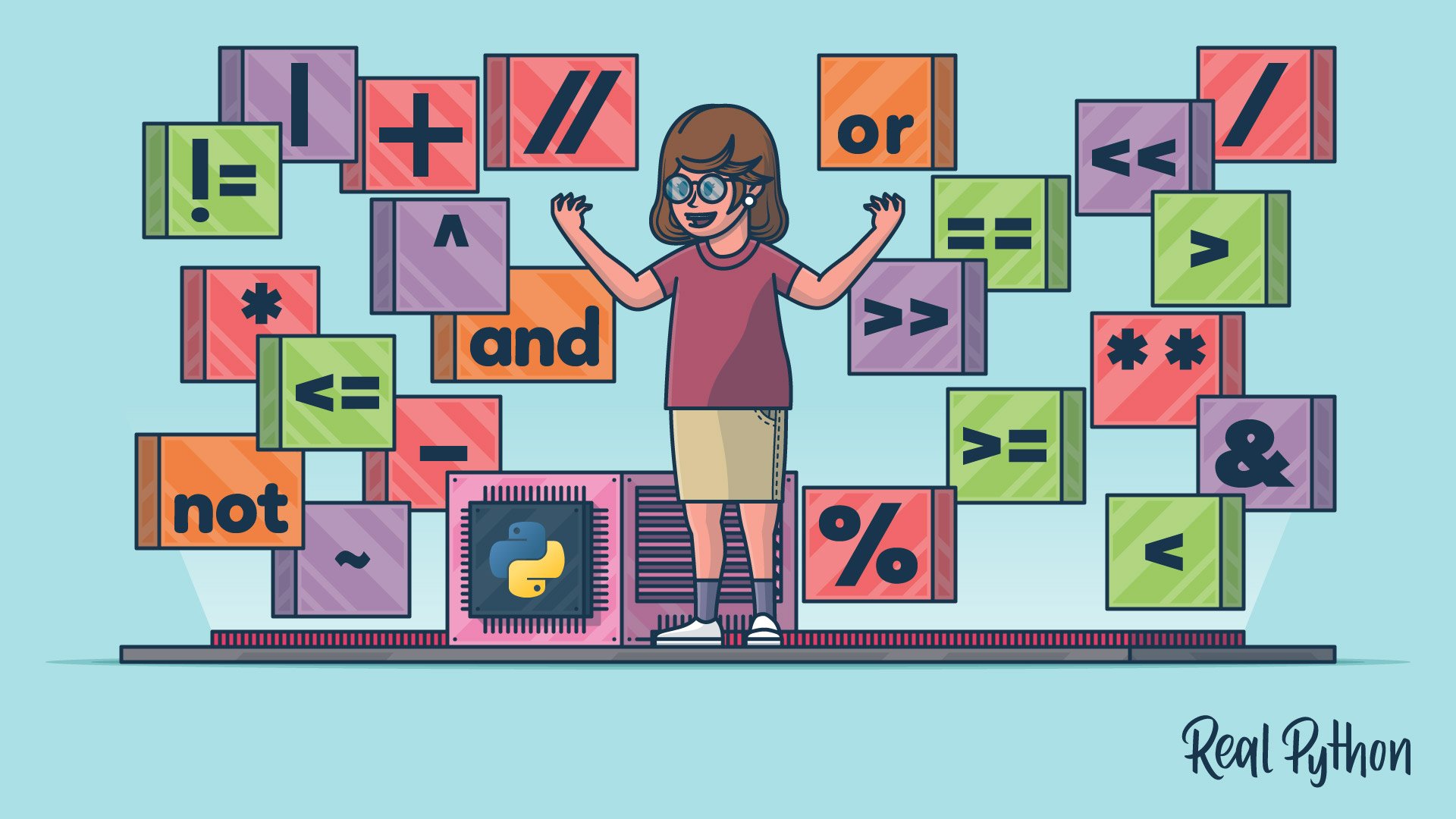
In Python, operators are special symbols, combinations of symbols, or keywords that designate some type of computation. You can combine objects and operators to build expressions that perform the actual computation. So, operators are the building blocks of expressions.
For additional information on related topics, take a look at the following resources:
- Functional Programming in Python: When and How to Use It (Tutorial)
- Python Operators and Expressions (Course)
- Working With the Python operator Module (Tutorial)
- Python's map(): Processing Iterables Without a Loop (Tutorial)
- Python's filter(): Extract Values From Iterables (Tutorial)
- Python's reduce(): From Functional to Pythonic Style (Tutorial)
- How to Use Python Lambda Functions (Tutorial)
- Operators and Expressions in Python (Quiz)
- Using Functional Programming in Python (Course)
- Functional Programming in Python: When and How to Use It (Quiz)
- Python's map() Function: Transforming Iterables (Course)
- Filtering Iterables With Python (Course)
- Using Python Lambda Functions (Course)
- Python Lambda Functions (Quiz)
Have a question about this? Mentor AI can show you examples, compare related terms, and point you to tutorials.
Ask Mentor AI

By Leodanis Pozo Ramos • Updated Oct. 15, 2026