entity-relationship diagram (ERD)
An entity-relationship diagram (ERD) is a visual model of a database’s structure that shows the kinds of things a system stores data about, the details recorded for each, and how those things relate to one another.
The diagram has three building blocks. An entity is a distinct kind of thing, such as a customer or an order, and usually becomes a table once the design turns into a SQL schema. Attributes are the properties an entity records, such as a name or a date. A relationship is a named association between entities, such as a customer placing an order.
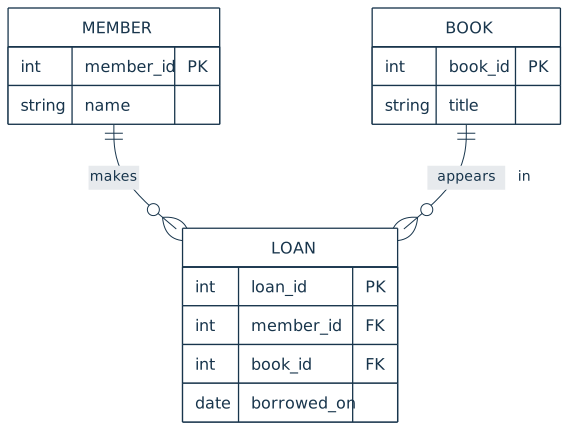
Each relationship also carries a cardinality, which states how many instances on one side can connect to instances on the other. The basic cases are one-to-one, one-to-many, and many-to-many. In a library model, a member borrows many books, and a book passes through many members’ hands over time. A relational schema resolves that many-to-many link with a junction table, here a loan table holding one row per borrowing:
Several notations draw the same model in different ways:
- Chen notation: Shows entities as rectangles, relationships as diamonds, and attributes as ovals.
- Crow’s foot notation: Draws relationships as plain lines whose ends mark cardinality, with a three-pronged fork standing for “many”.
- UML class diagrams: Reuse the class boxes of the Unified Modeling Language, list attributes inside each box, and write multiplicities such as
1and0..*on the lines.
Peter Chen introduced the entity-relationship model in a 1976 paper as a way to describe data independently of how a database stores it. Gordon Everest proposed the crow’s foot symbol the same year. ERDs remain a standard step in database design, and an object-relational mapper expresses the same entities and relationships as classes.
Related Resources
Tutorial
Data Management With Python, SQLite, and SQLAlchemy
Store and retrieve data with Python, SQLite, and SQLAlchemy. You'll compare flat files with SQL and work with your data as Python objects.
For additional information on related topics, take a look at the following resources:
- Introduction to Python SQL Libraries (Tutorial)
- SQLite and SQLAlchemy in Python: Move Your Data Beyond Flat Files (Course)
- Python REST APIs With Flask, Connexion, and SQLAlchemy – Part 3 (Tutorial)
- Handling SQL Databases With PyQt: The Basics (Tutorial)
- Data Management With Python, SQLite, and SQLAlchemy (Quiz)
- Introduction to Python SQL Libraries (Quiz)
Have a question about this? Mentor AI can show you examples, compare related terms, and point you to tutorials.
Ask Mentor AI

By Martin Breuss • Updated Nov. 10, 2026
