Amazon Bedrock
Amazon Bedrock is a fully managed Amazon Web Services (AWS) platform for building generative AI applications and agents on foundation models from many providers. A single serverless API reaches models from Amazon, Anthropic, DeepSeek, Google, Meta, Mistral AI, and OpenAI, among more than a dozen providers in the catalog.
Python developers call Bedrock through boto3, the AWS SDK for Python. Its bedrock-runtime client provides converse(), whose request shape stays the same across model providers, and invoke_model(), which passes a model’s native payload straight through. Bedrock also serves Anthropic Messages and OpenAI Responses surfaces, so code written for those clients reaches Bedrock models too. The path from a Python call to a model looks like this:
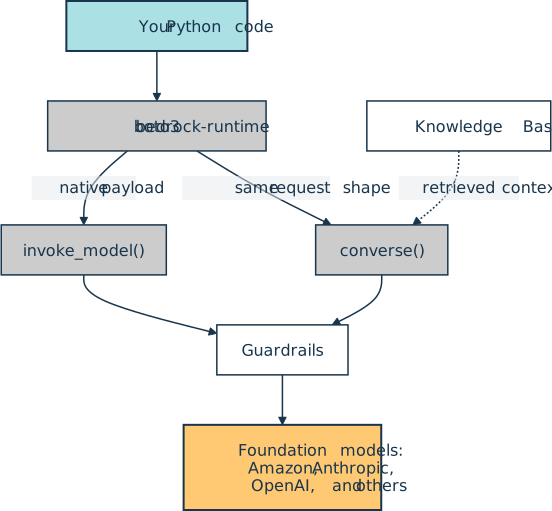
Beyond plain inference, Bedrock adds Knowledge Bases for retrieval-augmented generation, Guardrails for filtering harmful content and masking sensitive information, and customization by fine-tuning or distillation. Bedrock AgentCore hosts agents built with open-source frameworks, including CrewAI, LangGraph, LlamaIndex, the OpenAI Agents SDK, and Strands Agents.
On-demand usage bills per token, and batch inference runs asynchronous jobs at half that price on supported models. Provisioned Throughput reserves capacity by the hour with no commitment, or at a lower rate under a one-month or six-month term.
Competing managed platforms cover the same ground: Google’s Vertex AI and Microsoft’s Azure AI Foundry front many providers’ models on their own clouds, and OpenRouter routes to them without a cloud account at all. Calling a model provider’s own API directly stays simpler when a single model covers the job.
Official website: aws.amazon.com/bedrock
Related Resources
Course
Leverage OpenAI's API in Your Python Projects
Learn how to use the ChatGPT API with Python's openai library to send prompts, control AI behavior with roles, and get structured outputs.
For additional information on related topics, take a look at the following resources:
- Python, Boto3, and AWS S3: Demystified (Tutorial)
- Build an LLM RAG Chatbot With LangChain (Tutorial)
- Prompt Engineering: A Practical Example (Tutorial)
- Pydantic AI: Build Type-Safe LLM Agents in Python (Tutorial)
- CrewAI in Python: Coordinating Teams of AI Agents (Tutorial)
- Demystifying Python, Boto3, and AWS S3 (Course)
- Python, Boto3, and AWS S3: Demystified (Quiz)
- First Steps With LangChain (Course)
- Build an LLM RAG Chatbot With LangChain (Quiz)
- Practical Prompt Engineering (Quiz)
- Building Type-Safe LLM Agents With Pydantic AI (Course)
- Pydantic AI: Build Type-Safe LLM Agents in Python (Quiz)
- CrewAI in Python: Coordinating Teams of AI Agents (Quiz)
Have a question about this? Mentor AI can show you examples, compare related terms, and point you to tutorials.
Ask Mentor AI

By Martin Breuss • Updated Sept. 13, 2026