GPT-Engineer
GPT-Engineer is an archived open-source command-line agent that generates a whole codebase from a natural-language specification and then revises it on request. Anton Osika started the project in 2023, and its repository has since collected more than 55,000 GitHub stars.
Written in Python and installed from PyPI with python -m pip install gpt-engineer, it runs on Python 3.10 through 3.12. A project is a folder holding a file named prompt that describes the software in prose. Running gpte <project_dir> writes the code, and the -i flag switches to improve mode, which edits an existing codebase instead of starting fresh. Both modes read and write the same folder:

GPT-Engineer calls OpenAI models by default, and it can also target Azure OpenAI, Anthropic, or locally hosted open models. Custom preprompts override the agent’s built-in instructions, and a bundled bench command scores alternative agent implementations against the APPS and MBPP datasets.
The repository was archived in April 2026, and version 0.3.1 from June 2024 is the final release. Its commercial successor became Lovable.
Official website: github.com/AntonOsika/gpt-engineer
Related Resources
Tutorial
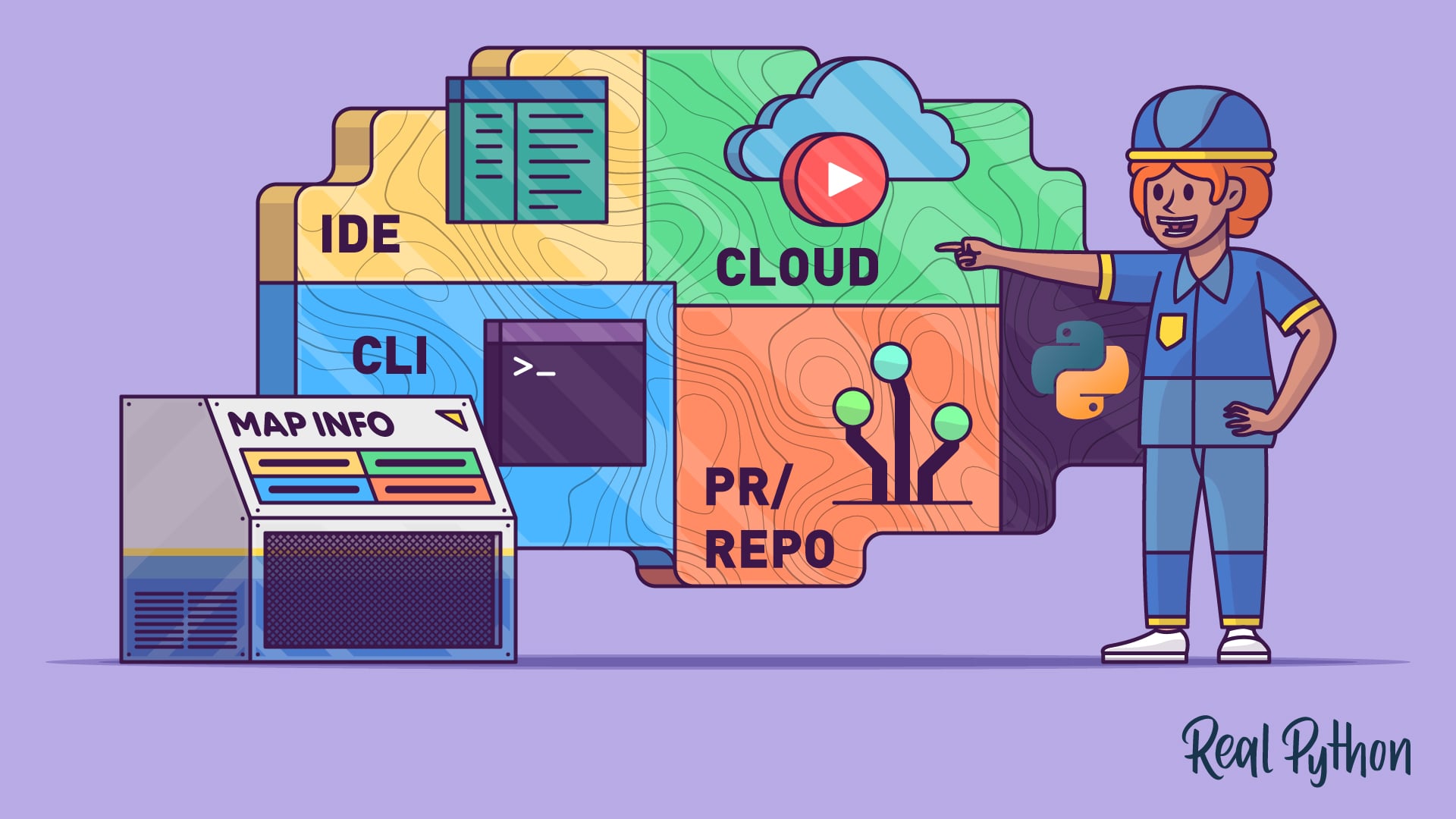
AI Coding Agents Guide: A Map of the Four Workflow Types
AI coding agents come in four types: IDE, terminal, PR, and cloud. Learn how each workflow fits into modern Python development.
For additional information on related topics, take a look at the following resources:
- How to Use Google's Gemini CLI for AI Code Assistance (Tutorial)
- How to Use OpenCode for AI-Assisted Python Coding (Tutorial)
- How to Use Google's Antigravity CLI for AI Code Assistance (Tutorial)
- Use ChatGPT to Learn Python Programming (Tutorial)
- Prompt Engineering: A Practical Example (Tutorial)
- Document Your Python Code and Projects With ChatGPT (Tutorial)
- AI Coding Agents Guide: A Map of the Four Workflow Types (Quiz)
- Getting Started With Google Gemini CLI (Course)
- How to Use Google's Gemini CLI for AI Code Assistance (Quiz)
- Coding With OpenCode: AI-Assisted Python (Course)
- How to Use OpenCode for AI-Assisted Python Coding (Quiz)
- How to Use Google's Antigravity CLI for AI Code Assistance (Quiz)
- Practical Prompt Engineering (Quiz)
Have a question about this? Mentor AI can show you examples, compare related terms, and point you to tutorials.
Ask Mentor AI

By Martin Breuss • Updated Oct. 14, 2026