agile
Agile is an approach to software development that delivers work in short, repeated cycles and treats changing requirements as normal rather than as a failure of planning. The name comes from the Agile Manifesto, a 2001 document in which seventeen developers set out four values that favor working software and close collaboration over heavy process and documentation.
In the manifesto’s own words, the four values each prize one thing over another:
- Individuals and interactions over processes and tools
- Working software over comprehensive documentation
- Customer collaboration over contract negotiation
- Responding to change over following a plan
The manifesto grants that the items on the right still have value, but an agile team weights the items on the left more heavily. Twelve supporting principles draw out the consequences, from delivering working software frequently, on a timescale of a couple of weeks to a couple of months with a preference for the shorter one, to having the team reflect and adjust its habits at regular intervals.
How It Shows Up in Practice
A Python developer rarely meets agile as an abstraction. It arrives as the way a team organizes its work: short iterations, a shared backlog of user stories, a daily standup, and a review and retrospective at the close of each cycle, all tracked on a board in a tool such as Jira, Linear, or GitHub Projects. A single iteration, usually called a sprint, runs the same loop every time:
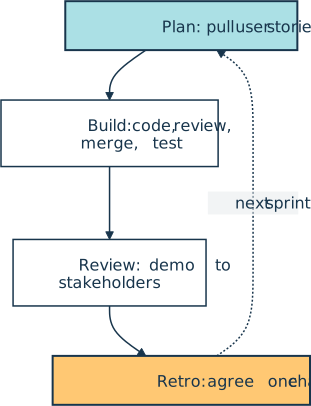
two-week sprint
  plan    ->  pull user stories from the backlog
  build   ->  code, review, merge, and test each day
  review  ->  demo working software to stakeholders
  retro   ->  agree on one process change for next time
  repeat
The vocabulary of that loop fills much of this area. The size of a backlog item is estimated in story points, an item counts as finished only when it satisfies the team’s definition of done, and a first release is often scoped down to a minimum viable product. “Comfortable working in an agile environment” is also one of the most common lines in a Python job posting, which is the other reason the word is worth pinning down.
Agile vs. Waterfall
Agile is usually defined against waterfall, the older model it reacted to. A waterfall project moves once through a fixed sequence of phases. It gathers every requirement up front, then designs, builds, and tests in turn, so working software appears only near the end.
Agile replaces that single long pass with many short ones, assuming from the start that requirements will change and shipping something usable early so real feedback can steer the next cycle.
Neither model is automatically correct. Waterfall can suit work with fixed, well-understood requirements and a hard regulatory sign-off, while agile fits the more common case where a team discovers what to build by building it. Agile is a philosophy rather than a procedure, though, so teams adopt a named framework to put it into practice. The two most common, Scrum and Kanban, turn these values into concrete roles, events, and artifacts.
Related Resources

Tutorial
Continuous Integration and Deployment for Python With GitHub Actions
With most software following agile methodologies, it's essential to have robust DevOps systems in place to manage, maintain, and automate common tasks with a continually changing codebase. By using GitHub Actions, you can automate your workflows efficiently, especially for Python projects.
For additional information on related topics, take a look at the following resources:
- Test-Driven Development With pytest (Course)
- Continuous Integration With Python: An Introduction (Tutorial)
- Continuous Integration With Python (Course)
- Python Continuous Integration and Deployment Using GitHub Actions (Course)
- GitHub Actions for Python (Quiz)
- Continuous Integration With Python: An Introduction (Quiz)
Have a question about this? Mentor AI can show you examples, compare related terms, and point you to tutorials.
Ask Mentor AI

By Martin Breuss • Updated Aug. 21, 2026