Qodo
Qodo is an AI code review and governance platform that examines pull requests against an entire repository, flagging defects and standards violations before a change merges.
Founded in 2022 as CodiumAI and renamed Qodo in 2024, the company started with automated test generation and now centers on review. Each review runs specialized agents in parallel to flag bugs, rule violations, requirement gaps, and breaking changes that affect other repositories. A judge agent then merges their findings, drops duplicates, and filters low-confidence issues before posting one comment on the pull request:
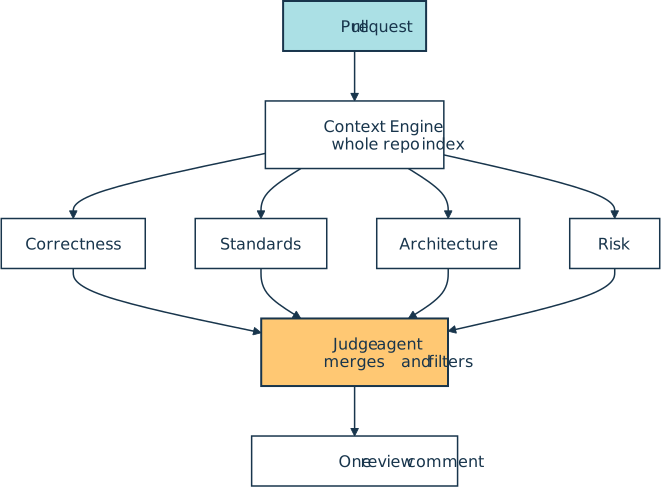
Its Context Engine indexes connected repositories rather than the diff alone, so a review can flag a change that breaks a data model or API contract owned by another repository. Qodo connects to GitHub, GitLab, Bitbucket, Azure DevOps, and Gerrit, and its plugin runs the same checks inside Visual Studio Code and JetBrains IDEs such as PyCharm.
Peer tools include CodeRabbit, Greptile, and GitHub’s own Copilot code review. They differ mainly in how much repository context they read and in whether they support hosts beyond GitHub.
Qodo itself is a paid commercial platform, offered as a cloud service or, on enterprise plans, as an on-premises deployment. Python teams have a free alternative in PR-Agent, the open-source reviewer Qodo built and handed over to community maintainers in 2026. It’s written in Python and installs with python -m pip install pr-agent.
Official website: qodo.ai
Related Resources
Tutorial
How to Use GitHub Copilot Code Review in Pull Requests
Learn how to use GitHub Copilot code review on pull requests for AI-assisted feedback, one-click fixes, and project-specific custom instructions.
For additional information on related topics, take a look at the following resources:
- How to Review AI-Generated Python Code Efficiently (Tutorial)
- Python Code Quality: Best Practices and Tools (Tutorial)
- Managing and Measuring Python Code Quality (Course)
- PyCharm for Productive Python Development (Guide) (Tutorial)
- How to Use OpenCode for AI-Assisted Python Coding (Tutorial)
- How to Use Google's Gemini CLI for AI Code Assistance (Tutorial)
- How to Use GitHub Copilot Code Review in Pull Requests (Quiz)
- How to Review AI-Generated Python Code Efficiently (Quiz)
- Python Code Quality: Best Practices and Tools (Quiz)
- Coding With OpenCode: AI-Assisted Python (Course)
- How to Use OpenCode for AI-Assisted Python Coding (Quiz)
- Getting Started With Google Gemini CLI (Course)
- How to Use Google's Gemini CLI for AI Code Assistance (Quiz)
Have a question about this? Mentor AI can show you examples, compare related terms, and point you to tutorials.
Ask Mentor AI

By Martin Breuss • Updated Oct. 8, 2026
