Haystack
Haystack is an open-source Python framework for building applications on top of large language models (LLMs), from retrieval pipelines to tool-using agents. The framework is maintained by deepset, a Berlin-based company founded in 2018, and released under the Apache 2.0 license.
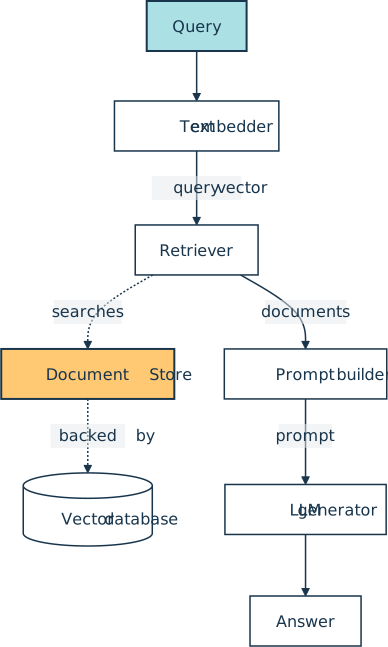
Haystack centers on components and pipelines. A component does one job, such as embedding text, retrieving documents, or prompting an LLM, and a pipeline wires components into an explicit graph that defines how data flows.
Document Stores connect the retrieval side to vector databases such as Weaviate, Pinecone, and Elasticsearch, which makes Haystack a common choice for retrieval-augmented generation (RAG), semantic search, and multimodal applications. A RAG pipeline wires those pieces into one graph:
An Agent abstraction pairs a chat model with tools for autonomous, multi-step workflows. Haystack stays vendor-agnostic, with integrations for OpenAI, Anthropic, Google, Hugging Face, and Amazon Bedrock, along with locally hosted models. Python developers install it from PyPI as haystack-ai, which needs Python 3.10 or later.
Haystack competes with other Python LLM frameworks. LlamaIndex and LangChain cover similar retrieval and agent ground, while Pydantic AI concentrates on type-safe agent definitions. Haystack orchestrates components rather than serving models or storing data itself, so you supply your own provider credentials and point Document Stores at a backend such as Weaviate or Elasticsearch. An in-memory store ships with the framework for prototyping.
Version 3.0, released in July 2026, targeted production agents with hooks around the agent loop, built-in state such as step counts and token usage, first-class skills, and ready-made agents for tasks like deep research. deepset also builds paid products on top of the framework, including the Haystack Enterprise Platform, whose free trial includes a visual, code-aligned editor for designing pipelines.
Official website: haystack.deepset.ai
Related Resources
Tutorial
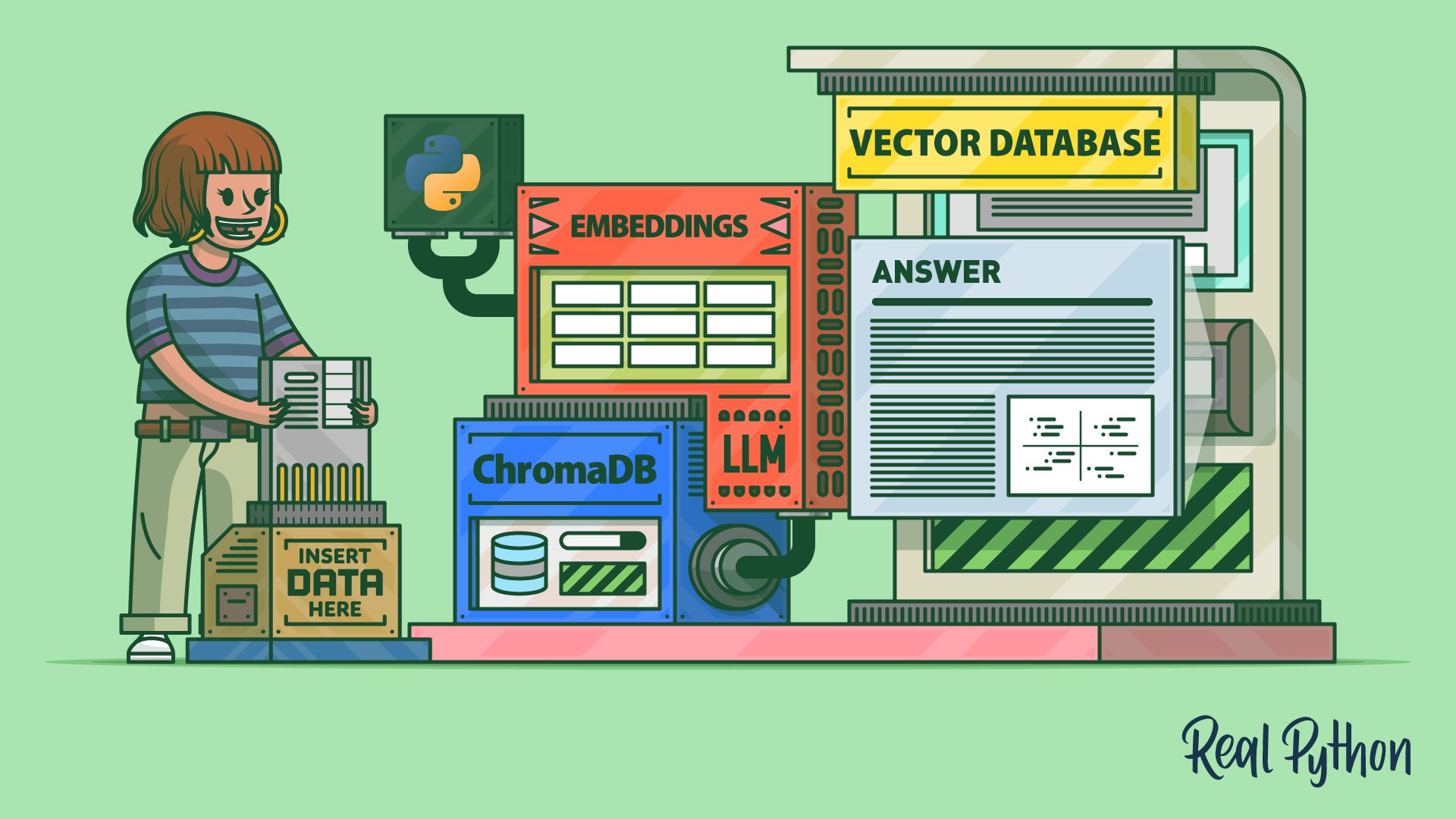
Embeddings and Vector Databases With ChromaDB
Learn how to use ChromaDB, an open-source Python vector database, to store embeddings and run semantic search with hands-on examples.
For additional information on related topics, take a look at the following resources:
- Hugging Face Transformers: Leverage Open-Source AI in Python (Tutorial)
- LangGraph Tutorial: Build Stateful AI Agents in Python (Tutorial)
- Pydantic AI: Build Type-Safe LLM Agents in Python (Tutorial)
- CrewAI in Python: Coordinating Teams of AI Agents (Tutorial)
- AI Coding Agents Guide: A Map of the Four Workflow Types (Tutorial)
- Vector Databases and Embeddings With ChromaDB (Course)
- Building Type-Safe LLM Agents With Pydantic AI (Course)
- Embeddings and Vector Databases With ChromaDB (Quiz)
- Hugging Face Transformers: Leverage Open-Source AI in Python (Quiz)
- Building an AI Agent With LangGraph and Python (Course)
- LangGraph: Build Stateful AI Agents in Python (Quiz)
- Pydantic AI: Build Type-Safe LLM Agents in Python (Quiz)
- CrewAI in Python: Coordinating Teams of AI Agents (Quiz)
- AI Coding Agents Guide: A Map of the Four Workflow Types (Quiz)
Have a question about this? Mentor AI can show you examples, compare related terms, and point you to tutorials.
Ask Mentor AI

By Martin Breuss • Updated Oct. 15, 2026
