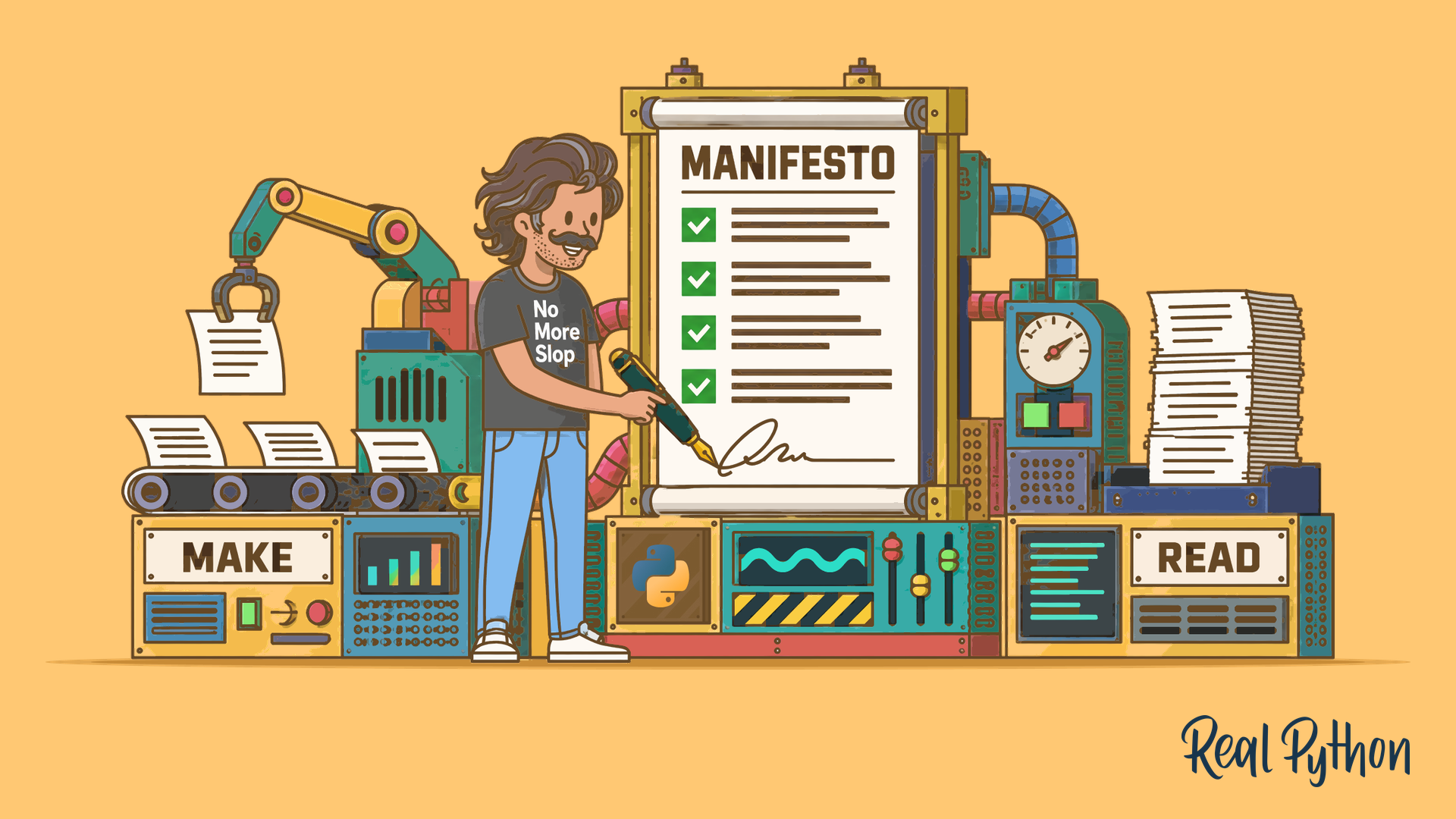
The No AI Slop Manifesto is a short statement from the speakers and attendees of the AIE Code Summit 2026. It defines AI slop and commits everyone who signs it to owning the work they ship with AI.
Here, you’ll find out what it says, why it appeared right now, and what it means for your own AI-assisted code.
By the end of this tutorial, you’ll understand that:
- Slop is work that took less effort to produce than it asks its reader to spend understanding it.
- The manifesto argues that AI makes producing code nearly free, while reviewing it costs as much as ever.
- AI-generated code turns into slop when someone passes it on without taking responsibility for it.
- A linter flags risky patterns, but some silent bugs only show up in tests.
- Critics question the effort-based definition and doubt the manifesto can beat business incentives.
To go deeper afterward, read How to Review AI-Generated Python Code Efficiently and How to Write a CLAUDE.md File for Claude Code, which put these ideas into practice.
Join our Claude Code live course and put these ideas to work with a real coding agent. The host will be Philipp Acsany, answering all your AI questions live.
What Is the No AI Slop Manifesto?
The No AI Slop Manifesto is a statement of values written at the AIE Code Summit 2026, a conference for builders of coding agents held from November 10 to 12 in San Francisco.
Note: You can read the full manifesto on slopmanifesto.com.
Dex Horthy announced it from the main stage on November 12, at the end of his talk A Software Factory Needs Pressure in Both Directions. The signing GitHub gist lives on his account.
Five Values, Nine Beliefs, and Twelve Resolutions
The manifesto’s opening recalls the 2001 meeting in Snowbird, Utah, that produced the Agile Manifesto and its “four values and twelve principles”:
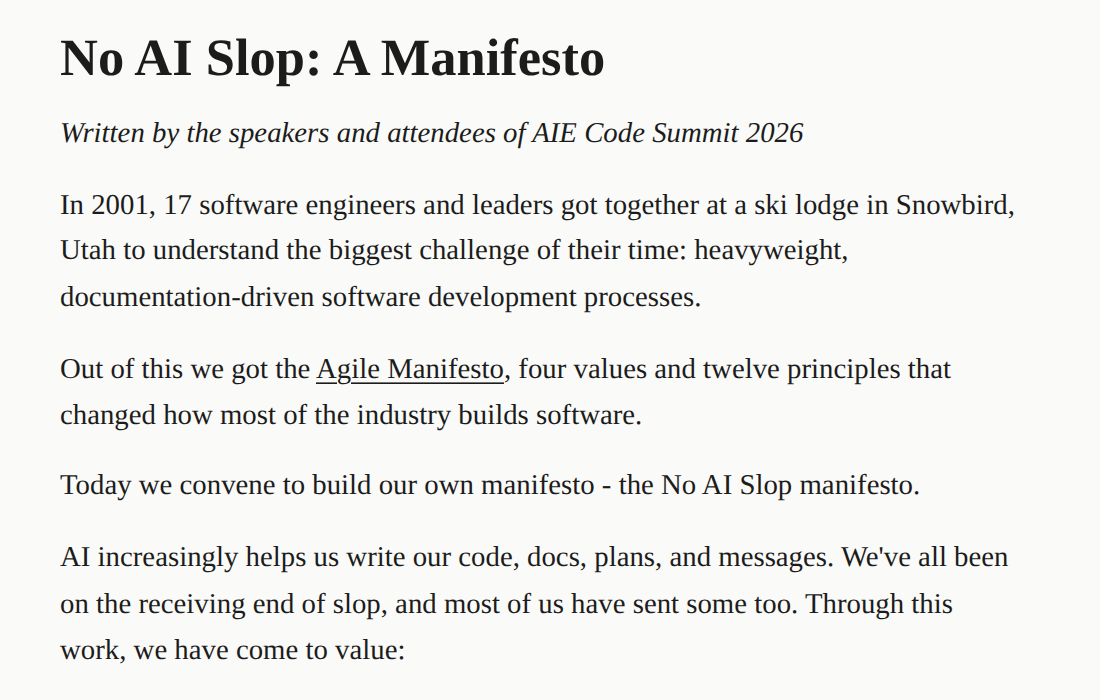
The No AI Slop Manifesto copies that shape. It has five values, nine beliefs about what’s going wrong, twelve resolutions for how signers will work, and a short closing line. Like Agile’s, its values prefer one thing over another:
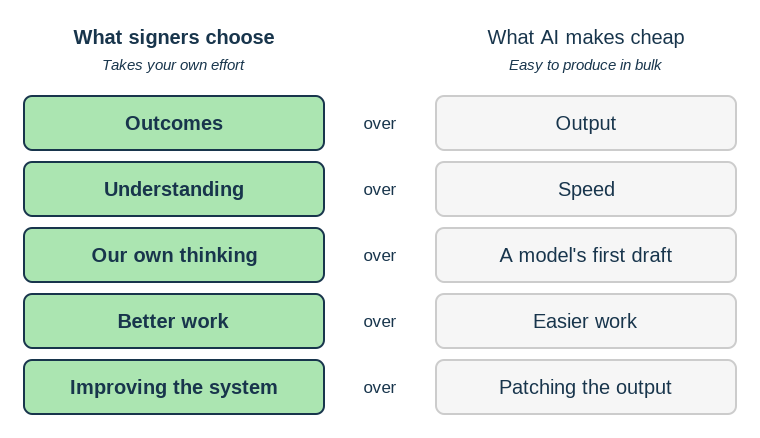
Each right-hand item comes cheap with AI. The left-hand items take effort, and the signers commit to that side.
How It Defines Slop
The second belief defines the term the rest of the document builds on:
“Slop is when we put less effort into producing something than we ask the consumer to spend understanding it.” (Source)
The manifesto adds that “Using AI doesn’t necessarily make something slop. Slop happens when we pass AI output along without taking responsibility for the quality or the reader’s experience.”
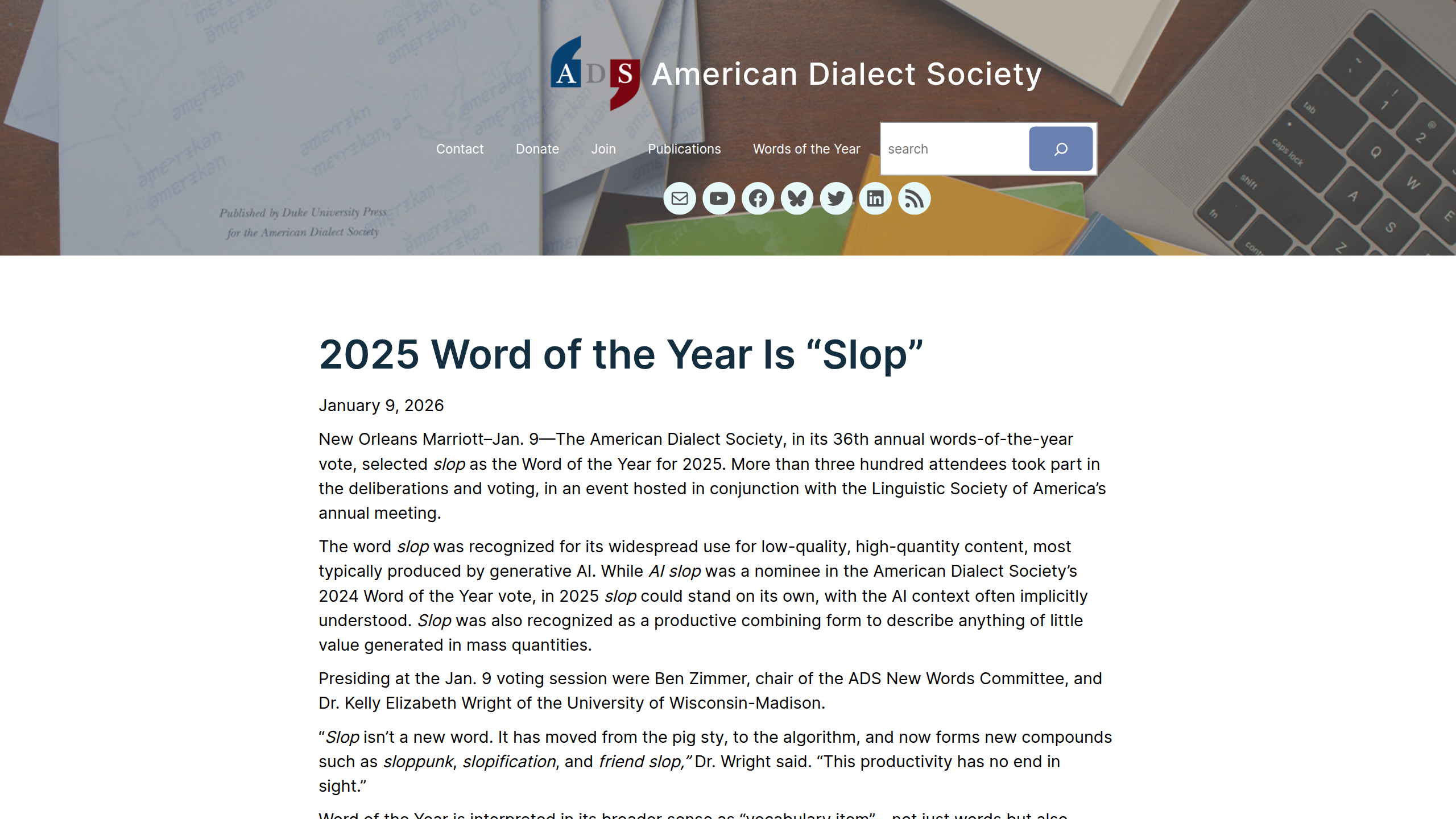
That’s narrower than the everyday sense of the word. When the American Dialect Society picked slop as its word of the year, it pointed to quantity and low quality:
The manifesto doesn’t count how much you make. Instead, it asks who pays to understand it.
Think of forwarding a long email thread that you haven’t read, with one word on top: “Thoughts?” Sending it takes you two seconds, and reading it takes your colleague twenty minutes. Passing that gap on unread is what makes it slop, whoever wrote the thread.
The same idea keeps slop apart from vibe coding, where you accept AI-generated code without reviewing it. One resolution calls vibe coding a “high leverage” tool and says slop “is bad when it undermines our outcome.”
Note: A vibe-coded prototype that only you run can be fine, but the same code becomes slop once a teammate has to maintain it. Agentic engineering describes a more disciplined way to work with an agent.
If you want to get a better understanding of what AI slop is and how you can spot it, then you can read Tejas Kumar’s Please Stop the Slop blog post.
Why the Slop Manifesto Appeared in 2026
Low-quality work is nothing new, but AI changed what it costs to make. Here’s what pushed the document out that November, and what it means for you as a learner. In short, one side of the work got cheap, and the other didn’t.
Making Work Got Cheaper Than Reviewing It
The document blames an imbalance between producing work and checking it. A PR, or pull request, is a set of code changes submitted for review:
“Slop is asymmetric. The cost of producing a thousand-line PR or a ten-page doc is approaching zero, while the cost of reviewing it remains constant.”
Put side by side, the two costs used to be roughly in balance. AI shrank only one of them:
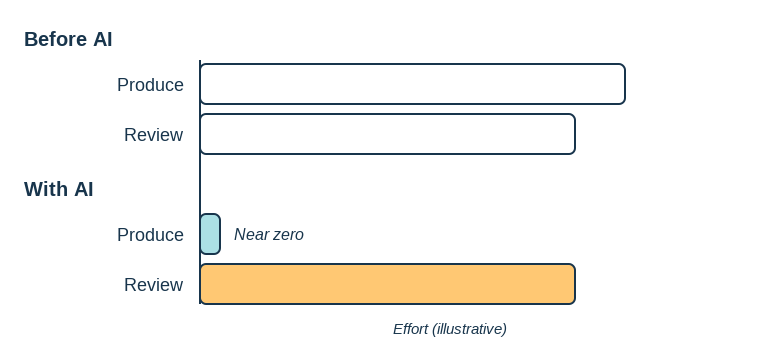
The first belief adds that “a swarm of agents can produce more work in a single day than a person can review in our lifetime.” Two events before the summit showed the problem in public:
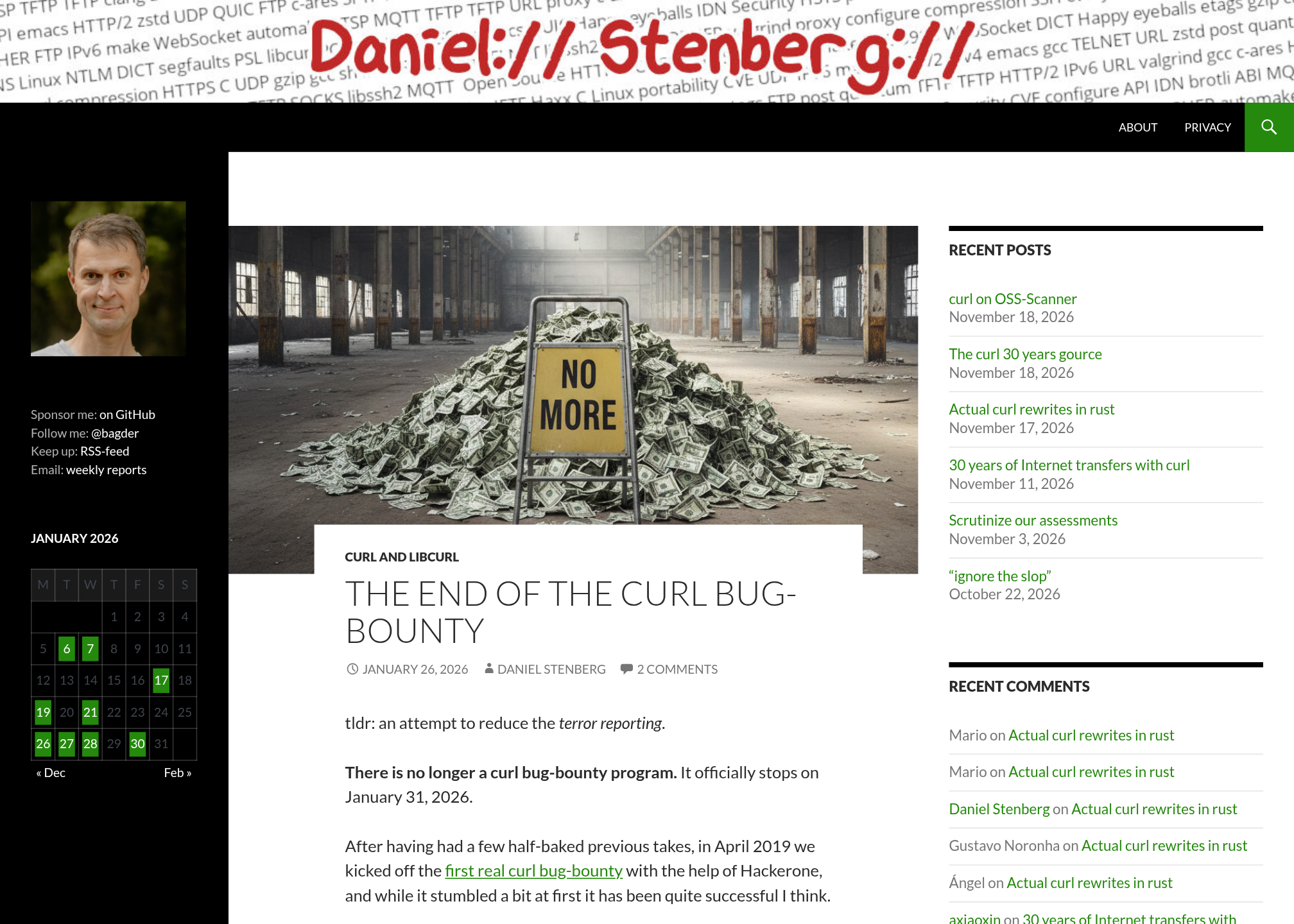
- curl ended its bug bounty. In January 2026, curl maintainer Daniel Stenberg ended the curl bug bounty, which paid rewards for confirmed security flaws. The share of confirmed reports had “plummeted to below 5%,” down from “somewhere north of 15%,” and Stenberg named an “explosion in AI slop reports” as part of the reason.
- Slop became a word of the year. The American Dialect Society voted slop its 2025 Word of the Year in January 2026, defining it as “low-quality, high-quantity content, most typically produced by generative AI.”
Stenberg’s post shows what that cost looks like for a project that runs on billions of devices:
Before either event, swyx, founder of the Latent Space newsletter and podcast, had declared war on slop in his November 2025 talk No More Slop, which the manifesto links as a resource.
Learners Pay the Reading Cost Later
As a learner, you sit on both sides of the imbalance. You produce AI output when you paste a suggestion into your project, and you consume it when you reread that code next week. If you didn’t understand it then, you pay the reading cost later.
The manifesto warns that “AI cannot replace human judgment, it can only amplify our judgment (or lack thereof).” That’s why “Understanding over speed” matters most while you’re learning: you need to build the judgment that AI amplifies. Learn With Mentor AI: Working Through a Coding Exercise shows one way to practice augmented coding, where you use AI heavily and still care about code quality.
The Key Beliefs and Resolutions in Context
The beliefs describe what’s going wrong, and the resolutions describe what signers commit to doing about it. Three of them shape how you work with AI day to day. The next sections look at what each one asks of you in practice and where tools can help.
Own What You Ship
One resolution reads, “We own the intent, taste, and consequences of what we ship, however much AI helps us make it.”
In practice, owning your code means you can explain what it does, why it’s there, and how it behaves. AI-generated code often looks tidy and handles the happy path, so a quick glance can’t tell owned code from slop. The difference shows up at the edges: an empty input, a value of the wrong type, or an error that gets swallowed and turned into a plausible-looking result instead of being raised.
Here’s how owned code compares with code that’s just passed along:
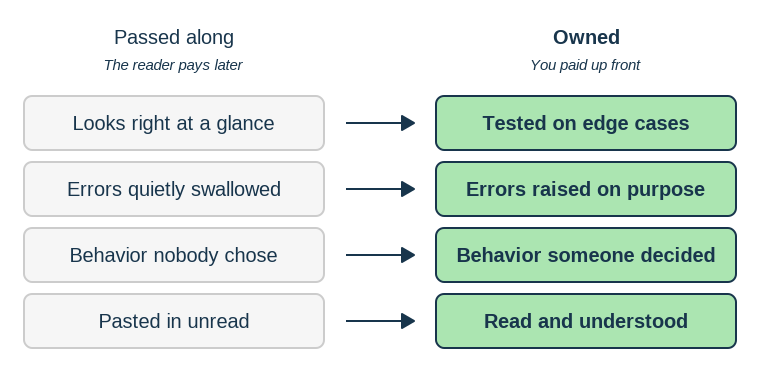
A good habit is to decide how your code should behave before you accept it, and then check that it does. Tests are the most direct way to do that, because they turn your expectations into checks you can rerun after every change, whoever wrote the code.
Fix the System, Not the Output
A later resolution says, “Anything a linter, type checker, or automated check can catch, we let it catch.” A linter like Ruff flags known problem patterns without running your code, such as an exception handler that hides every error. A type checker catches mismatches between what a function expects and what it gets.
Neither tool knows what your code is supposed to do, though. A function that quietly returns the wrong answer can pass every check, so you still need tests that pin down the intended behavior. Together, these checks work in layers, from automated tools that catch common mistakes to your own review at the end:
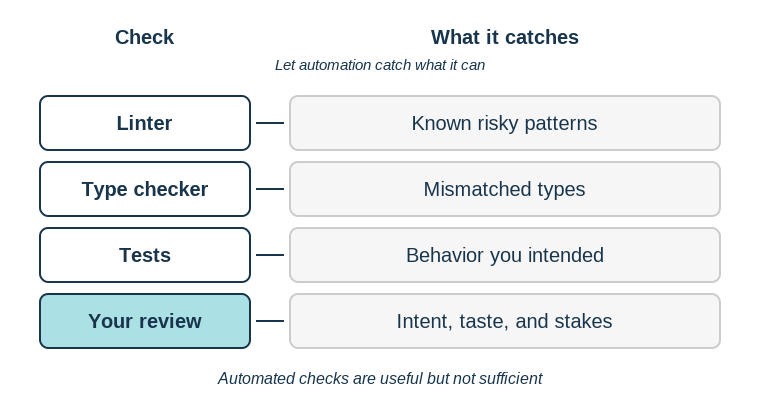
When a mistake “shows up twice,” the resolution asks you to improve the system instead of patching each output. That might mean enabling a lint rule, adding a test for the case that slipped through, or writing the lesson into your agent’s instructions so it stops repeating the mistake. You can set up your Python project for agentic coding or add Claude Code hooks that run Ruff and pytest after every AI edit.
Still, the manifesto calls checks “useful but not sufficient,” and says how much you review yourself “depends on the stakes.” A throwaway notebook cell needs less review than a function that other code calls.
Slop Compounds
The eighth belief explains why slop spreads: “The more slop sits in our knowledge base, in chat, in code, the more of it the next agent reads and copies.” In a codebase, that turns into a loop:
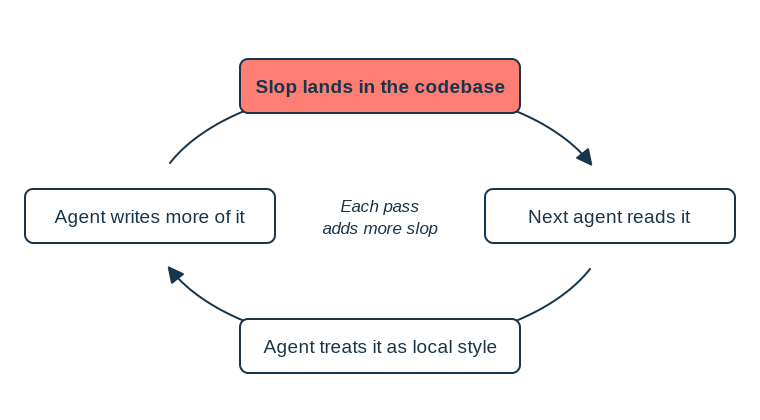
Coding agents copy a project’s conventions, so once a shortcut like a silently swallowed error lands in your codebase, the next agent can repeat it as the local style. That’s how technical debt grows without anyone choosing it. How to Refactor Python Code With an AI Agent shows how to clean it up safely.
Horthy brought data to this point in his talk. He cited SlopCodeBench, a University of Wisconsin-Madison benchmark that measures how code quality erodes as an agent keeps extending its own code. He also warned that some Python habits are getting worse, as newer models write “Python 3 in Python 2 style” and fall back to %s formatting instead of f-strings.
What Critics Dispute
In the Hacker News discussion on November 13, 2026, commenters raised several objections:
- The definition limits what AI is good for. One commenter argued that “if you define slop this way then you put a cap on AI productivity.” A valuable result that takes real effort to understand would count as slop.
- Incentives beat principles. Another commenter noted that Agile won on market advantage, asked whether this approach will “be advantageous in capitalism?” and answered, “I sincerely doubt it.” Companies reward shipping volume, so the cost of review lands on someone else, as it did for curl’s maintainers.
- Human review may be the wrong focus. A third commenter called it “a good thought for pre-agentic era,” expecting workflows where agents review other agents’ code to replace human review.
Horthy’s talk answers that objection. As models improve, he expects people to stop reading most of the code but still review “a plan or a design or a result,” and he calls agent reviewers, linters, and verifiers “very useful, but they are not sufficient.”
The manifesto’s closing line admits that “there’s no single right answer.” Even swyx writes that “one man’s slop is another man’s kino,” using internet slang for excellent work.
Common Pitfalls
A few misreadings of the definition come up often when you’re new to the idea:
- Assuming code you typed yourself can’t be slop. swyx points out that “AI does not have a monopoly on making Slop.” Judge your work by what it costs the next person to understand it, whoever wrote it.
- Pasting unread AI output into a request for help. A long answer you haven’t read makes the helper read what you skipped. Cut it to the lines that show the problem, and say what you expected and tried. That way, the helper can start where you’re stuck.
- Counting output as progress. More lines or features don’t mean your program works, which is the point of “Outcomes over output.” Decide what done means before you prompt, for example with a test, as TDD With AI Agents shows.
When someone sends you slop, the signers resolve to tell them, kindly, and to ask them to review it first.
Conclusion
You learned that the No AI Slop Manifesto calls work slop when it cost less to produce than it costs someone else to understand, and nobody took responsibility for it. It appeared in November 2026 because, in its authors’ view, AI made producing code almost free, while review still runs at human speed. Critics doubt it can beat business incentives, but it still works as a check on your own code.
Ownership is the resolution the others rest on. In practice, that means knowing what your code should do, letting tools like Ruff catch what they can, and writing tests for the behavior that only you can define. Feel free to take the next step with How to Review AI-Generated Python Code Efficiently, which turns these beliefs into a handy review routine.
Frequently Asked Questions
Now that you know what the manifesto says and how it applies to your own AI-assisted code, you can use the questions and answers below to check your understanding and recap what you’ve learned.
These FAQs are related to the most important concepts you’ve covered in this tutorial. Click the Show/Hide toggle beside each question to reveal the answer.
It’s a short statement of values from the speakers and attendees of the AIE Code Summit 2026 in San Francisco. Its signers commit to owning the work they ship with AI.
Slop is work that took less effort to produce than it asks the reader to spend understanding it. Using AI doesn’t automatically make something slop. It becomes slop when someone passes AI output along without taking responsibility for its quality.
No. Vibe coding means accepting AI-generated code without reviewing it, which can be fine for a prototype that only you run. The manifesto even calls it a “high leverage” tool. The same code becomes slop once you pass it on and someone else has to understand or maintain it.
Critics argue that the effort-based definition would label valuable but complex work as slop, and that business incentives reward shipping volume over careful review. Others expect agents reviewing agents to replace most human review. The manifesto itself admits that “there’s no single right answer.”
Stop Falling Behind on AI. Catch Up in Five Minutes.
New models, new prices, new agent tools, all the time. Our AI newsletter gives you the handful of stories you actually need as a developer. Free, from the Real Python team.