When you’re learning Python, the sheer volume of topics to explore can feel overwhelming because there’s so much you could focus on. Should you dive into web frameworks before exploring data science? Is test-driven development something you need right away? And which skills actually matter to employers in the age of AI-assisted software development?
By the end of this tutorial, you’ll have:
- A clear understanding of which Python skills employers consistently look for
- A personalized Python developer roadmap showing where you are and where you need to go
- A weekly practice plan that makes consistent progress feel achievable
Python itself is relatively beginner-friendly, but its versatility makes it easy to wander without direction. Without a clear plan, you can spend months studying topics that won’t help you land your first developer job.
This guide will show you how to build a focused learning strategy that aligns with real job market demands. You’ll learn how to research what employers value, assess your current strengths and gaps, and structure a practice routine that turns scattered study sessions into steady progress.
Instead of guessing what to learn next, you’ll have a concrete document that shows you exactly where to focus:
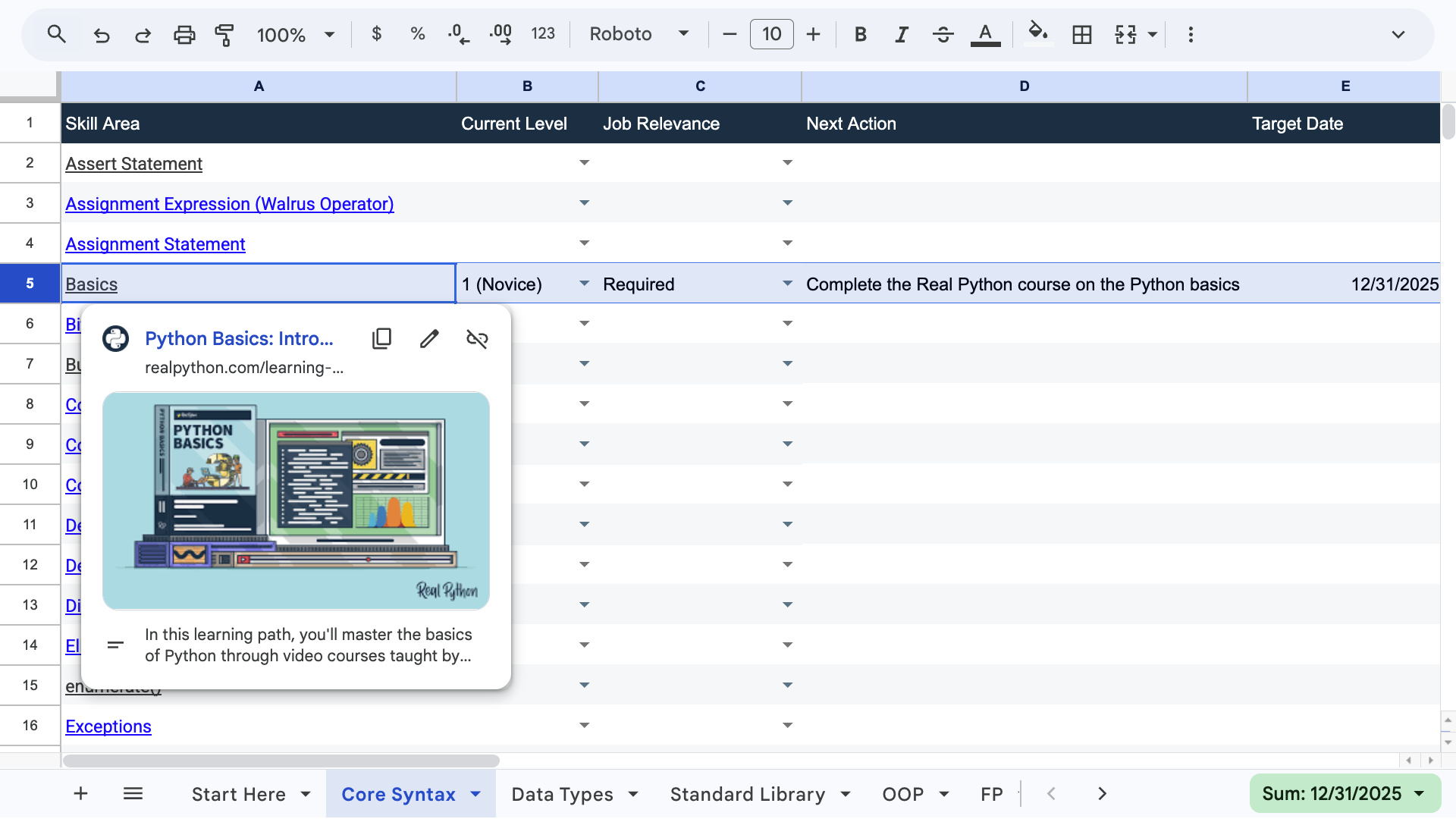
Work through this tutorial to identify the skills you need and set yourself up for success.
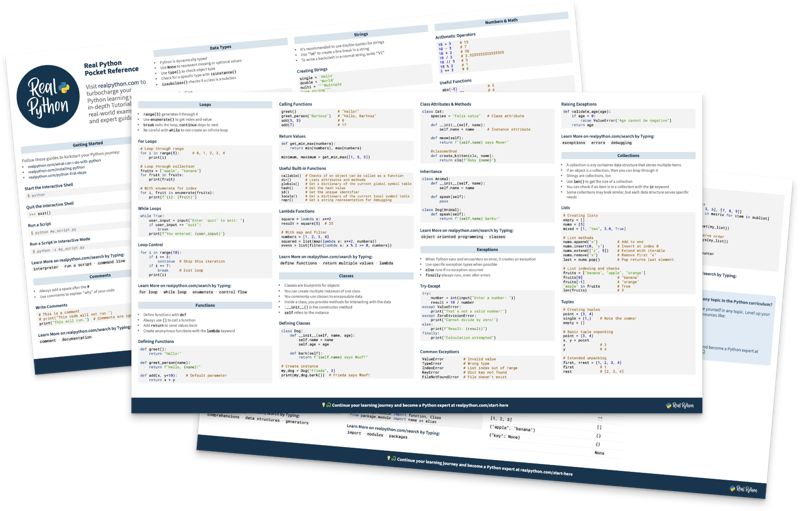
Get Your Downloads: Click here to download the free materials that will help you build the Python skills that get you hired.
Step 1: Identify the Python Skills Employers Value Most
Before you dive into another tutorial or framework, you need to understand what the job market actually rewards. Most Python learners make the mistake of studying everything that sounds interesting. You’ll make faster progress by focusing on the skills that appear in job posting after job posting.
Research Real Job Requirements
Start by opening five to ten current job listings for Python-related positions. Look for titles like Python Developer, Backend Engineer, Data Analyst, or Machine Learning Engineer on sites like Indeed, Stack Overflow Jobs, and LinkedIn. As you read through these postings, highlight the technical requirements that appear repeatedly. You’ll quickly start to notice patterns.
To illustrate, consider a few examples of different roles involving Python:
- Web development roles often emphasize frameworks like Flask, Django, and, more recently, FastAPI, along with database knowledge and REST API design. Employers often seek full-stack engineers who feel comfortable working on the backend as well as frontend, including JavaScript, HTML, and CSS.
- Data science positions highlight libraries like NumPy, pandas, Polars, and Matplotlib, plus an understanding of statistical concepts.
- Machine learning jobs typically add PyTorch or TensorFlow to the mix.
- Test automation roles likely require familiarity with frameworks such as Selenium, Playwright, or Scrapy.
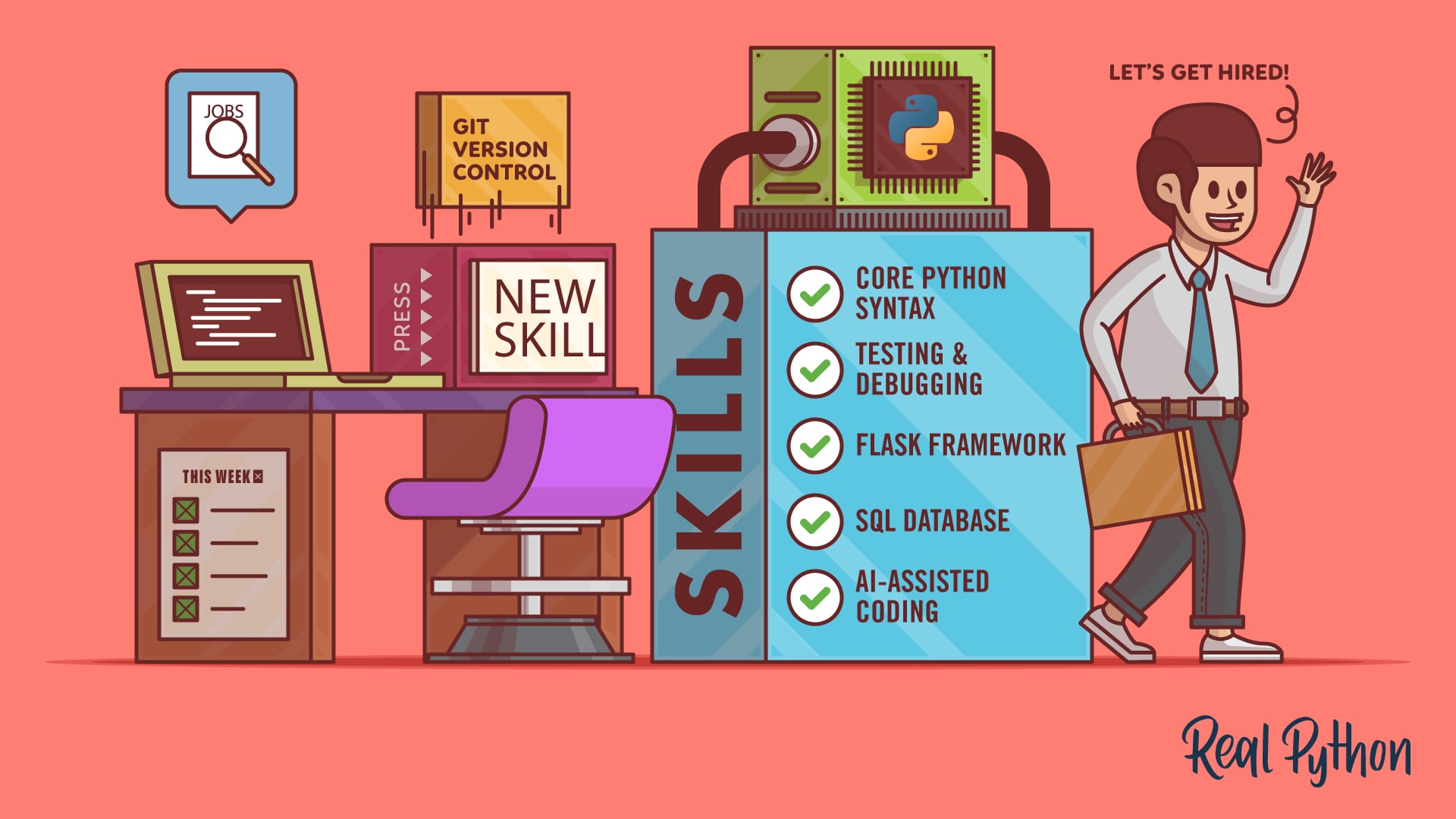
Despite these differences, nearly every job posting shares a common core. Employers want developers who understand Python fundamentals deeply. They should also be able to use version control with Git, write unit tests for their code, and debug problems systematically. Familiarity with DevOps practices and cloud platforms is often a plus. These professional practices matter as much as knowing any specific framework.
Increasingly, job postings also expect familiarity with AI coding tools like GitHub Copilot, Gemini CLI, Cursor, or Claude Code. Employers want developers who can use these tools productively while maintaining the judgment to review and validate AI-generated code.
Note: With AI tools handling more routine coding tasks, employers increasingly value developers who can think at the system level.
Understanding how components fit together, how to design scalable architectures, and how to make sound trade-offs between approaches matters more than ever. These system design skills are harder to outsource to AI because they require judgment about business requirements, user needs, and long-term maintainability.
Your informal survey will reflect what large-scale research confirms. The Stack Overflow Developer Survey ranks Python as one of the most widely used programming languages across all professional roles. The survey also reveals that Python appears in diverse fields, including finance, healthcare, education, and scientific research.
This trend is echoed by the TIOBE Index, a monthly ranking of programming language popularity, where Python consistently appears at or near the top:
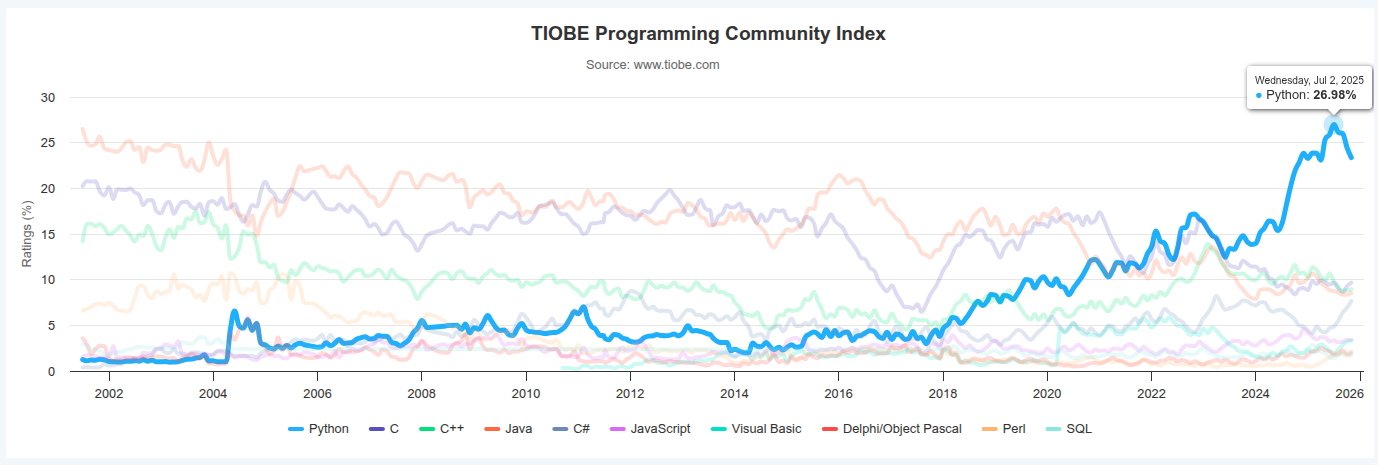
Similarly, LinkedIn’s Workplace Learning Report 2023 named Python as one of the most in-demand technical skills globally. Python’s versatility means that mastering its fundamentals opens doors across multiple career paths.
Understand Different Developer Paths
Python is a phenomenally versatile language. On the one hand, school teachers choose it to help their pupils learn how to program, often starting with fun, visual tools like the built-in turtle graphics module. At the same time, Python runs major platforms like Instagram, plays a role in powering large services such as YouTube, and supports the development of generative AI models. It even once helped control the helicopter flying on Mars!
Note: Check out What Can I Do With Python? to discover how Python helps build software, power AI, automate tasks, drive robotics, and more.
Python’s breadth can work in your favor once you understand how different roles emphasize different skill combinations. A web developer needs strong knowledge of HTTP, databases, and web frameworks. A data scientist relies on libraries for numerical computing and visualization, plus the ability to communicate insights from data. An automation engineer might spend more time with Python’s standard library and system administration tools.
However, you certainly don’t need to master every domain before applying for jobs. You just need to become proficient with the Python basics, and then choose one focus area that matches your interests and background. Finally, develop depth in this area while maintaining strong fundamentals that transfer across domains.
This strategic approach, consisting of broad foundations with targeted specialization—often referred to as T-shaped skills—is what separates developers who land jobs quickly from those who spend years learning everything.
Reflect on Your Findings
After reviewing several job postings, take a few minutes to capture your observations. Open a text file or notebook and answer these questions:
- Which skills or libraries appear in at least three of the postings you reviewed?
- Which career path—web development, data science, or another area—aligns best with your interests?
- Which skills feel within reach, and which seem unfamiliar?
- What kind of project could demonstrate those abilities to a potential employer?
These notes will guide your planning in the next step. By grounding your learning plan in real market data rather than opinions or trends, you’ll invest your time more wisely.
Step 2: Assess Your Current Skills and Map Your Path
Now that you know what employers want, you need to compare those requirements with your current abilities. The goal isn’t to judge yourself harshly or feel discouraged by gaps. Instead, think of it as an opportunity to create an honest inventory that shows you where to focus next.
It’s like building a map. You can’t plot a route to your destination without knowing your starting point. The clearer you are about where you stand today, the more focused your learning can be.
Create Your Skill Roadmap
Download the Python Developer Skill Roadmap Worksheet from the supporting materials. If you prefer to work in plain text, then you can recreate the table structure in a Markdown file or spreadsheet. Alternatively, you can simply sketch the layout with pen and paper.
The worksheet you’ll use is designed around the SMART criteria, a proven goal-setting framework that helps you create objectives that are Specific, Measurable, Achievable, Relevant, and Time-bound. By structuring your skill development using these principles, you’ll avoid vague intentions and instead create actionable steps that lead to measurable progress.
The worksheet includes five columns:
- Skill: The specific skill area you’re evaluating
- Current Level: Your self-assessment on a scale from 1 to 5
- Job Relevance: Whether this skill is essential for your target role
- Next Action: A concrete, small step you can take to improve
- Target Date: A realistic completion date for that action
Here’s what a few filled rows might look like:
| Skill | Level | Relevance | Next Action | Deadline |
|---|---|---|---|---|
| Core Python syntax | 4 | Required | Review dictionary comprehensions | Feb 15 |
| Git version control | 2 | Required | Learn branching workflow | Feb 20 |
| AI-assisted coding | 2 | Required | Complete Gemini CLI tutorial | Feb 22 |
| Testing & debugging | 2 | Required | Complete pytest tutorial | Feb 28 |
| Reviewing AI code | 1 | Required | Critique three AI-generated functions | Mar 1 |
| SQL databases | 3 | Required (web) | Practice JOIN queries | Mar 5 |
| System design | 2 | Required | Study API architecture patterns | Mar 10 |
| Flask framework | 1 | Required (web) | Build a simple API endpoint | Mar 12 |
| JavaScript basics | 1 | Nice to have | Complete a one-hour intro JS tutorial | Mar 15 |
Fill out one row for each skill you identified in Step 1. Be honest about your current level. A rating of 1 means you’re just starting to learn the concept. A 3 means you can use it in simple projects but still need to look up details frequently. A 5 means you could teach it to someone else.
The Next Action column is where the SMART criteria become especially important. Instead of writing vague goals like Get better at testing, specify a concrete step, such as Complete the Real Python pytest tutorial or Write unit tests for my calculator project.
Notice how these actions are:
- Specific: You know exactly what to do.
- Measurable: You’ll know when you’re done.
- Achievable: They’re small enough to complete.
- Relevant: They improve job-critical skills.
- Time-bound: They’re paired with your target date.
Small, specific actions structured this way are easier to start and more likely to get done.
Use a Skill Development Model
When you rate yourself, it helps to use a consistent framework. For example, the Dreyfus model of skill acquisition describes how learners progress through five stages:
- Novice
- Advanced beginner
- Competent
- Proficient
- Expert
A novice follows rules mechanically without understanding why they work. An advanced beginner can handle basic tasks but struggles with exceptions. A competent practitioner can troubleshoot problems and adapt solutions to new contexts. Proficient developers work intuitively and recognize patterns quickly. Experts operate on a level where solutions appear obvious after years of experience.
You don’t need to reach “expert” in every skill before you’re job-ready. For most entry-level positions, reaching competent in your target domain and proficient in Python fundamentals will qualify you for interviews.
This framework also reveals something important about learning strategy: focused work that specifically strengthens your weakest links. Instead of spending more time on topics you already understand, your personal roadmap should direct most of your energy toward skills rated 1 or 2 that are marked as Required.
Prioritize Based on Impact
Once your roadmap is complete, you’ll likely have more items than you can tackle at once. You need a way to prioritize. Drawing inspiration from Eisenhower’s quadrant, try dividing your desired skills into four categories based on impact and urgency:
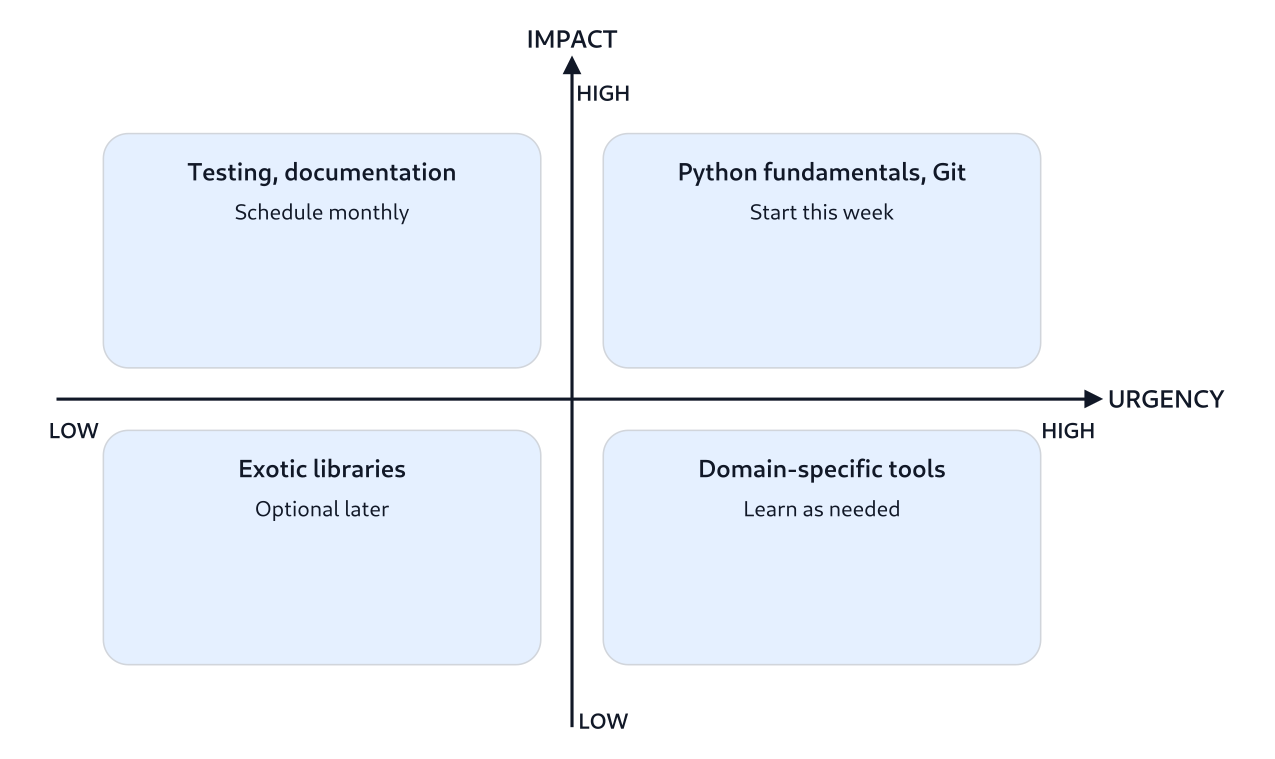
High-impact, high-urgency skills, such as solid Python syntax, control flow, data structures, and basic Git commands, deserve your immediate attention. These skills transfer across all domains and signal professionalism to employers. High-impact but lower-urgency skills, like test-driven development and clear documentation, should get regular but less intense focus.
Lower-impact items can wait. You don’t need to master every Python library or tool before you’re employable. You need depth in a focused area plus breadth in fundamentals.
Reflect on Your Roadmap
Before moving to the next step, spend a few minutes thinking about what your completed roadmap reveals. Answer these questions:
- Which one or two skills would most improve your job prospects right now?
- What specific actions can you complete this month to strengthen them?
- Are you spreading your focus too thin, or are you concentrating on high-impact areas?
These reflections will help you move from awareness to action. Instead of learning randomly, you’ll develop the strategic thinking that separates professional developers from perpetual students.
Step 3: Build a Sustainable Practice Routine
You now have a clear roadmap showing what to learn and why it matters. The final challenge is consistency. Progress in programming doesn’t come from intense bursts of motivation but from regular, focused practice over weeks and months.
A common trap for beginners is getting stuck in passive learning, endlessly watching video tutorials instead of actually building software, making mistakes, and learning along the way. Your goal in this step is to design a realistic study routine that turns your roadmap into steady progress.
Design Your Weekly Practice Schedule
Start by blocking specific time slots in your calendar for Python practice. You’ll learn more from three one-hour sessions spread throughout the week than from a single marathon weekend session. Distributed practice gives your brain time to consolidate concepts between sessions.
Below is an example of a weekly practice calendar structure. It includes columns for the day, focus area, specific task, and time commitment:
| Day | Focus Area | Task | Time |
|---|---|---|---|
| Mon | Core Python | Review list comprehensions | 1h |
| Tue | AI-assisted coding | Build feature using AI | 45m |
| Wed | Testing | Write tests for calculator app | 1h |
| Thu | Web development | Build Flask endpoint | 1.5h |
| Fri | Code review | Evaluate AI-generated code for bugs | 1h |
| Sat | Project review | Debug issues, update roadmap | 1h |
Notice that the schedule includes variety. You’re not grinding on the same topic every day. Different types of practice, such as reviewing fundamentals, building projects, writing tests, collaborating with AI, and debugging, work together to build comprehensive skills.
You can try a behavioral hack, such as habit stacking, to help you overcome dips in motivation. By attaching new behaviors to existing routines, you can anchor your Python practice to something you already do consistently. For example, saying “After I finish dinner, I’ll study Python for forty-five minutes” is going to be far more sustainable than “I’ll study when I feel motivated.”
Consider adding Real Python Office Hours to your weekly schedule as well. These live sessions happen every week and provide a consistent opportunity to ask questions, get unstuck on problems, and learn from other developers’ challenges. Attending regularly creates both structure and community, two powerful forces for maintaining momentum in your learning journey.
Build Projects That Demonstrate Skill
Employers care more about what you can build than about what courses you’ve completed. Each project you finish serves as evidence that you can take a problem from concept to working solution. Choose projects that align with your target Python career path.
For example, if you’re pursuing web development, build a simple CRUD application or REST API. If data science interests you, then analyze a public dataset and create visualizations. Aspiring machine learning engineers might implement a basic classifier using scikit-learn before diving into neural networks. Those interested in automation could write scripts that solve real problems in their daily workflow.
Start small. Your first project doesn’t need to be impressive—it needs to be complete. A tiny command-line tool that does one thing well teaches you more than an abandoned ambitious project. Each finished project also gives you something concrete to discuss in interviews.
As you build, practice professional habits. Use Git to track your changes. Add type hints for static type checking and write docstrings that explain what your functions do. Include tests that verify your code works as expected. These practices matter as much as the code itself because they show you can work the way professional teams work.
Also, consider documenting your AI-assisted workflow as part of the project if you built the project with AI assistance. A README that explains how you used tools like GitHub Copilot or Claude Code to accelerate development, and where you had to correct or improve on their suggestions, demonstrates exactly the kind of judgment that employers value. It shows that you can leverage AI productively while remaining in control of the codebase.
Prepare for Technical Interviews
Building real projects demonstrates practical skill, but many companies also use coding challenges to assess candidates. You’ll want to dedicate some practice time to the kinds of problems that appear in technical interviews.
Platforms like LeetCode, HackerRank, and Codewars offer thousands of algorithm and data structure problems. These challenges test your ability to think through problems methodically, choose appropriate Python collections and data structures, and write efficient solutions under time pressure. While they don’t always reflect the work you’ll do on the job, they’re still common enough in hiring processes that you can’t ignore them.
That said, the interview landscape is evolving. Some companies have shifted toward AI-enabled assessments or take-home projects that better reflect real-world development. Others still rely heavily on traditional algorithm challenges.
Since practices vary widely across employers, it’s worth researching the interview format at the companies that you’re targeting. A balanced approach of building projects, practicing algorithms, and developing AI fluency prepares you for the widest range of possibilities.
As is often the case, the key to preparation is balance. Spending all your time grinding LeetCode problems won’t teach you how to build complete applications or work with real codebases. But spending no time on algorithm practice at all can leave you unprepared when an interviewer asks you to reverse a linked list, implement a sorting algorithm, perform a binary search, or explain how a hash table works.
A reasonable approach is to allocate about twenty to thirty percent of your weekly practice time to coding challenges once you’re comfortable with Python fundamentals. Start with easy problems to build confidence, then gradually work up to medium difficulty. Focus on understanding the patterns behind solutions, such as when to use a mapping over a sequence or when recursion makes sense, rather than memorizing specific answers.
Note: If you enjoy puzzle-style programming challenges, then you might like Advent of Code, which is an annual event with a Christmas theme.
You can also practice explaining your thought process out loud as you solve problems. Many technical interviews ask you to talk through your reasoning as you code. This skill feels awkward at first, but it becomes natural with practice. Consider doing mock interviews with a study partner or using tools like ChatGPT and Code Mentor for practice sessions.
Note: To see examples of developers talking through their reasoning while coding, check out Real Python’s Code Conversations. These lessons demonstrate how to articulate your thought process, explain design decisions, and communicate technical concepts clearly, which are all essential skills for technical interviews.
Remember that coding challenges are one part of the interview process, not the entire process. Interviewers also evaluate your problem-solving approach, your ability to ask clarifying questions, how you handle feedback, and whether you can communicate technical concepts clearly. The projects you build and the professional habits you develop matter just as much as your algorithm skills.
Adapt to AI-Enabled Hiring Practices
The way companies hire developers is changing rapidly. Major employers like Meta have moved to AI-enabled coding interviews in which candidates have access to an AI assistant during the technical assessment. This format is spreading across the industry because it reflects how developers actually work today—and it makes old-fashioned cheating via AI less effective.
What does this mean for your preparation? The skills being tested have shifted. Many companies care less about whether you’ve memorized APIs or can write a binary search from scratch without help.
Instead, they care more about your judgment. Can you use AI tools effectively? Can you spot when AI-generated code is wrong, insecure, or inefficient? Can you guide the AI toward a working solution while demonstrating that you understand what’s happening?
A guaranteed way to fail an AI-enabled interview is to prompt your way to a solution without ever writing code yourself or reviewing what the AI produces. Interviewers want to see that you’re in charge. You should use AI as an accelerator, not a crutch.
To prepare for this reality, practice these skills deliberately:
- Work with AI coding tools regularly: Use GitHub Copilot, Gemini CLI, Claude Code, or Cursor during your practice sessions. Get comfortable with the rhythm of prompting, reviewing, and refining.
- Practice reviewing AI-generated code: Ask an AI assistant to solve a problem, then critically evaluate its output. Look for bugs, edge cases, security issues, and unnecessary complexity. Interviewers now test this skill directly by showing candidates flawed AI-generated snippets.
- Explain your reasoning out loud: AI-enabled interviews still evaluate your thought process. Practice narrating why you’re accepting, modifying, or rejecting AI suggestions. What trade-offs are you considering? What would you do differently?
- Maintain your fundamentals: AI tools are most powerful in the hands of developers who understand what good code looks like. If you rely on AI for everything while you’re learning, you won’t build the judgment needed to evaluate its output. Write code yourself when practicing new concepts, and use AI to accelerate tasks you already understand.
The developers who thrive in this new landscape are those who combine AI fluency with strong fundamentals and clear technical communication.
Stay Accountable and Track Progress
Motivation fades, but accountability and visible progress sustain you. Share your roadmap with a study partner or post your goals in the Real Python Community. Knowing that someone else will ask about your progress makes it easier to show up on difficult days.
At the end of each month, revisit your roadmap worksheet. Update your skill ratings. Mark completed actions. Add new next steps based on what you’ve learned. This monthly review serves two purposes:
- It shows you how far you’ve come.
- It keeps your plan aligned with your evolving goals.
Observing progress in meaningful work is one of the strongest motivators for sustained creative effort. Even small wins like finishing a tutorial, fixing a bug, or understanding a concept that confused you last week can build momentum. By making your progress visible, you create a positive feedback loop that carries you through plateaus.
Adapt Your Routine as You Grow
Your practice routine isn’t set in stone. As you complete skills from your roadmap, you’ll add new ones. As you discover what works for your schedule and learning style, you’ll adjust your approach. The goal isn’t to follow a rigid plan forever but to develop the habit of continuous, deliberate learning.
Reflect on your practice routine regularly, asking yourself these questions:
- Which study sessions feel most productive?
- What distractions or obstacles keep interrupting your practice?
- How can you make it easier to start your next session?
These questions help you refine your system over time. Small adjustments, such as studying at a different time of day, using a different project structure, or finding a better learning resource, compound into significant improvements over months.
Conclusion
You started this guide with a common question:
Which Python skills should you focus on to get hired?
You now have a framework for answering that question yourself, based on your goals and the real demands of the job market.
By researching what employers value, mapping your current skills against those requirements, and building a consistent practice routine, you’ve created something more valuable than a list of topics to study. You’ve developed a system for strategic learning. It’s a skill that will serve you throughout your career as technologies change and new challenges emerge.
Your completed Python Developer Skill Roadmap shows you exactly where to focus next. Your weekly practice calendar turns that knowledge into action. Together, these tools transform the overwhelming breadth of Python into a clear, manageable path forward.
The developers who land jobs most quickly aren’t always the most talented or the hardest working. They’re the ones who learn with intention, focus on high-impact skills, and practice consistently. You’re now equipped to do the same!
When you sit down to code tomorrow, you won’t wonder what to study. You’ll know exactly what skill you’re developing and why it matters. That clarity is the foundation of professional growth.
Get Your Downloads: Click here to download the free materials that will help you build the Python skills that get you hired.
Frequently Asked Questions
Now that you have some experience with building the Python skills that get you hired, you can use the questions and answers below to check your understanding and recap what you’ve learned.
These FAQs are related to the most important concepts you’ve covered in this tutorial. Click the Show/Hide toggle beside each question to reveal the answer.
Strong Python fundamentals, Git, unit testing, and systematic debugging show up across most roles. Experience with a domain stack, such as web frameworks, data tools, or automation, can further boost your fit.
Build broad fundamentals, then choose one focus area that matches your interests and background. Grow T-shaped skills by going deep in that area while maintaining strong core Python skills.
List each skill, rate your current level, mark its relevance to your target role, define a concrete next action, and set a target date. Keep your actions small and specific so progress stays realistic.
Ship real projects to prove practical ability, and spend about 20 to 30 percent of your study time on interview-style problems. Focus on understanding patterns rather than memorizing solutions.
Use AI to accelerate tasks you already understand, not as a replacement for learning fundamentals. When practicing new concepts, write code yourself first. Use tools like GitHub Copilot or Claude Code to check your work, explore alternatives, or get unstuck. This builds the judgment you need to evaluate AI output effectively.
Practice using AI tools during coding exercises so the workflow feels natural. Focus on reviewing and critiquing AI-generated code for bugs, security issues, and edge cases. Explain your reasoning out loud as you accept, modify, or reject suggestions. Interviewers want to see that you can guide AI productively while staying in control.
Schedule short, regular sessions that mix fundamentals, projects, testing, and review. Track your progress monthly, adjust based on what works, and use accountability to maintain momentum.