named tuple
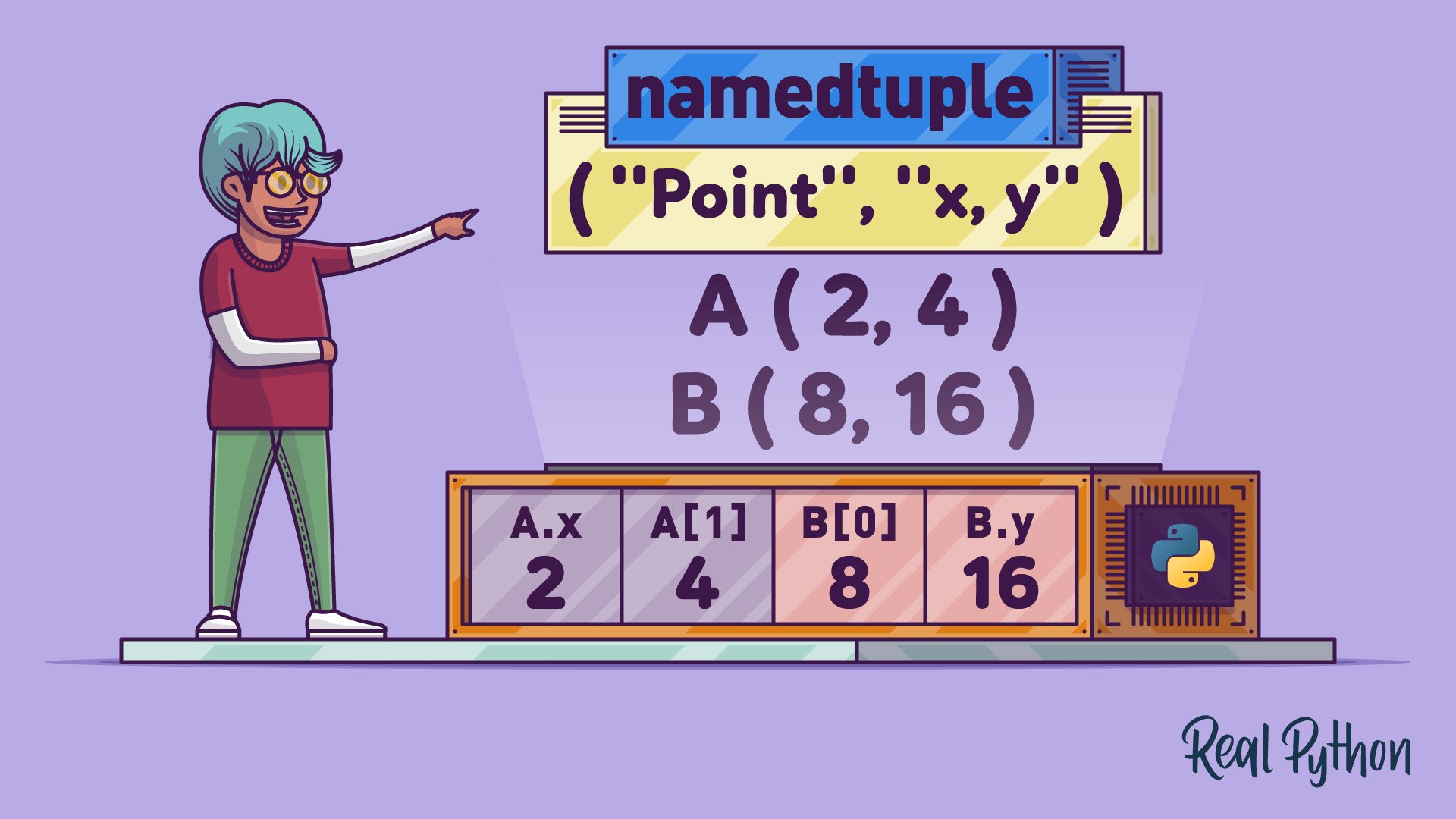
In Python, a named tuple is a variation of the built-in tuple data type that allows you to create tuple-like objects with items that have descriptive names. You can access each item by its name using dot notation.
Named tuples are available through the collections module (namedtuple) and the typing module (NamedTuple). The typing.NamedTuple class-based syntax is the modern alternative, offering inline type annotations and the ability to add methods and docstrings.
Named tuples are immutable, just like regular tuples, which means that once you create a named tuple, you can’t change its values.
Example
Here’s a quick example of how to use named tuples in Python:
>>> from collections import namedtuple
>>> Point = namedtuple("Point", ["x", "y"])
>>> point = Point(11, 22)
>>> point.x
11
>>> point.y
22
In this example, Point is a named tuple with two fields, .x and .y. You can create an instance of Point by providing values for these fields. Then, you can access those items using dot notation, which makes the code more readable.
Using the modern typing.NamedTuple syntax:
>>> from typing import NamedTuple

>>> class Point(NamedTuple):
...     x: float
...     y: float
...

>>> point = Point(11, 22)
>>> point.x
11
Related Resources
Tutorial
Write Pythonic and Clean Code With namedtuple
Discover how Python's namedtuple lets you create simple, readable data structures with named fields you can access using dot notation.
For additional information on related topics, take a look at the following resources:
- Python's collections: A Buffet of Specialized Data Types (Tutorial)
- Lists vs Tuples in Python (Tutorial)
- Python's tuple Data Type: A Deep Dive With Examples (Tutorial)
- Writing Clean, Pythonic Code With namedtuple (Course)
- Write Pythonic and Clean Code With namedtuple (Quiz)
- Python's collections: A Buffet of Specialized Data Types (Quiz)
- Lists and Tuples in Python (Course)
- Lists vs Tuples in Python (Quiz)
- Exploring Python's tuple Data Type With Examples (Course)
- Python's tuple Data Type: A Deep Dive With Examples (Quiz)
Have a question about this? Mentor AI can show you examples, compare related terms, and point you to tutorials.
Ask Mentor AI

