binascii
The Python binascii module provides low-level C functions for converting between raw binary data and several ASCII-encoded binary representations. It is typically used internally by higher-level modules like base64 rather than called directly by application code.
Here is a quick example using the most common pair of functions:
>>> import binascii
>>> binascii.hexlify(b"\xb9\x01\xef")
b"b901ef"
>>> binascii.unhexlify(b"b901ef")
b"\xb9\x01\xef"
Each byte is represented as two hexadecimal digits, and unhexlify() reverses the conversion exactly.
Key Features
- Converts binary data to hexadecimal strings and back with
hexlify()andunhexlify() - Encodes and decodes base64 data with
b2a_base64()anda2b_base64() - Encodes and decodes quoted-printable (MIME) data with
b2a_qp()anda2b_qp() - Encodes and decodes UU-encoded data with
b2a_uu()anda2b_uu() - Computes CRC-32 checksums compatible with ZIP files via
crc32() - Implements all conversion functions in C for performance
- Raises
binascii.Errorfor invalid input andbinascii.Incompletefor partial data
Frequently Used Functions
| Object | Type | Description |
|---|---|---|
binascii.hexlify() |
Function | Converts bytes to their hex representation (alias: b2a_hex()) |
binascii.unhexlify() |
Function | Converts a hex string back to bytes (alias: a2b_hex()) |
binascii.b2a_base64() |
Function | Encodes bytes as a base64 ASCII line |
binascii.a2b_base64() |
Function | Decodes a base64 string back to bytes |
binascii.b2a_qp() |
Function | Encodes binary data as a quoted-printable string |
binascii.a2b_qp() |
Function | Decodes a quoted-printable string back to bytes |
binascii.b2a_uu() |
Function | Encodes binary data as a UU-encoded ASCII line |
binascii.a2b_uu() |
Function | Decodes a UU-encoded line back to bytes |
binascii.crc32() |
Function | Computes an unsigned 32-bit CRC checksum |
binascii.Error |
Exception | Signals a conversion error for malformed input |
binascii.Incomplete |
Exception | Signals incomplete input data rather than malformed input |
Examples
Using hexlify() with an optional separator to format output:
>>> binascii.hexlify(b"\xb9\x01\xef", "-")
b"b9-01-ef"
>>> binascii.hexlify(b"\xb9\x01\xef", b"_", 2)
b"b9_01ef"
Encoding and decoding base64:
>>> binascii.b2a_base64(b"hello world")
b"aGVsbG8gd29ybGQ=\n"
>>> binascii.a2b_base64(b"aGVsbG8gd29ybGQ=\n")
b"hello world"
Computing a CRC-32 checksum incrementally:
>>> crc = binascii.crc32(b"hello")
>>> crc = binascii.crc32(b" world", crc)
>>> format(crc, "#010x")
"0x0d4a1185"
Common Use Cases
The most common tasks for binascii include:
- Displaying raw bytes as readable hex strings for debugging or logging
- Validating or computing checksums for file transfers and data integrity checks
- Encoding binary data as base64 for transmission over text-based protocols
- Supporting legacy formats such as UU-encoding and quoted-printable MIME data
- Serving as the low-level backend for higher-level encoding modules
Real-World Example
The following example computes a CRC-32 checksum for a file in chunks, which is memory-efficient for large files:
file_checksum.py
import binascii

def file_crc32(path, chunk_size=65536):
    crc = 0
    with open(path, "rb") as f:
        for chunk in iter(lambda: f.read(chunk_size), b""):
            crc = binascii.crc32(chunk, crc)
    return format(crc, "#010x")

print(file_crc32("document.pdf"))
Each call to crc32() passes the previous result as the starting value, allowing the checksum to be built up incrementally without loading the entire file into memory.
Related Resources
Tutorial
Bytes Objects: Handling Binary Data in Python
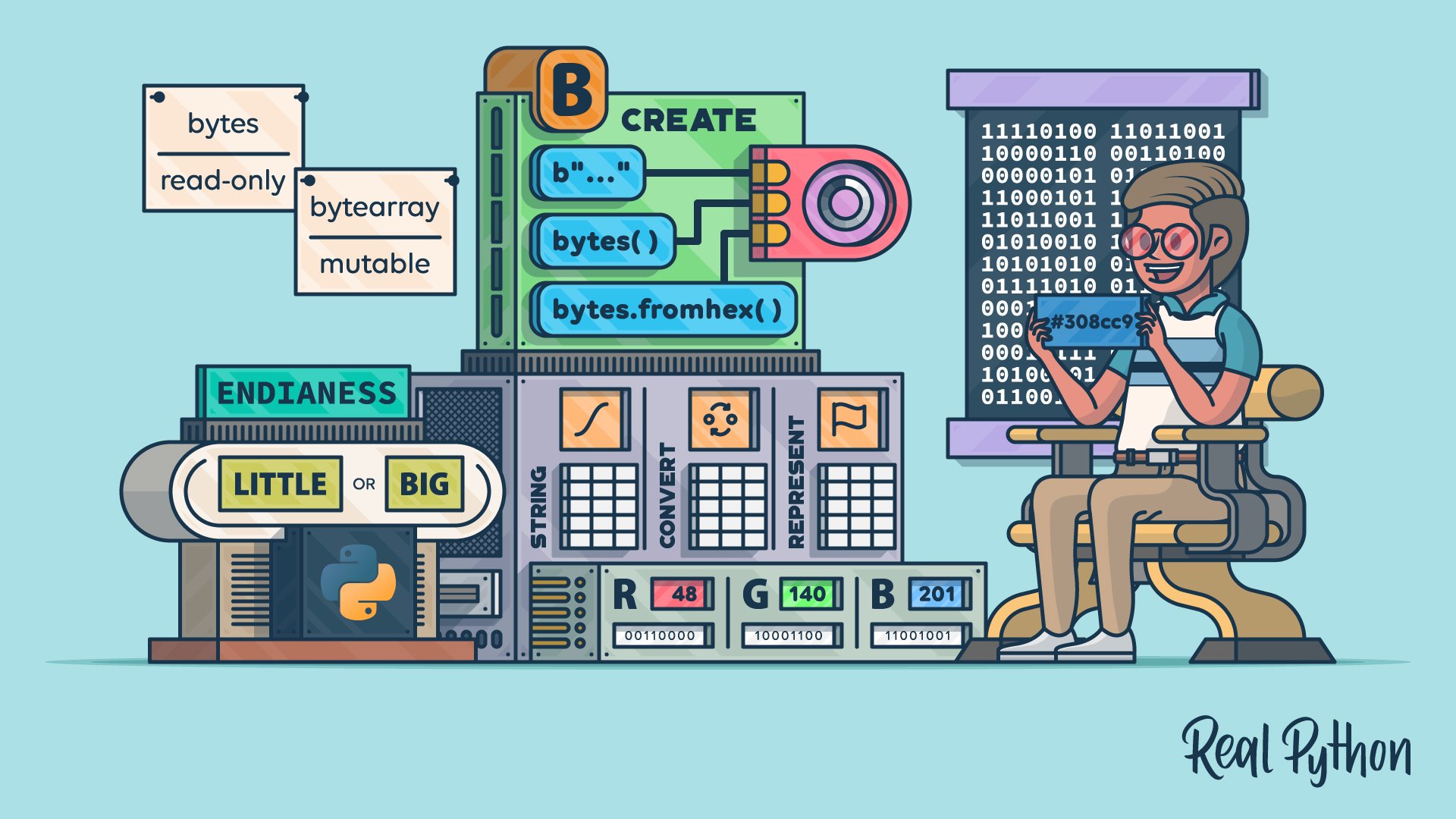
In this tutorial, you'll learn about Python's bytes objects, which help you process low-level binary data. You'll explore how to create and manipulate byte sequences in Python and how to convert between bytes and strings. Additionally, you'll practice this knowledge by coding a few fun examples.
For additional information on related topics, take a look at the following resources:
- How to Convert Bytes to Strings in Python (Tutorial)
- Python's Bytearray: A Mutable Sequence of Bytes (Tutorial)
- Python Bytes (Quiz)
- How to Convert Bytes to Strings in Python (Quiz)
- Python's Bytearray (Quiz)
By Leodanis Pozo Ramos • Updated March 2, 2026